
Unbiased headlines. Facts, not spin.
Unbiased Headlines is an independently owned news organization. We bring you the facts, not opinions, written fresh from 110+ named sources. Sources linked so you can verify it yourself.
 economy
Major Story (8/10)
Event date: October 15, 2026 ·
Treasury Proposes Rule Extending Outbound Investment Limits to Hypersonics, Supercomputing, Biotech and AI
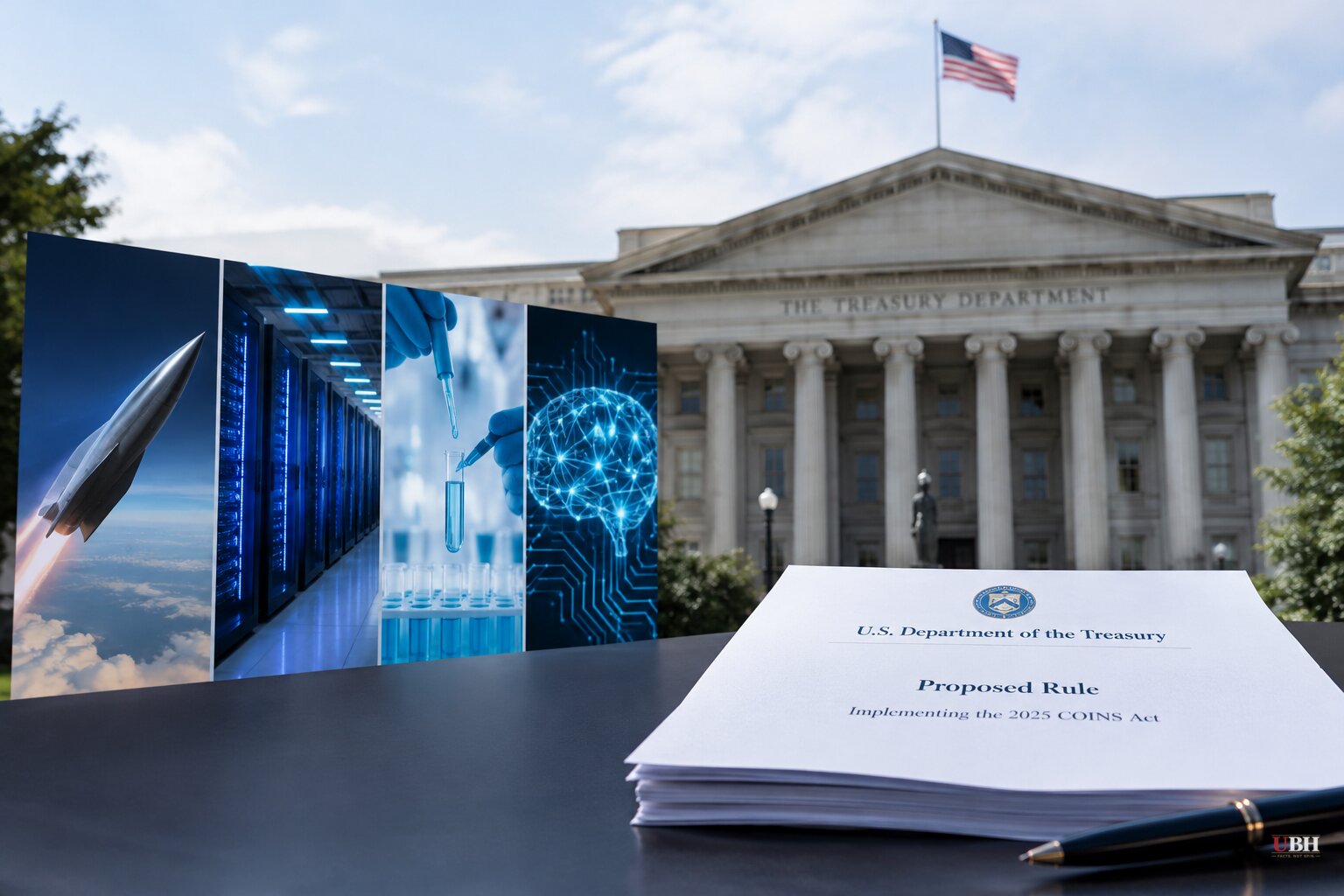
The U.S. Treasury Department proposed a rule today, Oct. 22, that would broaden restrictions on American investment in sensitive technologies abroad. The proposal implements the Comprehensive Outbound Investment National Security Act, known as the COINS Act, which was signed into law on Dec. 18, 2025.
It adds hypersonic systems, supercomputing and biotechnology to the program's existing focus areas. Treasury also uses the term "superintelligence," or SI, for the AI category, borrowing the administration's preferred label.
What the proposed rule covers
The law extends the program beyond China. Cuba, Iran, North Korea and Russia are now named as targets.
The proposal would apply only to investments above $50,000. It would exclude many financial investments, including stock purchases.
Treasury will take public comment before issuing a final rule. No date for that final rule has been announced.
The Russia piece lands awkwardly. WDIV noted that it comes days after President Donald Trump waived sanctions on Russia following a diesel deal with Vladimir Putin. Treasury has not publicly tied the two.
The program it builds on
The Outbound Investment Security Program, or OISP, traces to Executive Order 14105, signed by then-President Joe Biden on Aug. 9, 2023. Treasury's final rule took effect on Jan. 2, 2025.
It covers semiconductors and microelectronics, quantum technologies and AI. Some deals are banned outright. Others are legal but must be reported to Treasury.
When the rule was finalized, Paul Rosen, then assistant secretary for investment security, said U.S. investments "including the intangible benefits like managerial assistance and access to investment and talent networks" must not help countries of concern build military, intelligence and cyber capabilities. The penalty ceiling at that point was $368,136 or twice the transaction value, whichever is higher.
The first enforcement case
The proposal arrives two weeks after Treasury announced the program's first civil penalty. On Oct. 7, it disclosed a $200,000 fine against Amidi, LLC, the parent of California-based startup accelerator Plug and Play Tech Center. Treasury imposed the penalty in July.
Treasury said a Chinese investment fund controlled by Amidi put $92,478 into Shanghai Qiongche Intelligent Technology, known as Noematrix, on April 19, 2025. Noematrix develops AI that helps robots perceive their surroundings and perform physical tasks.
The violation was a failure to notify Treasury. Treasury did not find that the investment itself was prohibited. It said it spotted the transaction through regular compliance and market monitoring.
The fine is more than double the size of the deal. The case also shows that money routed through a foreign subsidiary of a U.S. company falls within the rules.
Christopher Pilkerton, Treasury's assistant secretary for investment security, said in the Oct. 7 announcement that the program addresses the development of sensitive technologies by countries of concern that could pose national security risks.
The case also has a timeline issue. Noematrix named Plug and Play China as an investor in September 2024, months before the restrictions took effect. It named the firm again as a participant in a financing round announced April 10, 2025, nine days before the Amidi-controlled fund's investment. Whether the two transactions were connected, or whether the fund was the vehicle for Plug and Play China's stake, has not been established.
What the people watching it say
Craig Singleton, a senior fellow at the Foundation for Defense of Democracies, said the proposal "sends an important signal to markets that Washington is tracking where U.S. capital is flowing and what capabilities it is helping build." Screening, he said, "recognizes that capital can accelerate military-relevant capabilities just as surely as technology transfer can."
Jason Chipman, a former Justice Department lawyer and partner at WilmerHale, said the rule "will require more substantial compliance programs to manage risk." That is a cost that lands on law-abiding U.S. firms, large and small.
Ryan Majerus, a former U.S. trade official now at King & Spalding, called the proposal "just the first step in a fairly long process to get to changes which presumably will be more enforcement-minded, to put more teeth behind the outbound investment program."
The China backdrop
China is the main target, and the competition is not one-sided. Beijing has tightened its own export controls on rare earths and other minerals. The U.S. Geological Survey has put China's share of world gallium production at 98 percent and germanium at 60 percent.
Washington is now policing dollars as well as chips. The $50,000 threshold and the stock-purchase carve-out will be the first things companies and lawyers examine in the proposal's text.
It is not yet clear where Treasury will land after comments. The enforcement record so far is one fine of $200,000 on a $92,478 deal that was never found to be illegal, only unreported. A final rule will show how the expanded program is meant to catch larger flows into the five named countries.
Sources used for this briefing
6 links from 6 independent newsrooms (syndicated copies of the same report count once)
These are the sources it draws on, linked so you can verify.


