
Unbiased headlines. Facts, not spin.
Unbiased Headlines is an independently owned news organization. We bring you the facts, not opinions, written fresh from 110+ named sources. Sources linked so you can verify it yourself.
 tech
Low Interest (4/10)
Event date: September 1, 2026 ·
tech
Low Interest (4/10)
Event date: September 1, 2026 ·
Stanford Study Finds Most Top Law Review Articles Have No AI Writing, But One Exceeded 50%
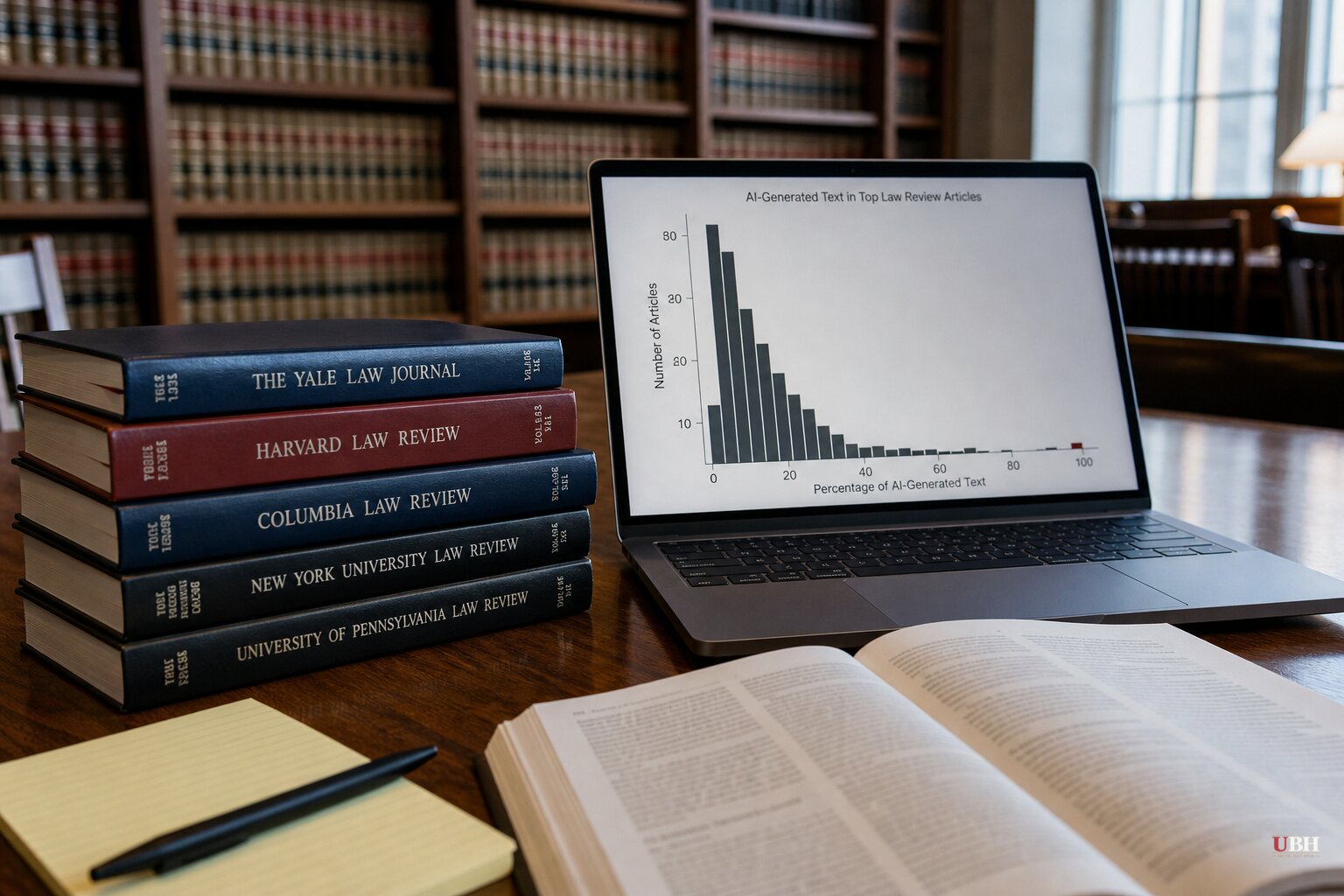
Julian Nyarko, a Stanford Law professor, ran a batch of articles published this year in top law reviews through Pangram, an AI-detection tool, and shared the results in a guest post on the Volokh Conspiracy blog hosted by Orin Kerr and published by Reason.
Nyarko's headline finding: most articles in top journals show no AI writing at all. Some have a small amount. A handful show a substantial share. One article, per Pangram's estimate, was more than 50% AI-written.
Nyarko frames the question as genuinely hard, not a slam dunk either way. In empirical legal scholarship, he argues, the thinking and the writing are largely separate jobs. The tables, figures and statistical models get built long before a sentence of prose gets drafted, and preregistration practices discourage scholars from rewriting their core findings late in the process. Doctrinal scholarship, where the writing itself is the argument, is a different animal, in his view, because the act of writing forces precision that AI-assisted drafting might short-circuit.
The Detection Tool Fight
Not everyone is comfortable trusting Pangram's numbers in the first place. Above the Law published an open letter to law review editors challenging the rush to treat AI-detection scores as fact, after a professor posted online that a submission to a law review at what the letter describes as an "R1, T75" law school was flagged by Pangram as 79% AI-generated.
The letter's author pushed back hard on the idea that Pangram is somehow error-proof, writing on X, "A reminder that AI detection software triggers when the author is on the spectrum. We need to be careful with making accusations without facts." The piece invokes the recent death of scholar Jason Arday as a reminder of the stakes when accusations go wrong, though the source does not spell out a direct causal link between his death and any specific AI-detection dispute.
The letter lays out three conditions under which it says AI-detection use becomes a real problem: when a no-AI policy isn't disclosed to authors before submission, when the tool produces false positives against human-written work with no appeal process, and when it lets sophisticated users dodge detection entirely (false negatives). Above the Law also raises pointed questions for law review editors: did your journal disclose an AI policy before authors paid submission fees through the platform Scholastica, and does your editorial board understand that even a tool as hyped as Pangram isn't foolproof.
Detection software making a career-ending accusation with no disclosed policy and no appeals process is a due-process problem regardless of how accurate the tool claims to be. Nyarko's own study doesn't resolve whether Pangram's scores are reliable enough to justify rejecting a submission outright. It just tells us how often the tool flags AI use across a sample of journals.
A Different Framework
John McGinnis, a professor at Northwestern Law, takes the debate in a different direction in an essay titled "The Scholars Telescope: AI and the Public Purpose of Legal Scholarship." McGinnis argues the real question isn't how much unaided labor went into an article, it's whether the scholarship improves public understanding of the law.
His proposed rule, what he calls a "responsibility principle," would let scholars use AI extensively so long as they personally verify every material claim, acknowledge their intellectual debts, and understand and can defend every judgment call in the piece. He rejects listing AI as a coauthor and argues disclosure should focus on the methods needed to check or reproduce a claim, not a full production history of how the article got written. He also proposes a four-factor test, weighing materiality, opacity, verifiability, and substitution, for deciding how much human oversight a given use of AI actually requires.
What's Unresolved
None of the four sources here settle the underlying dispute: whether a law review can fairly police AI use without a transparent, disclosed policy and a way for accused authors to challenge a flagged score. Nyarko's data shows AI use in legal scholarship is real but still a minority practice at the top journals. Whether journals adopt anything like McGinnis's responsibility principle, or keep relying on detection scores that Above the Law says can misfire on neurodivergent writers, is a decision that rests with individual law review editorial boards, not with any single study or software vendor.
Sources used for this briefing
4 links from 3 independent newsrooms (syndicated copies of the same report count once)
These are the sources it draws on, linked so you can verify.


