
Unbiased headlines. Facts, not spin.
Unbiased Headlines is an independently owned news organization. We bring you the facts, not opinions, written fresh from 110+ named sources. Sources linked so you can verify it yourself.
 tech
Notable (5/10)
Event date: September 6, 2026 ·
tech
Notable (5/10)
Event date: September 6, 2026 ·
RTX 5090 Connector Melts During DLSS 5 Test: Board Power Hit 613.5W in Single User Report
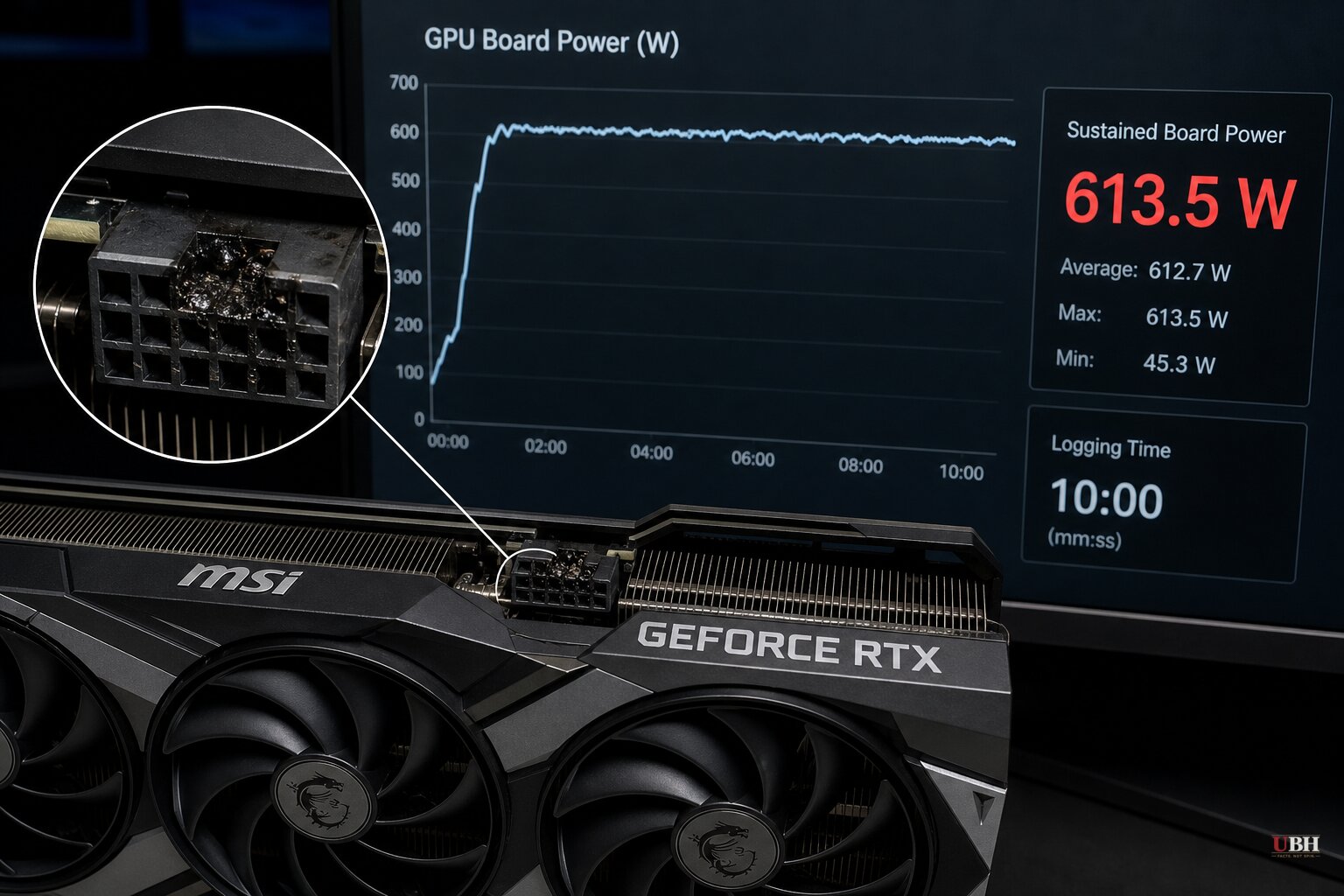
A HardOCP forum user going by the handle erek says his MSI GeForce RTX 5090 Gaming Trio OC stopped working while he tested NVIDIA's new DLSS 5 3D-Guided Neural Rendering feature in NBA 2K27, the only game with official DLSS 5 support as of this writing. GPU-Z logs he shared show board power hit a peak of 613.5W and held above 610W for an extended stretch rather than spiking briefly, according to reporting from VideoCardz, TechPowerUp, Tom's Hardware, PC Guide, Tech4Gamers, and thinkcomputers, all of which cite erek's original post.
Before he enabled DLSS 5, erek says the card was drawing about 450W, a normal gaming load. MSI rates the Gaming Trio OC at 575W. The 613.5W peak is roughly 38W over that rating and edges past the 600W theoretical ceiling of the 12V-2x6 connector standard the card uses.
Shortly after, the card became unstable and quit. Erek reported a burning smell and found the 16-pin connector's plastic had melted and bonded to the cable. Photos he shared, described consistently across the outlets covering the story, show at least five scorched pins and one pin housing melted away entirely. The cable was MSI's yellow-tipped model, a design MSI introduced specifically to give users a visual check that the connector is fully seated.
The board-power caveat every outlet flagged
Multiple outlets, including VideoCardz, TechPowerUp, Tom's Hardware, PC Guide, and thinkcomputers, note the same technical caveat: GPU-Z's 613.5W reading is total board power, not power carried by the 16-pin connector alone. The PCIe slot itself supplies up to 75W separately. That means the connector may not have carried the full 613.5W, and the reports are consistent in saying this hasn't been independently verified as a connector-specific failure analysis. Thinkcomputers put it plainly: this is "a user report rather than an independently verified failure analysis."
DLSS 5's power cost, measured independently
Tom's Hardware ran its own tests on an MSI Lightning Z variant of the RTX 5090, a dual-connector card with a 1,000W XOC BIOS. In Control, that card pulled 691W without DLSS 5 and 800W with it enabled. In Hogwarts Legacy, power went from 480W to 720W, a 50% jump, according to Tom's Hardware's own measurements.
Thinkcomputers cites a separate test showing power rising from roughly 417W to 547W on a Founders Edition card in one title. VideoCardz also references a second HardForum user who reported power climbing from 435W to 520W after injecting DLSS 5 into Hitman 3, a game without official support for the feature. Across these separate data points, DLSS 5's neural rendering workload consistently adds well over 100W to RTX 5090 power draw, though the exact figure varies by title and card configuration.
Part of a longer pattern, not an isolated design
The RTX 5090's 16-pin connector, and its 12V-2x6 predecessor on the RTX 4090, has a documented history of melting failures going back roughly three and a half years, per Tech Times. TechPowerUp's own coverage references a separate incident from March 2026 in which Hardware Unboxed reported a melted connector reaching 175°C. VideoCardz and TechPowerUp both stress that connector failures have occurred under ordinary gaming and stress-test workloads with no DLSS 5 involved at all, usually tied to incomplete seating or contact resistance issues rather than any single software feature.
That history is the reason several outlets are cautious about pinning this specific failure on DLSS 5. TechPowerUp writes that DLSS 5 "may have contributed without being the sole cause." PC Guide and thinkcomputers use nearly identical language. Tom's Hardware states outright: "We can't confirm whether DLSS 5 was actually responsible for burning Erek's card."
Tech Times' coverage takes a more definitive stance, framing the incident as proof that standard mitigation advice, using a manufacturer-approved cable, seating it fully, and monitoring per-pin draw, has reached its limit against software that can drive sustained high power. That is a stronger causal claim than the other six outlets are willing to make from a single case.
NVIDIA has not commented on the incident or on DLSS 5's power draw, according to every outlet that covered the story. No recall, advisory, or investigation has been announced by NVIDIA or MSI as of this writing. Whether this remains an isolated report or the first of more failures tied to DLSS 5's sustained power demand will depend on whether additional cases surface as more games gain official or modded support for the feature.
Sources used for this briefing
7 links from 7 independent newsrooms (syndicated copies of the same report count once)
These are the sources it draws on, linked so you can verify.


