
Unbiased headlines. Facts, not spin.
Unbiased Headlines is an independently owned news organization. We bring you the facts, not opinions, written fresh from 110+ named sources. Sources linked so you can verify it yourself.
 tech
Notable (6/10)
Chartbeat: Google Search Referrals to Publishers Fell 40% in the Year to July 2026
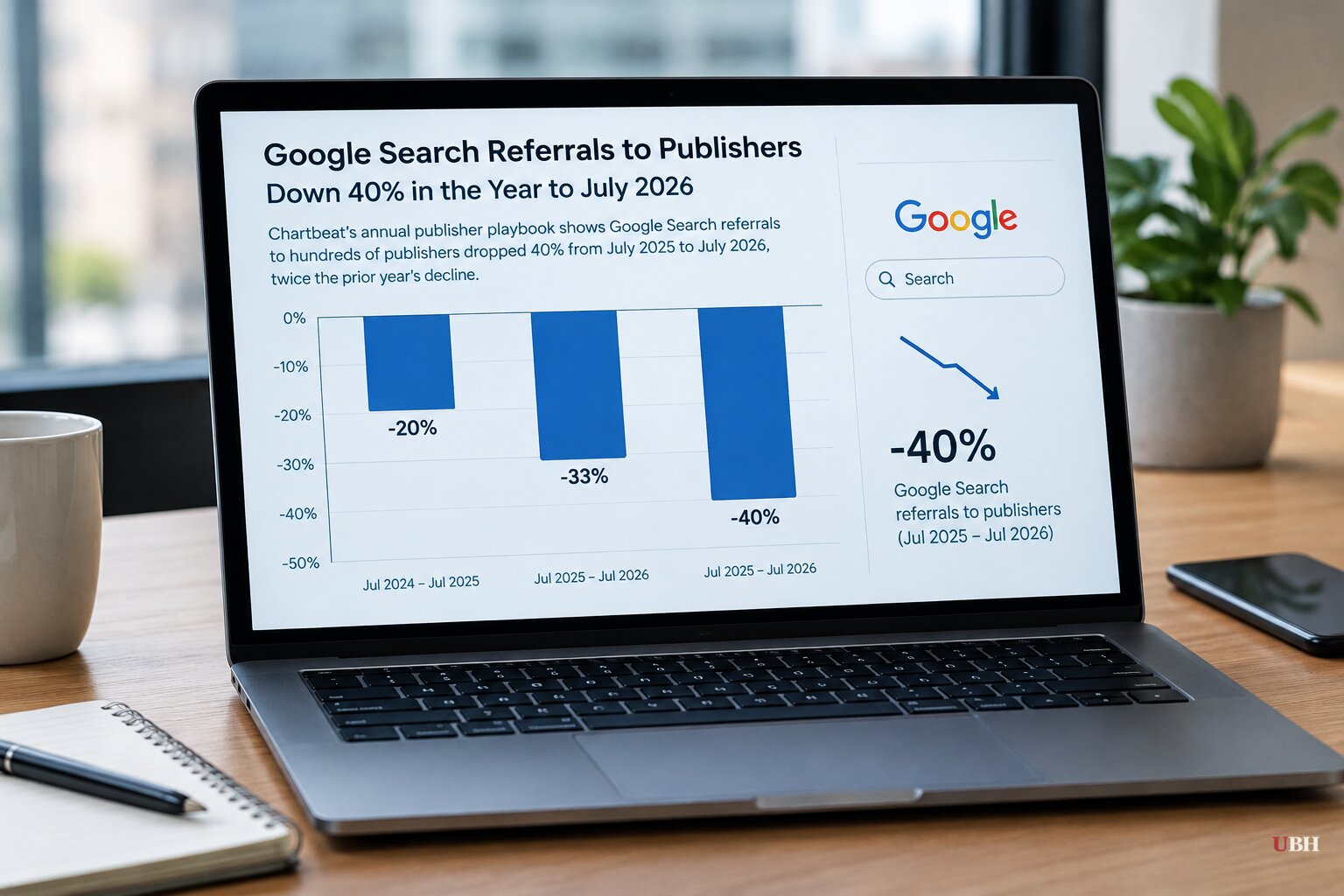
Since Google rolled out AI Overviews in 2024 and AI Mode in May 2025, the numbers on what reaches publishers' websites have gotten steadily worse. The newest figures show the slide accelerating.
Chartbeat's annual publisher playbook found that referrals from Google Search to hundreds of publishers fell 40% between July 2025 and July 2026. That is twice the decline of the previous 12 months, according to the Reuters Institute for the Study of Journalism, which reviewed the data in an Oct. 13 analysis.
An earlier Chartbeat dataset, cited in the Reuters Institute's January 2026 report, covered more than 2,500 sites. It showed organic Google traffic down 33% globally from November 2024 to November 2025. The samples differ, but the direction does not.
Small publishers took the worst of it
Chartbeat research indicates search referrals to small publishers fell around 60% over two years. Larger publishers saw a drop of about 22%.
Piano, a separate analytics firm, found a 36% decline in publisher search traffic in its benchmark sample. Revenue in that sample fell 16%.
The revenue hit is now visible in company results. Reach, publisher of the Daily Mirror, Daily Express and a string of regional papers, reported in its H1 2026 results that digital revenue dropped from £61.1 million to £54.2 million. That is a fall of about £6.9 million, or roughly 11.4%.
Reach also reported Google referrals down about 55% and digital page views down about 40%. Indirect digital revenue fell 16.2%.
The background
Google's AI Overviews put a machine-written summary at the top of results, with source links below it. The News/Media Alliance warned at launch that the feature would be "catastrophic" for web traffic.
A 2024 Press Gazette investigation found AI Overviews appeared on almost a quarter of news-related searches in May 2024. By August, it found the summaries had begun displacing media sites that previously held top spots for certain queries.
A June 2025 Wall Street Journal report documented traffic declines since 2022 at Business Insider, The Washington Post, HuffPost and the Journal itself. Similarweb data in that report showed search's share of New York Times traffic falling from 44% to 35.5% over three years.
Not everyone agrees AI is the whole story
The causal picture is messier than the headline numbers suggest. InfoTech Lead's review of the research notes that not every traffic decline can be pinned on artificial intelligence. It points to changes in Google's search algorithms, social media distribution, reader behavior and advertising markets as additional factors.
The Reuters Institute's own analysis adds a wrinkle. At the time of its writing, Google did not show AI Overviews on news queries. News-adjacent searches, such as historical context on Iran or biographical details on political leaders, did trigger them. Gemini and other chatbots also produce similar summaries.
The Verge's weekly Stepback column, published today, Oct. 25, argues that AI search features combined with changes to Google's ranking have made it harder for publishers to survive on Google traffic alone. AI chatbots do send some referral traffic, but InfoTech Lead's summary of the research says the volume is small next to traditional search.
Lawsuits and licensing deals
Publishers are responding in different ways. The Boston Institute for Nonprofit Journalism says it has joined 59 other publishers in a mass-action lawsuit against OpenAI and Microsoft. The group, represented by Platkin LLP, controls more than 500 news outlets across the United States.
The plaintiffs' core claim is that OpenAI and Microsoft took their articles without permission or payment to build large language models, in violation of copyright law. A BINJ representative wrote in Truthout that the exposure for the defendants is "absolutely huge," especially alongside The New York Times' suit on the same grounds, which has been working through the courts for three years. The defendants' positions are not laid out in the material on the filing.
Others are taking money. Forbes has joined Google's paid News AI pilot, Mediabistro reports. Publishers in the program give Google expanded content rights in exchange for compensation and a chance to test discovery formats that give users context before they click through.
Meta is pushing the opposite model. According to Press Gazette, industry groups are urging publishers to delete their Facebook and Instagram accounts. Meta's updated terms of service claim AI training rights over content posted to its platforms after Oct. 30, with no additional payment.
What newsrooms are doing
Newsroom managers quoted by the Reuters Institute describe a pivot away from SEO toward direct audience relationships. Some are also tracking how often AI tools like ChatGPT, Perplexity and Google AI Overviews cite them. The experts, from Axios, the Guardian and The Athletic, argue brand authority now matters more than chasing clicks.
The near-term test arrives Oct. 30. Publishers that keep active Facebook and Instagram accounts after that date will be operating under Meta's new AI-training terms. Meanwhile, the OpenAI and Microsoft copyright suits will determine whether training on news content without a license carries a price.
Sources used for this briefing
7 links from 6 independent newsrooms (syndicated copies of the same report count once)
These are the sources it draws on, linked so you can verify.


