
Original briefings. Zero spin.
Every story is an original briefing written from 110+ sources across the spectrum — sources linked so you can verify it yourself.
 defense
Notable (6/10)
August 19, 2026 at 10:03 PM
defense
Notable (6/10)
August 19, 2026 at 10:03 PM
Sri Lanka's Chemmani Excavation Ends at 582 Sets of Human Remains, Identification Hasn't Started
The digging stopped Wednesday. It might not stay stopped.
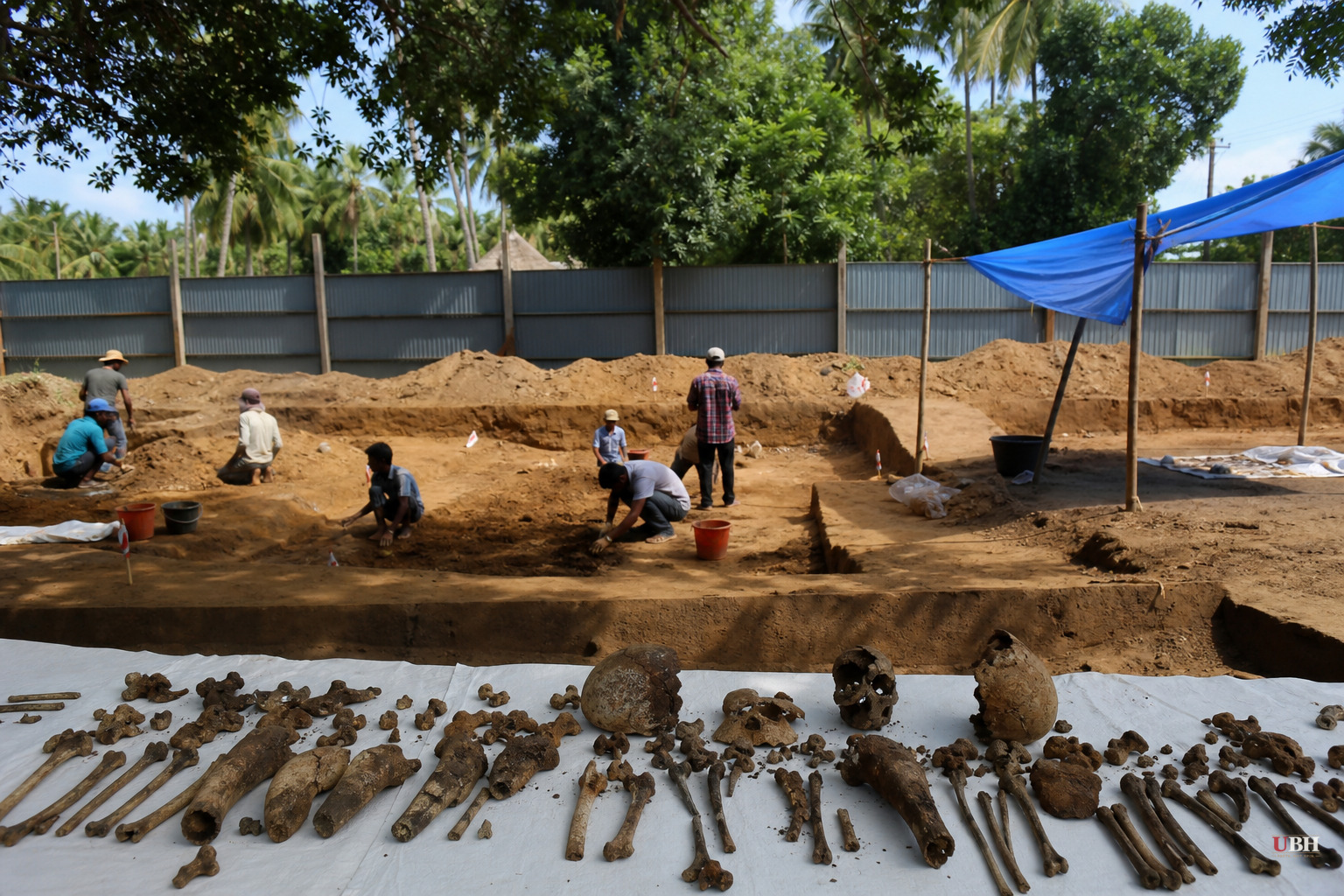
Excavation at the Chemmani mass grave site outside Jaffna, Sri Lanka, closed out its third and court-authorized phase with 582 sets of human remains identified, according to the Jaffna Monitor. Ten more sets were found Tuesday alone, one of them a child's. That brought the running total from 515, reported by The News Minute on August 12, up to 582 by Wednesday.
Of those 582 sets, 573 have been fully exhumed. Nine remain in the ground as the authorized digging period expires. The Jaffna Monitor reports this was the 56th and final day the court permitted for this phase, and the 110th day of digging total since work restarted in April after a funding gap shut the project down last September.
This is now the largest mass grave excavation in Sri Lanka's history, surpassing the Mannar Sathosa site, according to the Jaffna Monitor. Investigators have pulled infants and young children from the ground stacked alongside adults, buried in clusters, along with clothing, feeding bottles, toys and beads.
What's proven, what isn't
582 human skeletons is a fact. Who they were, when they died, and whether a crime occurred is not established.
Sri Lanka's Criminal Investigation Department told the Jaffna Magistrate's Court in July that it had not yet determined whether a crime took place at all, according to The News Minute. Identification work on the remains hasn't even started yet. That means no names, no cause of death, no timeline, none of it is settled science at this point. It's bones in the ground and a court docket.
But the allegation driving decades of attention on this site remains: that hundreds of Tamil civilians disappeared after the Sri Lankan military recaptured Jaffna in 1995, during the country's brutal civil war, and were buried at Chemmani. Al Jazeera's coverage frames the discovery directly around "allegations of military killings of Tamil civilians during the civil war, with investigations delayed for 30 years." That's an allegation, not a verdict, but it's the allegation that's kept families showing up at this site for three decades.
The allegation isn't new and it isn't unfounded speculation. Chemmani first drew scrutiny in 1998 when Somaratne Rajapakse, a Sri Lankan soldier convicted in the rape and murder of 18-year-old schoolgirl Krishanthi Kumaraswamy, testified that hundreds of bodies of disappeared Tamils were buried there. An internationally observed excavation the following year recovered 15 bodies, two identified as men who vanished in 1996, per the Jaffna Monitor. A skeleton found bound and blindfolded during that 1999 dig echoes grimly with what investigators found this month: a headless skeleton, hands bound across its chest, unearthed on August 8 according to The News Minute, citing the Tamil Guardian.
Earlier excavations turned up more remains with head and body separated, some with the neck apparently severed. Whatever happened at Chemmani, it wasn't simple burial.
Why this dig only happened now
The current investigation didn't start because of a renewed political push for accountability. It started because construction work near a Hindu cremation ground accidentally uncovered skeletal remains in February 2025, according to the Jaffna Monitor. The Jaffna Magistrate's Court then ordered a forensic excavation, which began in May 2025, ran 54 days across two phases, and stalled in September when funding ran out. Digging resumed in April this year after the government allocated 21 million rupees for a third phase.
In plain terms, this happened by accident, got funded in fits and starts, and nearly died for lack of money, not political will. That's a legitimate criticism of how Colombo has handled a case tied to alleged wartime atrocities against a minority population. Families of the disappeared have pushed for international involvement in the probe, per the Jaffna Monitor, a demand that reflects real skepticism about whether a domestic investigation into the military's own alleged conduct can be trusted to run its full course.
Test pits dug around the excavation zone, meant to check whether burials extend beyond the current site, have themselves turned up remains, including that bound, headless skeleton. There's no indication the ground is exhausted. Investigators simply ran out of authorized days.
The next checkpoint is October 14, when the Jaffna Magistrate's Court takes up reports on the excavation, including ground-penetrating radar findings and a full accounting of evidence recovered so far. That hearing will decide whether a fourth phase of digging goes ahead. Identification of the 582 sets of remains, the step that would finally start answering who died and how, has not yet begun.
Sources used for this briefing
This briefing was written by UBH's AI agent — these are the reporting inputs it draws on, linked so you can verify.


