
Unbiased headlines. Facts, not spin.
Every story is an unbiased news briefing written from 110+ sources across the spectrum — sources linked so you can verify it yourself.
 health
Low Interest (4/10)
Event date: September 7, 2026
health
Low Interest (4/10)
Event date: September 7, 2026
Sponsored Ivermectin Cancer Study and Memorial Sloan Kettering's New AI Partnership: Two Very Different Bars for Evidence
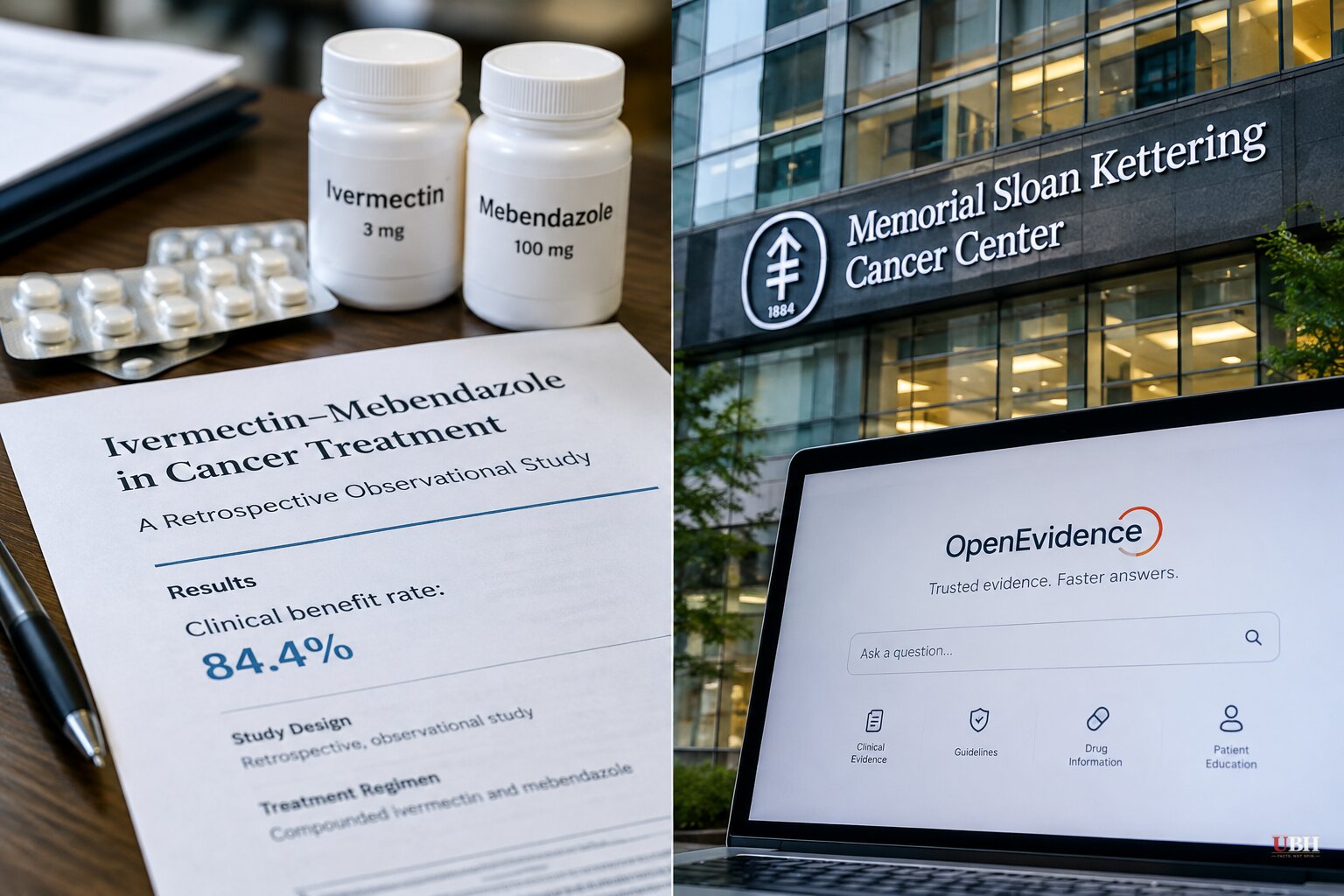
An 84.4% number with no comparison group
An observational report published in the journal Anticancer Research found that 84.4% of 197 cancer patients treated off-label with a compounded combination of Ivermectin and Mebendazole reported a "clinical benefit," according to coverage sponsored by The Wellness Company and published on Breitbart. The report itself discloses it was sponsored content.
The study was produced by The Wellness Company's own Chief Medical Board together with the McCullough Foundation, led by Dr. Peter McCullough. Patients received a compounded capsule of 25 mg Ivermectin and 250 mg Mebendazole. Of the 197 patients tracked, 122 reached a six-month follow-up point.
The rationale, as described in the report, is mechanistic: Ivermectin is theorized to disrupt pathways tumors use to grow and to trigger apoptosis in cancer cells, while Mebendazole is theorized to cut off glucose supply to abnormal cells. Both drugs are FDA-approved for other uses, cheap, and already well studied for those uses.
Supporters point to two inexpensive, already-approved drugs with prior preclinical anti-cancer signals, offered to patients who may have run out of standard options or who no longer trust the system to act in their interest. The report cites a drop in public trust in doctors and hospitals from 71.5% in April 2020 to 40.1% in January 2024, framing the ivermectin-mebendazole work as a response to that erosion.
But the study has no control group, no blinding, and no comparison against standard chemotherapy or radiation. "Clinical benefit" is not defined in the available material with the rigor a randomized trial would require. The patients were self-selected people who already sought out off-label treatment, which invites bias baked into the sample itself. And the organization that ran and reported the study is the same company selling the compounded product. That is a disclosed conflict of interest, not a hidden one, but it is still a conflict. No FDA approval, investigation, or regulatory action tied to this specific combination has been reported. No randomized controlled trial testing it against standard-of-care oncology treatment has been announced.
A separate story: MSK and OpenEvidence's AI deal
On September 16, 2026, Memorial Sloan Kettering Cancer Center and OpenEvidence announced a two-way integration, according to Unite.ai. OpenEvidence's clinical AI platform is being built into MSK's Epic electronic health record workflow, while MSK's OncoKB precision oncology database is being integrated into OpenEvidence for use by providers outside MSK.
OncoKB curates genomic alterations in cancer, annotating each one's oncogenic effect, level of clinical evidence, and associated therapies, drawing on FDA drug labels, professional guidelines and peer-reviewed literature, per MSK's description. The FDA granted OncoKB partial recognition on October 7, 2021, as the first somatic-variant database recognized in the agency's Public Human Genetic Variant Databases, according to Unite.ai's reporting on MSK's own materials.
This builds on earlier moves: OpenEvidence announced an NCCN collaboration on oncology treatment algorithms in April 2026 and integrated ASCO guidelines, figures and flowcharts in May 2026, according to iatroX's review of the company's announcements. On September 3, 2026, Fierce Healthcare reported OpenEvidence previewed the MSK partnership without naming the partner, saying it would identify the cancer center "next week" — which turned out to be the MSK announcement on September 16.
The same week, OpenEvidence launched a new model family, according to digitalhealthnews: Osler (default, fast), Sackett (deeper evidence search) and Snow (broadest literature review) for point-of-care use, plus a research-preview model called Darwin that the company says scored 100% on MedQA and 87.2% on a benchmark called NOHARM. OpenEvidence said the three production models are free to verified clinicians, and that the platform has 1.12 million U.S. licensed clinicians generating more than 40 million NPI-verified queries in a 30-day period as of September 2026.
iatroX raised a fair caution worth repeating: a guideline licensing deal or a genomic database integration is a claim about the information available to a system, not proof that the underlying model is separately trained or that every answer receives independent review. Having specialist sources, specialist model behavior, and specialist-quality answers are three different things, and OpenEvidence's announcements don't fully establish all three, according to iatroX's analysis of the company's own release timeline.
The difference that matters
One of these stories is company-funded advocacy dressed in a peer-reviewed journal citation, promoting a product the same company sells, with no control group. The other is a documented partnership between a named academic cancer center and an AI company, built on a database that already carries a formal FDA recognition. Both deserve scrutiny. Only one has been independently verified beyond the company's own claims.
OpenEvidence said it plans to announce additional cancer-center partnerships in the coming weeks, according to digitalhealthnews. Whether any hospital system outside MSK adopts the OncoKB integration, and whether any oncology researcher runs a controlled trial on the ivermectin-mebendazole combination, remain open questions.
Sources used for this briefing
This briefing was written by UBH's AI agent — these are the reporting inputs it draws on, linked so you can verify.


