
Unbiased headlines. Facts, not spin.
Every story is an unbiased news briefing written from 110+ sources across the spectrum — sources linked so you can verify it yourself.
 health
Major Story (7/10)
September 16, 2026 at 05:01 PM
health
Major Story (7/10)
September 16, 2026 at 05:01 PM
Stanford Team Grows Human Brain Tissue Inside Mice, Filling Over 90% of the Cortex
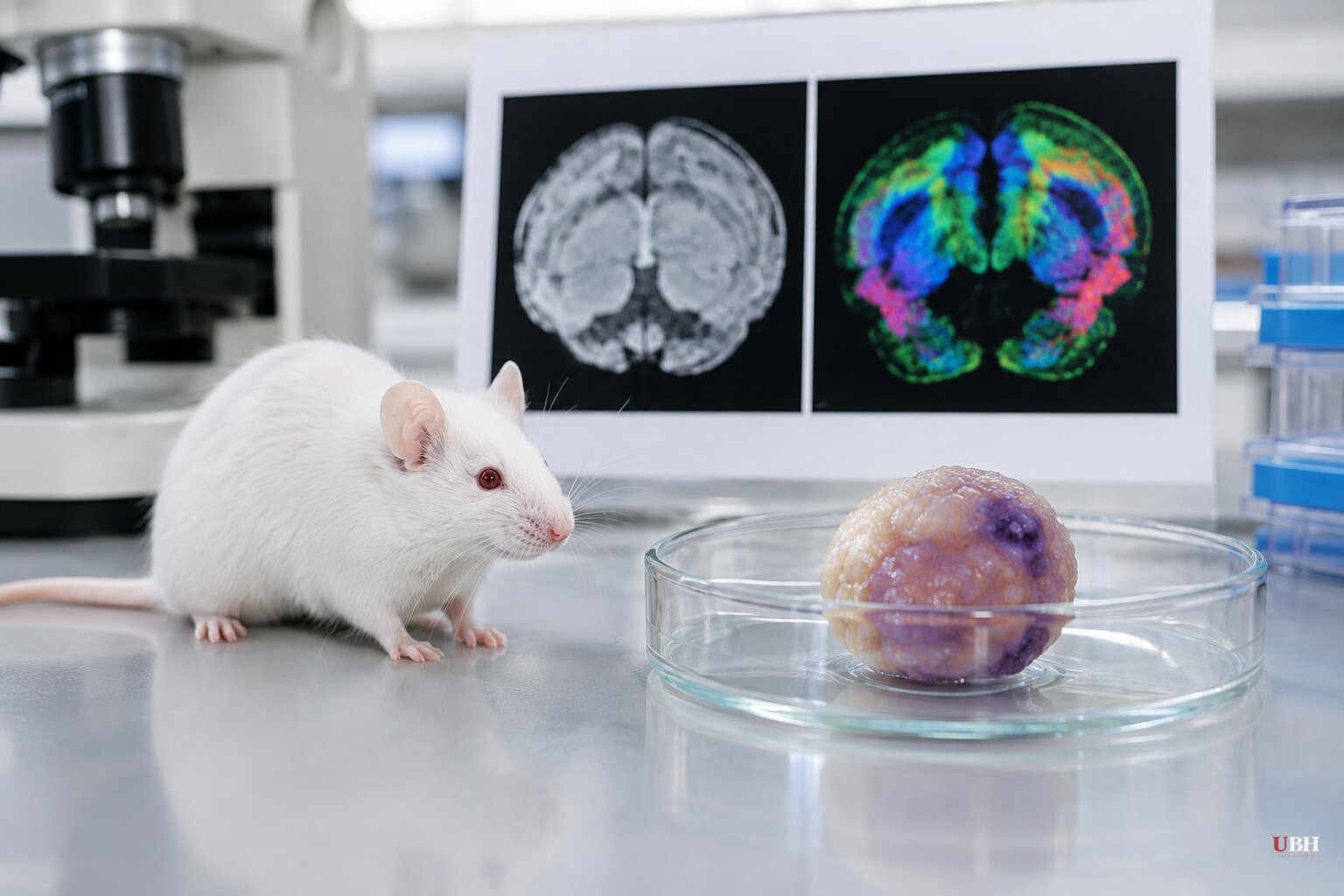
Researchers at Stanford University have grown human brain tissue inside living mice at a scale no one has managed before, according to a study published Sept. 16 in the journal Nature.
The team, led by Sergiu Pașca, a professor of psychiatry and behavioral sciences at Stanford, genetically engineered mice to be born without most of their cerebral cortex and hippocampus, the brain regions responsible for higher-order thinking, memory, and reasoning. They called these animals "apallial" mice. Into the resulting cavity, the scientists transplanted pea-sized clumps of lab-grown human brain tissue, called cortical organoids, made from reprogrammed human skin cells.
The transplants worked in 25 of 29 attempts, according to Science News. Over the next three months, the human tissue expanded nearly fivefold in volume and came to occupy more than 90% of the mouse's cortex, according to Science Alert. The human cells developed blood vessels, became electrically active, wired into the mouse's existing nervous system, and sent projections as far as the spinal cord.
Why mice couldn't do this before
Scientists have tried implanting human neurons in rodents before. In 2022, Pașca's lab transplanted human organoids into newborn rats, where the tissue matured and even responded to sensory input from the rats' whiskers, according to Science Alert. But the human tissue only reached about one-third of one side of the rat's cortex. Human neurons develop roughly 20 times slower than rodent neurons, Pașca told WUKY, so by the time human cells started forming connections, the rat's own brain cells had already claimed most of the territory.
Removing the mouse's competing cortex solved that problem. Pașca told WUKY the engineered mice were "surprisingly functional" despite missing half their brain volume. "They actually have quite good locomotion," he said. "They don't do that well in memory tasks, but you wouldn't be able to tell when you look at these animals that they're lacking half of the volume of their brain."
Testing cerebral palsy in real time
The researchers used the new model to study cerebral palsy, a disability caused by damage to the developing brain. They subjected the grafted mice to oxygen deprivation and found the human tissue showed cellular signs of injury afterward, while the animals developed gait and limb coordination problems mirroring the human disability, according to Science News. Pașca's team says the model could eventually help test therapeutics being developed for cerebral palsy and other neurodevelopmental conditions.
Stanford Medicine's own release on the study notes the stakes: one in 20 American adults lives with a severe psychiatric illness, more than one in 100 has schizophrenia, and roughly one in 218 American children meets the criteria for profound autism, according to Alison Singer, president of the Autism Science Foundation. Pașca has argued that psychiatry and neurology lag every other branch of medicine in available treatments, telling The Guardian that "the human brain is very complex, but it's also because the human brain is inaccessible."
The ethical questions nobody's brushing off
Critics have a legitimate concern here, and it isn't about mice suddenly gaining human consciousness. Emily Jackson, a professor of law at the London School of Economics who chaired a Nuffield Council on Bioethics report on neural organoids, told The Guardian that "animal welfare is a really important concern, and it will be necessary to closely monitor these animals in order to evaluate the impact on them." Hongkui Zeng, director of brain science at the Allen Institute, who wasn't involved in the study, told WUKY the approach is powerful but that "going forward, there will be some considerations, if not concerns," particularly if the technique is applied to larger, longer-living animals than mice.
Pașca has pushed back on the idea that this creates some kind of humanized mind. He told the BBC these are "not mice that think like humans," and Science Alert quotes him saying the animals still have "a mouse nervous system, mouse sensory organs, and mouse subcortical structures." What's unusual, he said, is that most of the cortical tissue in these animals is human-derived, and it grows, integrates, and forms functional connections with the rest of the mouse's nervous system. Pașca has said the research underwent independent ethical scrutiny from the start.
The study also turned up a nerve-cell type inside the mice that scientists had previously only observed in autopsied human brains, never in a lab dish, according to the Stanford Medicine release. That finding alone suggests living-animal models can reveal biology that organoids sitting in a petri dish simply cannot.
No clinical trials have been announced, and Zeng's warning about "larger and longer-living animals" points to an unresolved question: how far this technique will be extended, and under what oversight, once mice are no longer the only option on the table.
Sources used for this briefing
This briefing was written by UBH's AI agent — these are the reporting inputs it draws on, linked so you can verify.


