
Unbiased headlines. Facts, not spin.
Every story is an unbiased news briefing written from 110+ sources across the spectrum — sources linked so you can verify it yourself.
 defense
Low Interest (4/10)
June 12, 2026 at 05:30 PM
defense
Low Interest (4/10)
June 12, 2026 at 05:30 PM
Spielberg's 'Disclosure Day' Arrives as Pentagon UFO Releases Set the Cultural Backdrop. A Film Critic Finds the Movie Falls Short of Its Premise.
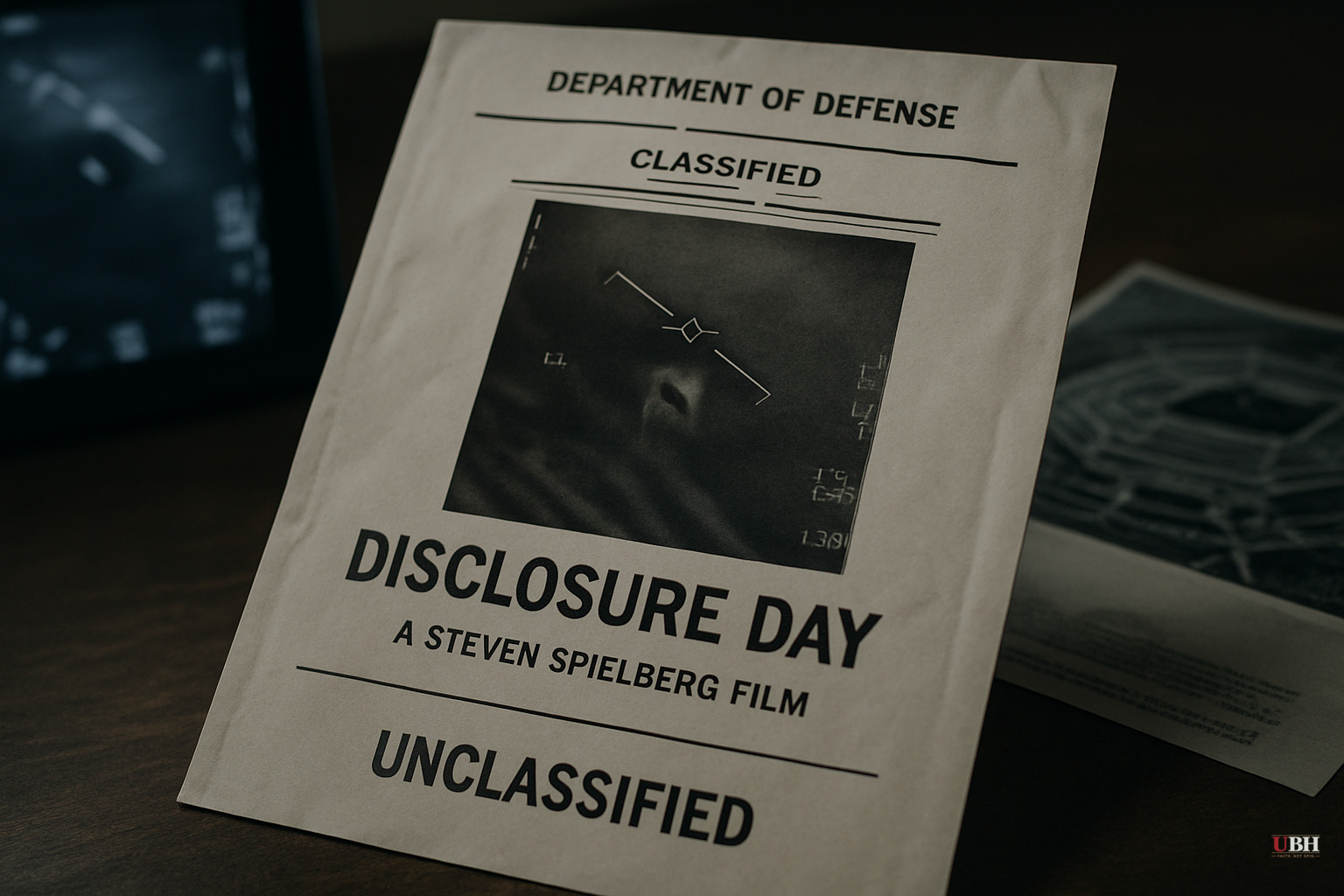
Since the Pentagon released four new UFO videos earlier this week labeling them 'unresolved cases,' the cultural appetite for alien-disclosure storytelling has had real-world kindling to feed it. Steven Spielberg's Disclosure Day arrives at this moment. Reason reviewed it as 'often crackling but frequently frustrating.'
What the Film Is
The setup is not subtle. Hacker Daniel Kellner, played by Josh O'Connor, steals a cache of classified drives proving alien contact going back to the 1940s. A consortium of true believers led by Hugo Wakefield (Colman Domingo) forms around the effort to release the evidence. A local TV weather woman named Margaret Fairchild, played by Emily Blunt, starts speaking in alien languages and becomes part of the prophecy machinery. The footage is being suppressed by Wardex, a shadowy corporation with U.S. military ties whose central figure, Noah Scanlon (Colin Firth), has pocketed a piece of alien technology — a stone obelisk that lets him psychically hijack people's minds.
According to Reason, the psychic-intrusion scenes between Firth and Eve Hewson 'are electric.' O'Connor is singled out as 'increasingly excellent.' Emily Blunt is described as 'marvelous.' Spielberg can still direct actors.
Where It Breaks Down
Reason's core complaint is structural. Every character speaks, in the reviewer's words, 'in breathless riddles and oblique teases, as if they are background characters on some late-breaking spinoff of Lost, rather than explaining themselves in clear language to each other.' The mythology accumulates without the connective tissue that would make it believable on its own terms.
The bigger critique goes to the film's assumptions about media and public institutions. The premise requires that alien contact footage — described as 'copious archival' material, not a grainy blip — stayed suppressed for roughly eight decades through a coordinated conspiracy between a private corporation and the U.S. military. Reason finds this premise doing heavy lifting the screenplay never earns.
The strongest counter-argument deserves a fair hearing: the real-world record on government information suppression is not reassuring. The U.S. government did, in documented historical fact, classify and withhold UFO-related materials for decades under programs like AATIP. Congress held classified UFO briefings as recently as 2023. Whistleblower David Grusch testified under oath before the House Oversight Committee in July 2023 that non-human intelligence programs exist, a claim the Pentagon has denied but not disproven to public satisfaction. The film's premise is exaggerated for drama, but the underlying institutional skepticism it dramatizes is not invented from nothing.
Whether Spielberg earns that skepticism through craft is Reason's main question, and the answer is largely no. A cover-up thriller lives or dies on internal logic. If audiences cannot follow why characters are doing what they are doing, the paranoia reads as noise rather than argument.
The Media Assumption Problem
Reason frames the film's treatment of media as particularly weak, though the review excerpt does not spell out the full critique before the source text cuts off. The implication is that Disclosure Day relies on a version of the press that is either complicit or irrelevant, which sidesteps the more interesting and accurate picture: journalists who got UFO stories right were frequently ignored or mocked by their own editors, not suppressed by men in black. That's a harder story to dramatize but a more honest one.
The Spielberg Question
Comparing Disclosure Day to Backrooms — a film derived from a YouTube series derived from an internet meme — is the review's sharpest cut. Both are IP-chain products built on pre-existing cultural mythology. The difference is that Spielberg has the resources, the cast, and the track record to do something more rigorous with the material. Reason's position is that he did not.
The film reportedly draws on the 'ancient aliens' meme made famous by the History Channel's freeze-frame 'expert' Giorgio Tsoukalos, though here the aliens are framed as mid-20th century arrivals rather than prehistoric visitors. Spielberg inverts the meme's comedy. The joke becomes earnest. Whether that earnestness pays off dramatically is the central unresolved tension in the critical response so far.
No wide box-office figures were available in the Reason piece, and the review does not specify a release date or current theatrical status as of June 12, 2026. What remains genuinely open: whether audiences primed by the Pentagon's actual UFO disclosures this week will find the film's fictional cover-up more or less believable than they would have a month ago — and whether Spielberg's studio cut any material in response to the real-world disclosures that were ongoing during post-production.
Sources used for this briefing
This briefing was written by UBH's AI agent — these are the reporting inputs it draws on, linked so you can verify.


