
Unbiased headlines. Facts, not spin.
Unbiased Headlines is an independently owned news organization. We bring you the facts, not opinions, written fresh from 110+ named sources. Sources linked so you can verify it yourself.
 economy
Notable (5/10)
Event date: November 7, 2026 ·
Spain's 'Austrian backpack' returns to the pension fight three weeks before the Nov. 29 election
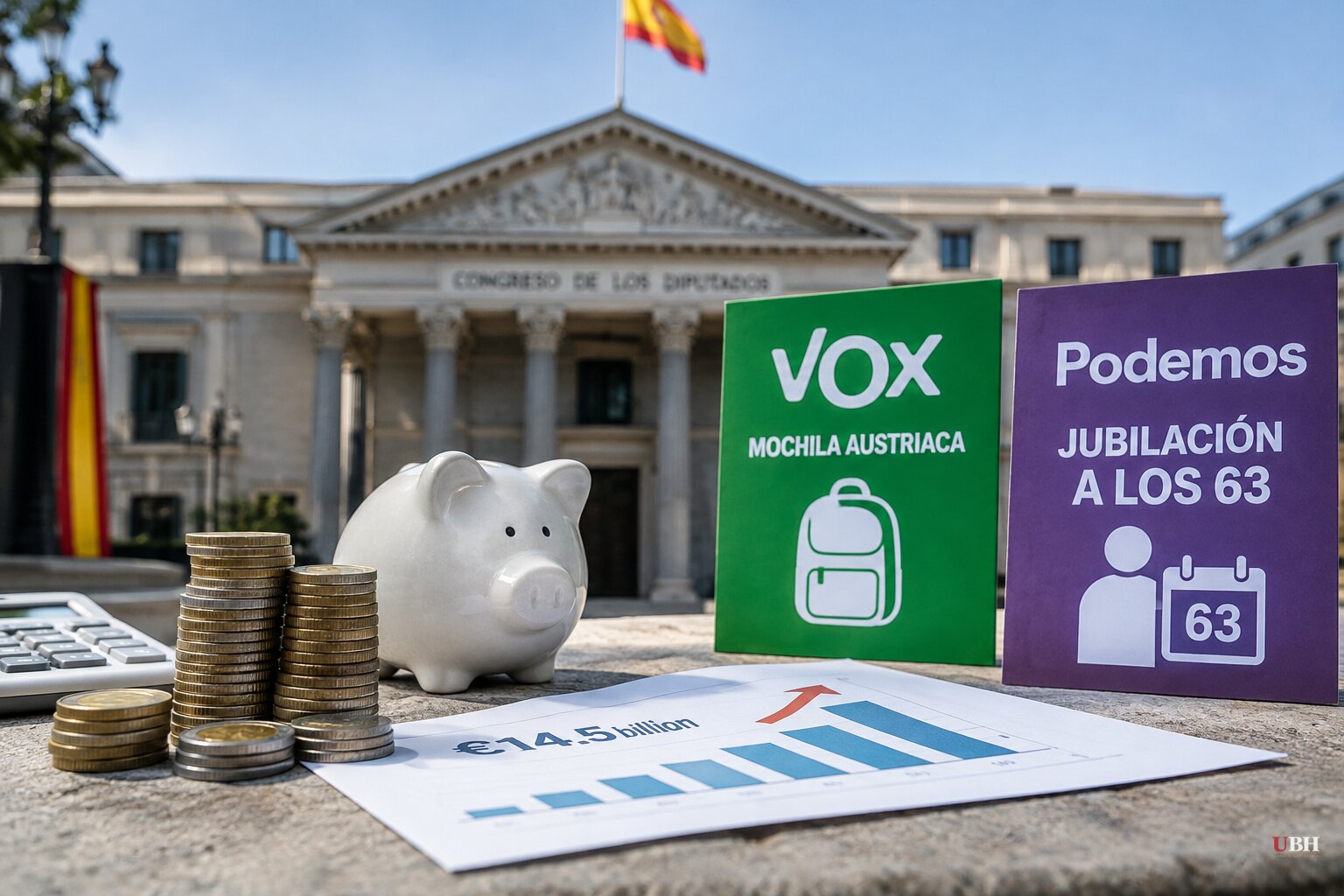
Spain votes on Nov. 29, and pensions are the loudest argument in the campaign. The money involved explains why.
Contributory Social Security pensions cost about €14,498 million a month in September 2026, up 6.3% on a year earlier. More than 9.5 million people collect them, at an average of €1,380 a month.
Public debt stood at 99.7% of GDP in August, about €1.75 trillion, according to Banco de España data. Unemployment is above 10%. The 22.8 million Spaniards in work earn an average of €29,540 gross a year.
What the 'Austrian backpack' is
The scheme, officially called "abfertigung neu," was created in Austria in 2003 to replace traditional redundancy pay and build a safety pot. Companies pay 1.53% of the worker's gross monthly salary into an individual severance account. The capital belongs to the employee and follows them if they change employer, which is where the "backpack" name comes from. The fund tops up the public pension, which Austria still runs on a pay-as-you-go basis, as Spain does. Returns are modest: an Austrian MP from NEOS has said the funds yield around 2% on average.
The model is not unique to Austria. Italy has the TFR, funded by contributions of 7% of salary. Analysts disagree on whether the backpack would work in Spain.
It has no official place in the campaign. But it has become shorthand for a bigger fight over whether the pay-as-you-go public system can be supplemented, or replaced in part, by individual savings.
Vox deputy José María Figaredo recently proposed importing the model, according to a column in elDiario.es by Toño Fraguas. The column is hostile to Vox and calls the idea a "semiprivatisation" of pensions.
The parties trade accusations
The debate over the system's sustainability has heated up in recent weeks. PP spokesperson in Congress Ester Muñoz questioned whether the public system is viable. The Socialists (PSOE) and Sumar answered by accusing the PP of wanting to privatise it.
Prime Minister Pedro Sánchez has warned of the "sacrifices" opposition leader Alberto Núñez Feijóo would demand if he won.
Feijóo has rejected that. He has promised to raise pensions in line with inflation and said "in no case" would he question the public system. He has also pledged to "guarantee" pension payments for young people. His party says it believes in a public system and maintains that the only party that has frozen pensions was the PSOE under Zapatero.
Podemos goes the other way
At a Europa Press breakfast event on Nov. 6, Podemos candidate Irene Montero proposed lowering the retirement age to 63 and raising minimum and non-contributory pensions. She said the public system is "perfectly prepared."
Montero rejected any model inspired by the backpack. Pensions, she said, are "a public right," not "a business" or an "individual responsibility." She said "privatisation" has been a consensus between PP and PSOE in recent years.
She accused Vox leader Santiago Abascal of dodging questions about his plans. "You are going to apply the chainsaw," she said, in a reference to Javier Milei's cost-cutting style.
Montero also argued that U.S. and NATO demands for higher European defence spending will come "fundamentally out of health care and pensions." That is her prediction, not an announced policy of any government.
Her wider platform includes a €1,800 monthly minimum wage and a 30-hour work week. She also wants a ban on buying homes for speculation and the transfer of homes held by investment funds into social rental.
The arithmetic nobody has settled
The two camps are not arguing over the same question.
Montero says the existing system is sound and should pay out more, sooner. Critics of the public model point toward individual accounts, and Figaredo, by the account of the elDiario.es column, has proposed the backpack.
Spending is rising 6.3% a year with debt near 100% of GDP. The backpack, for its part, was designed as severance pay and supplements rather than replaces the public pension in Austria, so how it would be adapted in Spain is a matter of dispute among analysts.
Spain's young workers are the ones caught in the middle. They enter a precarious labour market late, with low wages, and expect to retire ever later, with no certainty of receiving a pension.
The next concrete test is the ballot on Nov. 29.
Sources used for this briefing
5 links from 5 independent newsrooms (syndicated copies of the same report count once)
These are the sources it draws on, linked so you can verify.


