
Unbiased headlines. Facts, not spin.
Unbiased Headlines is an independently owned news organization. We bring you the facts, not opinions, written fresh from 110+ named sources. Sources linked so you can verify it yourself.
 economy
Major Story (7/10)
Event date: November 13, 2026 ·
NOAA Gives 80% Odds Strong El Niño Lasts Into Early 2027 as UN Agencies Tally $63.6 Million in Pooled Aid
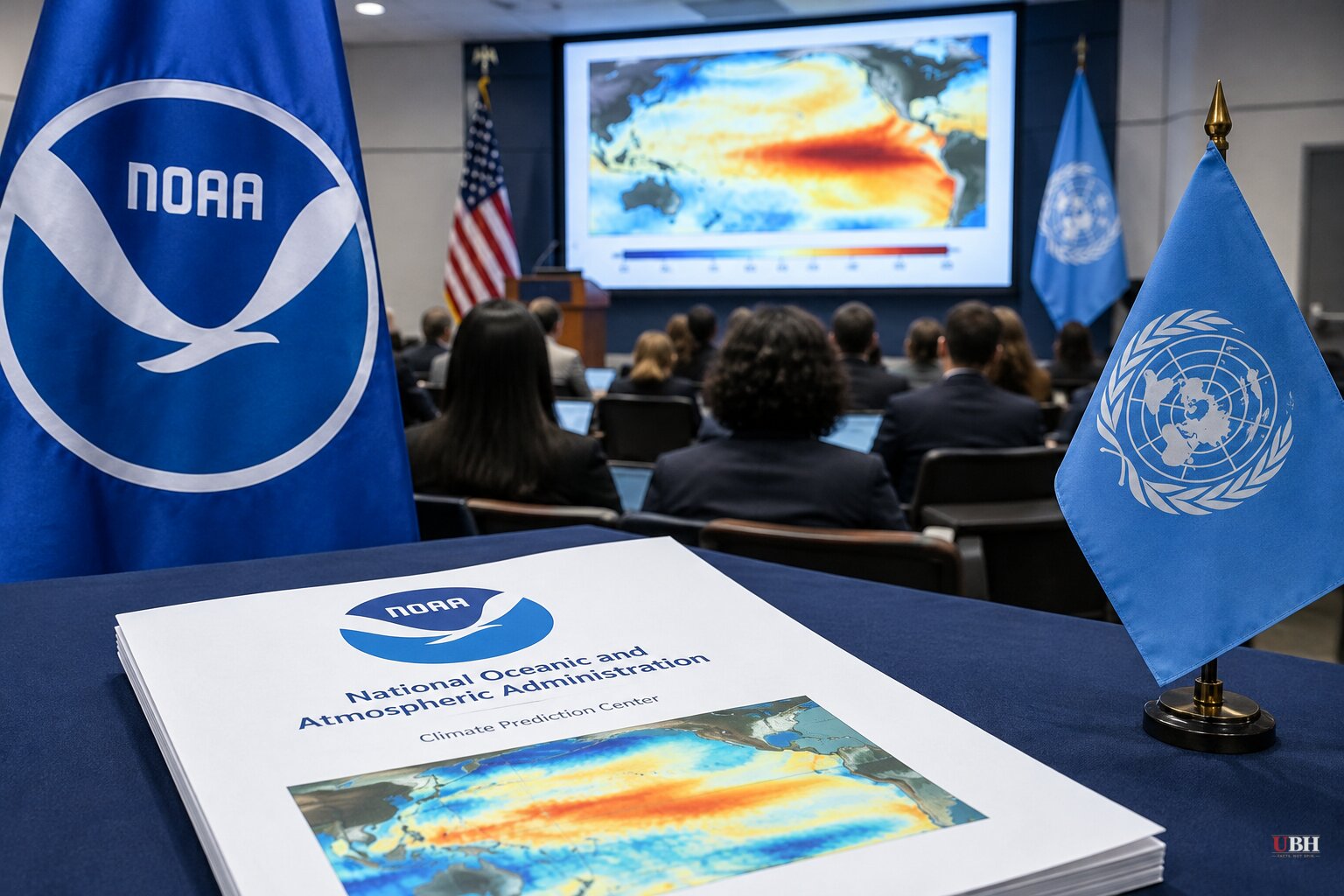
Since NOAA's Climate Prediction Center (CPC) issued its El Niño Advisory in June 2026, the Pacific warming event has strengthened month after month. It is now one of the strongest on record, and the forecast says it is not done.
What the forecasters say
CPC maintained the advisory on Nov. 12. It puts the chance that strong-to-very strong conditions persist through January–March 2027 at more than 79%.
Sea surface temperature anomalies top +4.0°C (+7.2°F) in parts of the eastern equatorial Pacific. Below the surface, anomalies exceed +10.0°C (+18.0°F). Winds, rainfall and convection patterns match the ocean data, including suppressed convection over Indonesia.
Michelle L'Heureux, who leads NOAA's ENSO forecast team, laid out the comparison at a Nov. 17 Southeast Climate Monthly Webinar. The 2026–27 event is tracking closely with 1997–98, she said. The Relative Oceanic Niño Index (RONI) is hovering near 2.0°C above average, with a 60% chance of reaching or exceeding 2.5°C. The record is 2.4°C, set in 1982–83.
Peak ocean temperatures are expected in late fall or early winter. L'Heureux noted that weather effects across the southern U.S. usually build later in winter and early spring.
What it means for the U.S.
El Niño pushes the Pacific jet stream south and east. NOAA's drought office says that tilts the odds toward a wetter winter in the Southeast, with warmer and drier conditions in the northern states.
That could bring relief to drought-stressed farms and watersheds. It also raises the risk of river flooding.
The global ledger
The World Meteorological Organization (WMO) released its State of the Climate Update 2026 at the opening of the COP31 climate conference in Antalya, Türkiye. January–September 2026 averaged about 1.47°C above the pre-industrial level. WMO says that figure is likely to rise by year-end as El Niño, intensifying since August, is expected to become the strongest on record by December.
WMO Secretary-General Celeste Saulo was specific about the mechanism. "El Niño doesn't add new heat to the planet. It releases heat from the ocean, which is the warmest ever measured," she said. She called El Niño a "risk multiplier."
UN Secretary-General António Guterres put the blame on human activity. "A supersized El Niño is colliding with a planet already superheated by manmade climate change," he said, and he urged leaders to cut emissions faster and speed a "just transition" from fossil fuels.
The report cites this year's toll. Heat waves in Europe this summer are estimated to have killed more than 50,000 people, a figure scientists describe as likely an undercount. A rock-ice avalanche on the Nepal-China border killed more than 1,300. Some scientists predict 2027 could end up the hottest year on record. That is a forecast, not a measurement.
Humanitarian fallout and the money
The inter-agency Global ENSO Analysis Cell says the risks it flagged in September are materializing.
- South Sudan is having its driest year on record, and Sudan faces famine risk in Darfur and Kordofan.
- The IPC 3+ projection for Central America's Dry Corridor has doubled.
- Twenty of 22 provinces in Papua New Guinea are in extreme or severe drought.
- FEWS NET warns famine could become the most likely outcome in southern Somalia if flooding becomes widespread and severe.
WMO now forecasts an anomaly of about +3.8°C for November–January, up from +3.6°C for September–November, according to the same report.
OCHA-coordinated anticipatory action is under way in 12 countries, with frameworks activated in seven and $52.1 million allocated. CERF has put in a further $11.5 million for early action in three countries. That brings OCHA-managed pooled funding for El Niño to $63.6 million. CERF's own allocations have risen from $28.4 million in September to $52.5 million, supporting an estimated 2 million people.
The World Food Programme says it has reached more than 1.3 million people in 17 countries, and the Food and Agriculture Organization has acted in 15.
New appeals keep stacking up:
- WHO: $35.1 million
- IOM: $110 million
- Sudan's Humanitarian Country Team: $359.7 million for a six-month response for 3.86 million people in Darfur and Kordofan, running to March 2027
- UNICEF: a global call to action covering 40 priority countries, with a gap of about $2.83 billion against its existing 2026 appeals, plus an Asia-Pacific investment case of $121.4 million
The WMO is also expanding early-warning, drought-management and water-security support across Africa, Asia, the Caribbean and the Pacific, according to its Nov. 20 project update.
What comes next
The pooled-fund total of $63.6 million is a small fraction of the $2.83 billion gap UNICEF alone has identified. Negotiators at COP31 are scheduled to spend two weeks on how to move away from fossil fuels and on who should pay, and how much, to countries already facing severe climate impacts. Whether donor governments close that gap before El Niño's effects peak in the Southern Hemisphere and across the Horn of Africa has not been settled.
Sources used for this briefing
6 links from 6 independent newsrooms (syndicated copies of the same report count once)
These are the sources it draws on, linked so you can verify.


