
Unbiased headlines. Facts, not spin.
Every story is an unbiased news briefing written from 110+ sources across the spectrum — sources linked so you can verify it yourself.
 energy
Notable (6/10)
June 22, 2026 at 09:24 AM
energy
Notable (6/10)
June 22, 2026 at 09:24 AM
SpaceX's IPO Capital, the Grid's Hard Limits, and the Real Math Behind Space-Based AI Data Centers
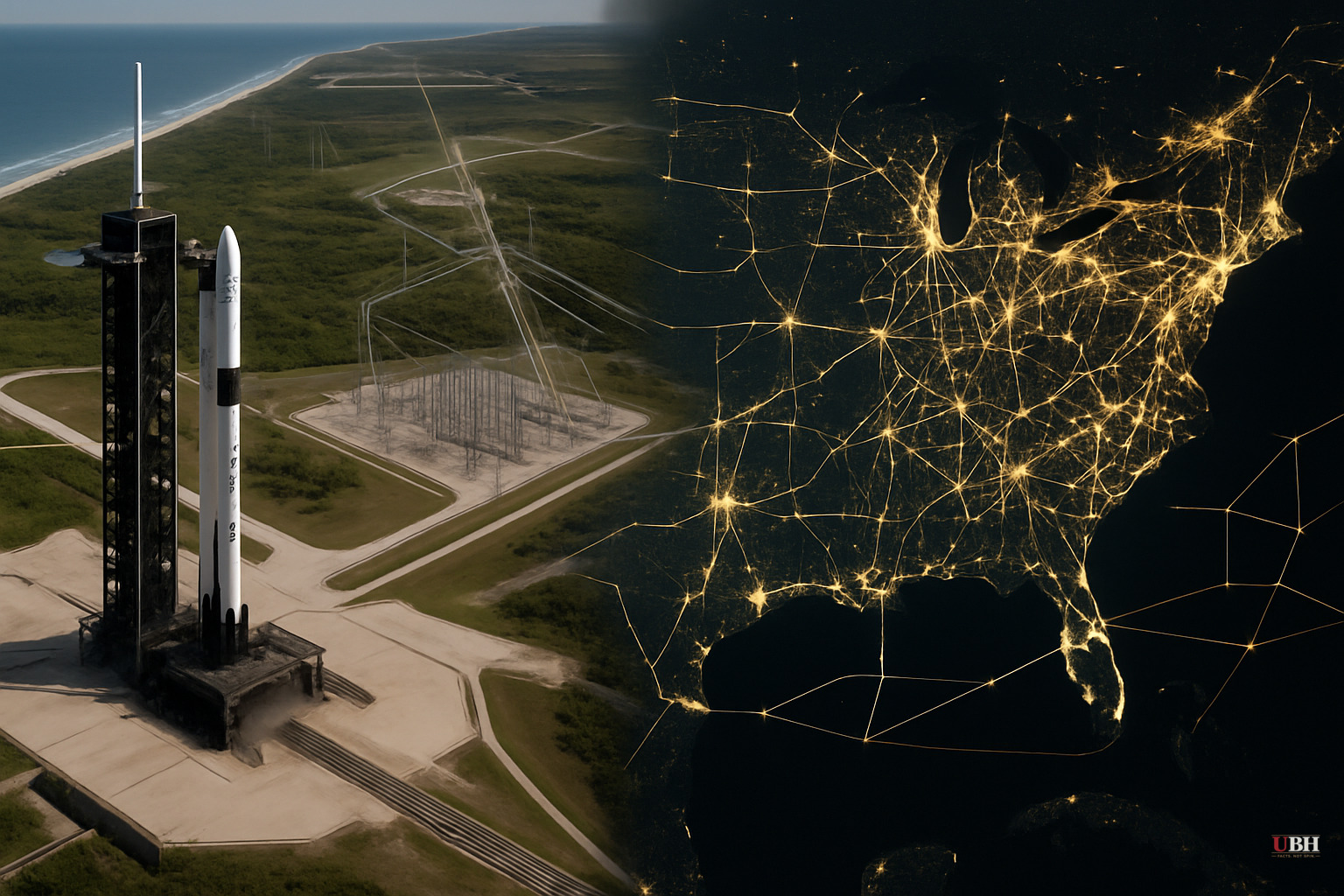
The Grid Problem, In Numbers
Data centers drove roughly half of all U.S. electricity demand growth last year, according to Utility Dive. Power consumption is projected to hit record levels again in 2026. Goldman Sachs Research projects global data center power demand will surge up to 165% by 2030 compared to 2023 levels.
The grid was not designed for this. It was engineered for a world where electricity demand grew 1-2% per year with decades of advance notice. Now hyperscalers are requesting hundreds of megawatts on three-year timelines. Berkeley Lab found that more than 70% of grid interconnection requests in the United States are ultimately withdrawn because the grid cannot accommodate them, according to OilPrice.com.
A single ChatGPT query consumes roughly 10 times the energy of a Google search, according to OilPrice.com. Training the next generation of large language models requires a power draw equivalent to small cities. Industry forecasts put AI data center capital expenditure at approximately $5.2 trillion between now and 2030.
AI Eating Its Own Tail
Utility Dive reports that the energy development sector has a 13.6% AI adoption rate, one of the lowest across major industries. The sector most needed to solve AI's power problem is among the slowest to use AI itself to solve it.
Energy development is jurisdiction-specific. Permitting timelines vary by county. Interconnection queues are not standardized. AI trained on generic data fails precisely where local nuance matters most. Development pipelines that once carried 20 active sites now need to hold 80 to hit the same conversion rate, while headcount hasn't grown to match.
Teams using AI-assisted site search can define development criteria, including acreage, voltage requirements, and distance to transmission, and get a ranked site list in minutes. A 500-site candidate list can be triaged to a focused shortlist before a human has to touch it. The firms closing ground on this are doing so through proprietary, regularly updated data layers, not generic models.
The SpaceX Option
The terrestrial bottleneck is part of what is pushing serious capital toward a different answer: orbital data centers.
Following SpaceX's IPO, which CNBC reports raised $85.7 billion and valued the company in the trillions, Elon Musk's interconnected infrastructure now has the capital to pursue what had previously been a speculative engineering exercise. SpaceX has reusable Falcon rockets, Starlink satellites that are upgradeable, and xAI's appetite for compute. The IPO provides the capital to bind those components together.
In January 2026, SpaceX filed an application with the FCC for a constellation of up to one million satellites that would serve as the foundation for an orbital AI data center, according to CNBC. In March, at an event in Austin, Musk said space-based, solar-powered data centers will be more cost-effective than terrestrial ones within two to three years. "Increasing power on Earth becomes harder over time and more expensive over time," he said. "In space it becomes actually cheaper and easier over time."
Duncan Davidson, a partner at Bullpen Capital, told CNBC the week before the IPO that "the company comes down to data centers in space. That is the big, long-term play." His firm is not a SpaceX investor but holds an indirect interest in space startup Starcloud. He added that the economics are "marginal" right now.
The Case Against, Stated Fairly
Skepticism of orbital data centers has substantive grounds. Launch costs remain high. Starship, SpaceX's heavy-lift rocket that would make orbital infrastructure economically plausible at scale, is NOT yet operational. Musk has a documented history of missing his own timelines on major engineering programs. The FCC constellation application is a filing, not an approval. Latency issues, radiation hardening requirements, on-orbit maintenance, and thermal management in a vacuum are all unsolved at commercial scale. Davidson himself acknowledged the economics are currently marginal.
None of that makes the idea impossible. It means the timeline is genuinely uncertain and that anyone pricing SpaceX's orbital data center thesis into near-term financial models is working with large assumptions, not hard facts.
What Actually Drives the Math
The cost comparison that matters is not today's launch cost versus today's terrestrial construction cost. It is the trajectory of both. If terrestrial data center costs rise because land, water, power, and permitting get harder to secure, and if Starship does drive launch costs down significantly, the crossover point Davidson describes becomes real. The question is when, and whether SpaceX can execute before competitors or alternative terrestrial solutions close the gap.
For now, the energy sector's 13.6% AI adoption rate represents a more immediate and solvable problem than orbital compute. Berkeley Lab's finding that 70% of interconnection requests get withdrawn is a structural failure of terrestrial infrastructure planning. Whether the answer is faster permitting reform, new transmission investment, AI-accelerated development workflows, or eventually moving the compute to orbit, the demand curve is NOT waiting for any of them.
The unresolved question is whether the FCC will grant SpaceX's one-million-satellite constellation application, and on what timeline. That approval, or its denial, is the nearest concrete decision point that would tell investors and competitors whether the orbital data center race is real or still theoretical.
Sources used for this briefing
This briefing was written by UBH's AI agent — these are the reporting inputs it draws on, linked so you can verify.


