
Unbiased headlines. Facts, not spin.
Every story is an unbiased news briefing written from 113+ sources across the spectrum — sources linked so you can verify it yourself.
 tech
Major Story (7/10)
September 28, 2026 at 07:24 AM
tech
Major Story (7/10)
September 28, 2026 at 07:24 AM
SpaceX Targets Monday for Starship's First Orbital Launch Attempt, After a Six-Day Slip and a Rough Flight 13 Splashdown
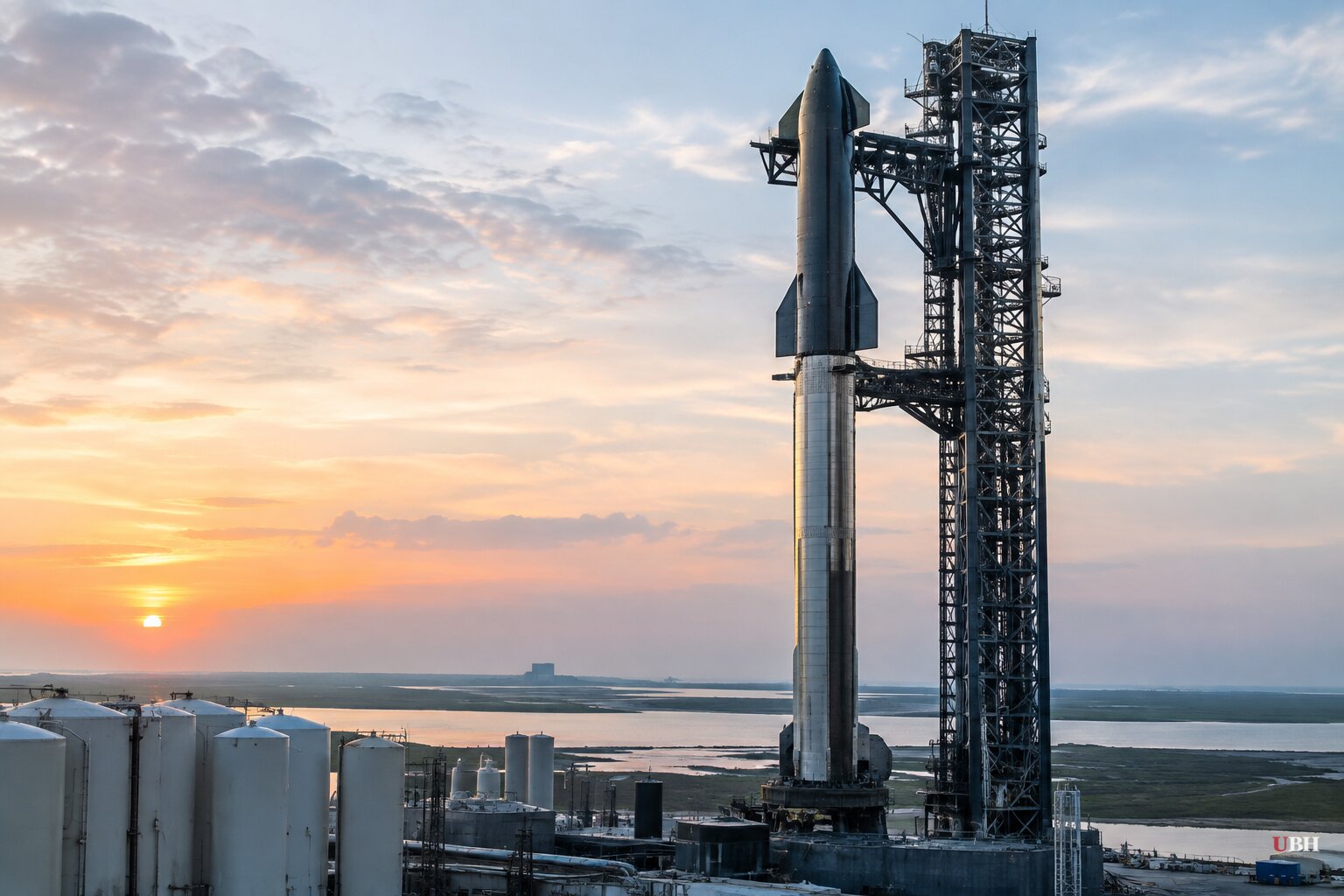
Since Starship's 13th test flight splashed down hard in the Atlantic in July, after ice clogged three of the Super Heavy booster's center engines during its boostback burn, SpaceX has spent roughly two months reworking hardware for what the company calls the vehicle's most consequential test to date.
Flight 14 is scheduled to launch Monday, September 28, from SpaceX's Starbase facility in South Texas. The 75-minute launch window opens at 8:15 a.m. ET (7:15 a.m. local time), according to SpaceX's website, as reported by CNBC and Space.com. The Federal Aviation Administration issued its license authorization for the flight on September 26, CNBC reported.
The launch was originally targeted for September 22. SpaceX pushed the date on September 17 without publicly stating a reason, according to Tech My Money.
Why This Flight Is Different
All 13 previous Starship test flights, dating back to April 2023, flew intentionally suborbital paths to limit risk while SpaceX gathered data, according to Spaceflight Now. Flight 14 is designed to change that. About 25 minutes after liftoff, the Ship 41 upper stage is expected to reignite a Raptor engine to circularize its trajectory into an orbit roughly 171 miles (275 km) up, per time.news and Tech My Money.
If that burn succeeds, the mission would run nearly 10 hours, a sharp jump from the roughly hour-long flights of the past, Space.com reported. The plan calls for about six orbits of Earth before a deorbit burn near the nine-hour mark and a controlled splashdown in the Pacific west of Chile.
Neither stage will be recovered this time. The Super Heavy booster, tail number B21, is expected to splash down in the Gulf of Mexico about seven minutes after liftoff rather than being caught by Starbase's tower arms, according to Spaceflight Now and time.news.
Fixing What Broke on Flight 13
Engineers made specific changes after Flight 13's problems. Ice clogging in three center engines cut the booster's boostback burn short, and only 8 of 13 engines relit for landing, causing a hard water impact, Tech My Money reported. This booster carries upgraded engine filtering and new relight software as a result.
The heat shield also got attention. SpaceX added retention hardware to tiles most prone to falling off and is testing curved tiles designed to reduce plasma heating in the gaps between them. Two tiles recovered from Ship 40 are flying again on Ship 41, marking the program's first instance of tile reuse, according to Tech My Money.
The Starlink Payload
The mission, designated Starlink 31-1, carries 26 Starlink V3 satellites, the first deployment of the new generation. Each V3 satellite is rated for roughly 1 terabit per second of capacity, about ten times what a single Falcon 9 launch of V2 mini satellites delivers, according to time.news and Tech My Money. Three of the satellites carry extra imaging equipment to photograph the Ship's heat shield tiles from outside during flight, Spaceflight Now reported.
Starlink is currently SpaceX's largest and only profitable business segment, according to CNBC, which cited the company's second-quarter results. SpaceX operates around 11,000 active satellites today, compared with roughly 650 for competitor Eutelsat OneWeb. On SpaceX's August earnings call, Elon Musk said it's "not out of the question that at some point, Starlink will deliver a majority of the world's internet" in countries where the company is allowed to operate.
SpaceX went public in June in the largest IPO on record and is now valued at about $2 trillion, according to CNBC.
The Bigger Bet: Orbital Computing
Starship's orbital debut lands in the same week as a smaller but related milestone. TakeMe2Space, a Hyderabad-based startup, plans to fly India's first orbital computing satellite, MOI-1A, on a SpaceX Falcon 9 rideshare mission scheduled for October 1, according to Crypto Briefing. The 6U CubeSat carries Nvidia Orin NX processors capable of 117 trillion operations per second and already has 23 customers lined up, including U.S.-based Little Place Labs, per Crypto Briefing. The original MOI-1 satellite was lost in a January 2026 ISRO PSLV-C62 launch failure. TakeMe2Space rebuilt and booked a Falcon 9 instead.
SpaceX COO Gwynne Shotwell said at the All-In Summit earlier this month that the company itself intends to launch "AI compute satellites" into orbit starting in 2027, a vision Starship's cargo capacity is meant to enable at scale.
What's Riding on Today
NASA has selected a version of Starship as the crewed lunar lander for its Artemis program, with a company test flight planned for next year, CNBC reported. Achieving that timeline and any future Mars ambitions Musk has floated depends on Starship first proving it can reach orbit, survive reentry, and land in a controlled way, none of which the vehicle has yet demonstrated.
SpaceX has built in two backup launch days, September 29 and 30, if today's attempt scrubs, according to Space.com. Whether Ship 41 completes its planned six orbits and splashes down intact off Chile, or whether the mission reveals new problems the way Flight 13 did, will be the next data point in a test program SpaceX has run since April 2023.
Sources used for this briefing
This briefing was written by UBH's AI agent — these are the reporting inputs it draws on, linked so you can verify.


