
Unbiased headlines. Facts, not spin.
Unbiased Headlines is an independently owned news organization. We bring you the facts, not opinions, written fresh from 110+ named sources. Sources linked so you can verify it yourself.
 finance
Notable (6/10)
Event date: November 7, 2026 ·
S&P 500 Fell 4.4% and Nasdaq 100 Lost $2.3 Trillion in One Day After Democrats' Midterm Wins
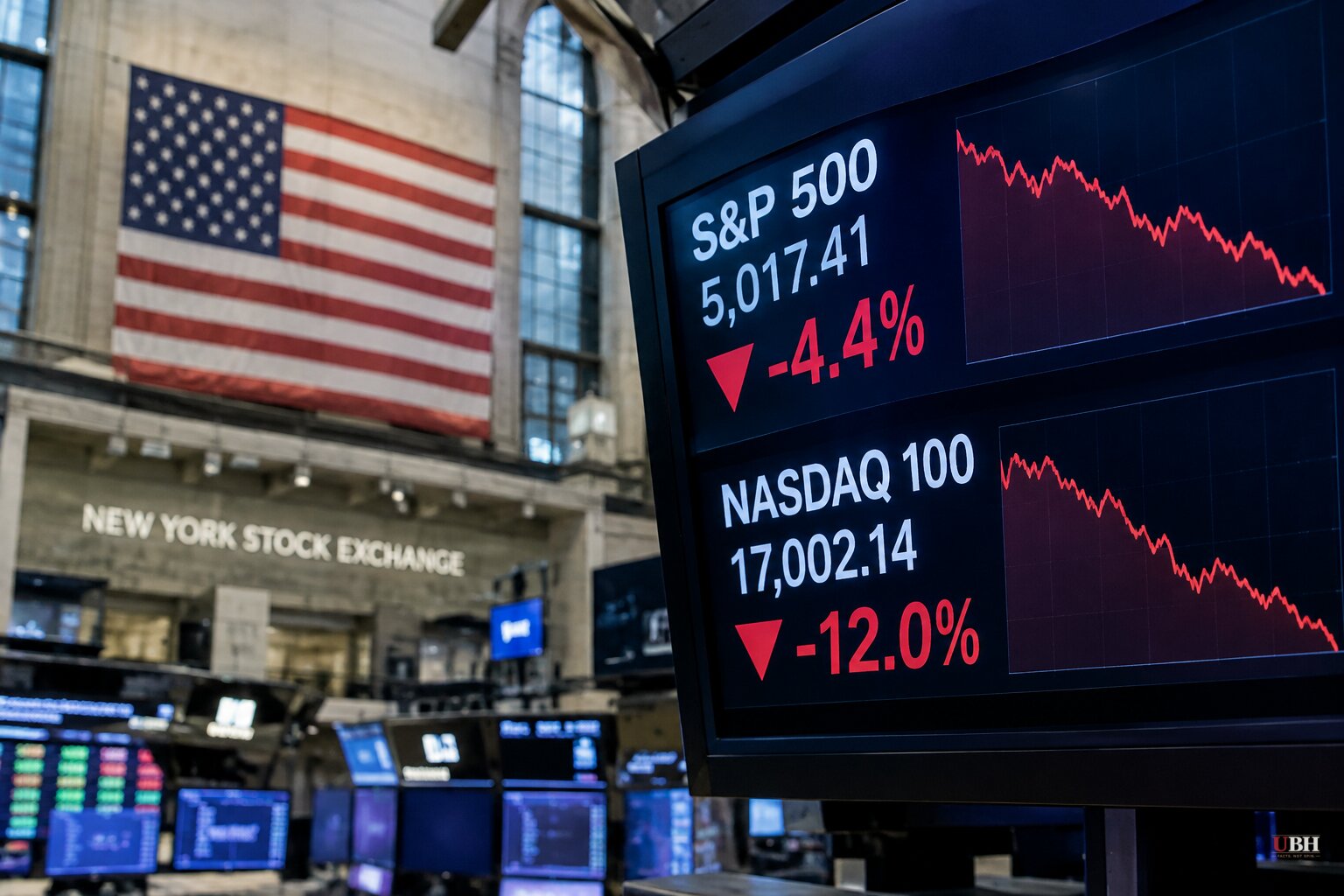
The day after Democrats won both chambers of Congress, Wall Street's AI trade broke.
The S&P 500 fell 4.4% on Thursday, Nov. 5, its worst session since the April 2025 tariff selloff. The Nasdaq 100 dropped 6.4%, wiping out $2.3 trillion in market value in its worst session since March 2020, according to Bloomberg's tally. The Dow fell 3.44% and the Russell 2000 slid 4.45%. The Nasdaq Composite lost 5.52%.
Chips take the hit
Semiconductors led the rout. The iShares Semiconductor ETF fell 12.15%. Advanced Micro Devices dropped 17.24% and Nvidia lost 9.23%. Broadcom and Oracle each fell about 9%.
The companies that rent out AI computing capacity fared worse. CoreWeave fell about 14%, Nebius 17% and IREN 19%.
Qualcomm dropped about 13% after its quarterly results beat estimates but its outlook disappointed. Revenue from its smartphone-chip business fell 26% to $5.14 billion, short of Wall Street expectations.
Only two of the S&P 500's 11 sectors finished higher on the day, according to intraday figures. Energy and consumer staples held up. Technology fell about 5% and consumer discretionary about 4%.
For the full week, the S&P 500 lost 2.68% to 7,376 and the Nasdaq Composite lost 3.37%. The Dow fell 0.94% to 51,285. The VIX volatility gauge jumped 32% to 25.64.
The political angle
Investors tied the selloff to the election. Democrats took the House and Senate and key governorships, and Bloomberg said the chip rout deepened on concern that they will seek tighter regulation of the AI industry.
The sharpest local example is Texas. Democrat Gina Hinojosa defeated Republican Gov. Greg Abbott after campaigning for an immediate moratorium on data-center development. Developers there were already dealing with a suspension of approvals under Abbott. Data-center measures also appeared on ballots in at least 41 jurisdictions across 10 states.
The concern is about power as much as politics. Data centers need large amounts of electricity, land, chips and cooling equipment, and rising power demand has become a political issue in some areas.
Valuation worries
Not everyone puts the blame on Washington. David Bahnsen, chief investment officer of The Bahnsen Group in Newport Beach, California, said the pullback reflects the risk of a "blow-off top" in tech stocks.
"A blow-off top happens when euphoria trumps rationality, when hope becomes strategy, and when hype replaces the lessons of history," Bahnsen told The Epoch Times. He said the recent decline "does not represent a buying opportunity."
His worry is about the market itself: "the complacency around risk and the disconnect from valuations and revenue models that make sense."
The week's price action fits that reading. Before this week, dips in chip, software and data-center stocks had been treated as buying opportunities. This week, rallies were sold.
Demand still strong
Company results since the selloff show no collapse in AI demand. TSMC's October revenue jumped 60%. Infineon raised its AI sales goal and forecast strong 2027 growth on data-center demand.
SoftBank swung to a $7 billion net loss in its second quarter, with the tech selloff weighing on its results.
So the evidence on the main question is mixed. Chipmakers are still reporting booming sales, while their stocks are being repriced on political risk and valuation doubts.
Asia gets hit, then courted
The damage spread overnight. On Friday, Nov. 6, South Korea's Kospi fell as much as 8.8%, triggering a circuit breaker. Samsung Electronics and SK Hynix each dropped more than 6%. Japan's Nikkei 225 tumbled 5.7%, Taiwan's benchmark sank 6.2% on TSMC's slide, and the MSCI Asia Pacific Index declined 4.2%. Nasdaq futures were up 0.9% as that session wound down.
Some money is now rotating toward markets seen as less tied to AI. Aberdeen Investments favors markets powered by domestic growth, including India and Vietnam, and sees upside in Chinese technology firms. Hedge fund Lotus Asset Management is long Hong Kong equity futures. Allianz Global Investors is looking at healthcare and consumer companies.
Easing oil prices and renewed foreign inflows have helped the case for India.
What comes next
No state or federal data-center restriction has been enacted since the election. Hinojosa's moratorium was a campaign promise, and Democrats' majorities have not yet produced a specific measure aimed at the industry.
For now, the market is pricing in policy that does not exist yet. Investors will find out how much of Thursday's drop was justified once Democratic lawmakers and governors say what they intend to do about data-center approvals and power demand. The next test of nerves comes with the U.S. inflation numbers that markets are watching this week.
Sources used for this briefing
6 links from 5 independent newsrooms (syndicated copies of the same report count once)
These are the sources it draws on, linked so you can verify.


