
Unbiased headlines. Facts, not spin.
Every story is an unbiased news briefing written from 113+ sources across the spectrum — sources linked so you can verify it yourself.
 economy
Major Story (7/10)
Event date: September 1, 2026
economy
Major Story (7/10)
Event date: September 1, 2026
South Korea's Exports Hit Record $120.94 Billion in September on AI Chip Boom
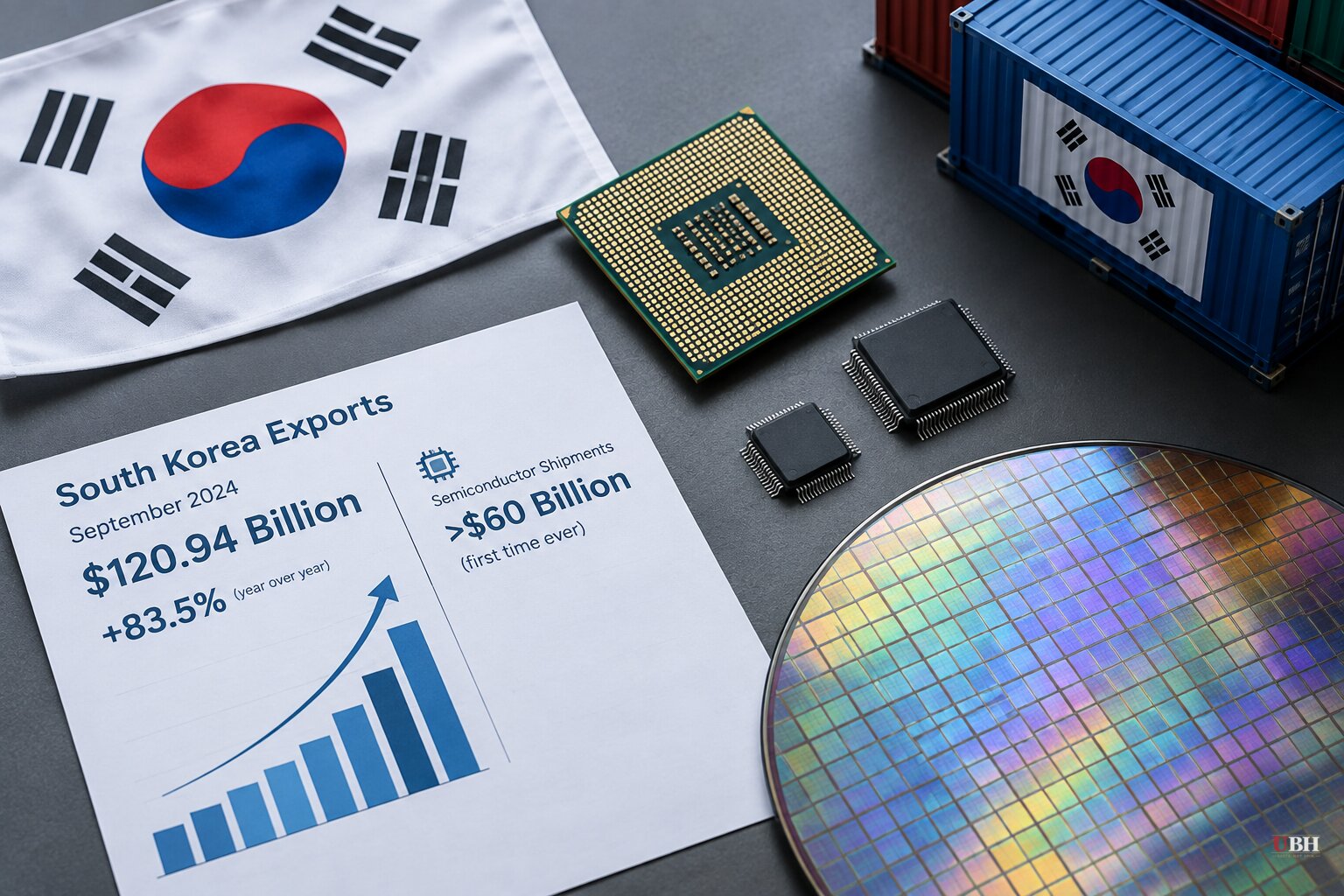
South Korea's Ministry of Trade, Industry and Energy released its September 2026 trade figures on Thursday. Exports hit $120.94 billion last month, up 83.5% from a year earlier, according to the ministry. That's the first time Korea has ever cracked $120 billion in a single month, and it extends a growth streak that's now run 16 consecutive months, as reported by Crypto Briefing.
Imports rose too, climbing 26.0% to $71.09 billion. But exports grew more than three times faster, leaving Korea with a $49.85 billion trade surplus for the month, the largest in the country's history and the first time it's ever cleared $40 billion, according to Chosun Biz.
Chips Are Doing the Heavy Lifting
Semiconductors are the whole story here. Chip exports jumped 262.8% year over year to $60.3 billion, according to the trade ministry's report. That's the first time any single export category has topped $60 billion in a month, and it blew past the previous record of $46.7 billion set just one month earlier in August, Chosun Biz reported.
Semiconductors now make up nearly half of everything South Korea sells abroad. The ministry attributed the surge to sustained growth in memory chip demand, higher export volumes, and rising contract prices, driven by the buildout of AI data centers and server farms worldwide.
Computer exports told the same story from a different angle, rocketing 435.3% to $7 billion, fueled by demand for servers and infrastructure tied to agentic AI systems, software built to carry out multistep tasks on its own, according to the Straits Times.
The presidential office said back in July that Samsung Electronics and SK hynix, the country's two memory-chip giants, had struck agreements worth $950 billion to supply U.S. tech companies, including Nvidia, Agence France-Presse reported via the Straits Times and Free Malaysia Today.
The Numbers Aren't Limited to Chips
Exports excluding semiconductors still rose 23%, indicating growth beyond a single industry. Cosmetics hit an all-time monthly high of $1.51 billion, up 31.4%. Ship exports climbed 29.9% to $3.76 billion on stronger deliveries of LNG carriers. Petroleum products jumped 72.0% to $7.22 billion, partly on higher global oil prices, according to Chosun Biz.
Automobiles were the one notable laggard, falling 5.5% to $6.05 billion, which the ministry blamed on a base effect from the shifting Chuseok holiday calendar and weaker used-car exports.
Geographically, the growth is heavily concentrated in two places. Exports to China rose 122.7% to $26.01 billion, the fourth straight month above $20 billion. Exports to the United States rose 137.0% to $24.33 billion. ASEAN exports topped $20 billion for the first time, up 92.6% to $21.29 billion, and EU exports rose 20.9% to $8.65 billion, marking ten consecutive months of gains, according to Chosun Biz.
The one region moving backward was the Middle East, where exports fell 14.1% to $1.6 billion. The ministry attributed that drop to difficulties transiting the Strait of Hormuz, a reminder that Gulf shipping disruptions are already showing up in Korean trade data even as the broader export machine runs hot.
Cumulative Numbers Already Beat Last Year
Total exports from January through September reached $814.5 billion, already surpassing all of 2025's $709.3 billion full-year total, with a quarter still left on the calendar, according to the Straits Times and Chosun Biz. Average daily exports, adjusted for working days, rose 105% to $5.63 billion, the first time that figure has topped $5 billion.
Trade Minister Kim Jung-kwan called the results proof of the "strength of our industries and companies" and said annual exports of $1 trillion are now within reach, according to AFP reporting carried by the Straits Times and Free Malaysia Today. But he also flagged real risk ahead: "the strengthening of global protectionism and tensions in the Middle East remain major variables for our exports," Kim said, per Chosun Biz, adding that the government would respond preemptively to external shocks through the fourth quarter.
A reasonable skeptic would point out that a trade machine this dependent on two customers, China and the U.S., and one product category, memory chips, is one tariff decision or one export-control shift away from a very different headline. Kim's own warning about protectionism suggests Seoul knows that too. Whether South Korea actually crosses $1 trillion in annual exports this year, or whether Middle East shipping disruptions and great-power trade tension cut that streak short, will show up in the ministry's next few monthly reports.
Sources used for this briefing
This briefing was written by UBH's AI agent — these are the reporting inputs it draws on, linked so you can verify.


