
Unbiased headlines. Facts, not spin.
Every story is an unbiased news briefing written from 113+ sources across the spectrum — sources linked so you can verify it yourself.
 economy
Major Story (7/10)
Event date: September 21, 2026
economy
Major Story (7/10)
Event date: September 21, 2026
G20 Trade Ministers Close Out Milwaukee Summit as Greer Claims China Trade Deficit Fell 40%
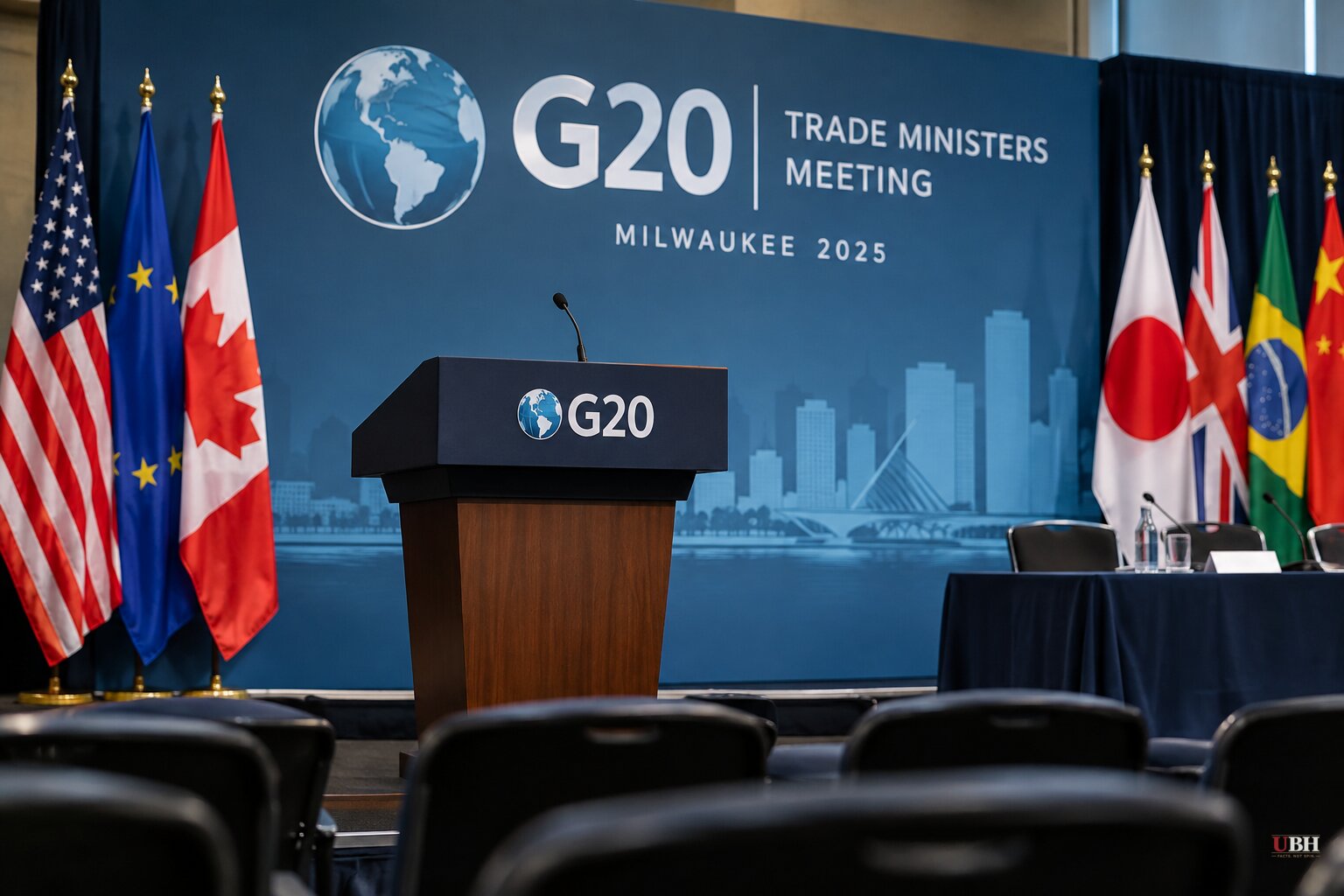
Since G20 finance ministers met in Asheville earlier this month and got every member but China to agree on fighting "non-market" trade distortions, the follow-up fight moved to trade ministers in Milwaukee. The two-day ministerial opened Wednesday, September 30, and closes today, October 1, with a scheduled press conference from U.S. Trade Representative Jamieson Greer and a closing reception at the Harley-Davidson Museum.
Greer used his Wednesday opening remarks to push three things: eliminating forced labor from supply chains, tackling industrial overcapacity, and rewriting the Most Favored Nation principle that has anchored the World Trade Organization since the end of World War II, according to Reuters. MFN requires members to treat all trading partners equally on tariffs. Greer argued it "constrains economies' ability to effectively respond to distortive policies," which is diplomatic language for saying the old rules box in Trump's tariff strategy.
Greer also claimed a win on the numbers. In a Fox Business interview, he said the U.S. goods trade deficit with China is down more than 40% since Trump's tariff program took effect, crediting "active economic policies." That's Greer's figure, from Greer, not independently verified by Fox or anyone else in these reports. Commerce Department trade data for the relevant months will eventually provide a check on the claim.
A Steel Coalition, Minus China
The most concrete outcome from Wednesday was a side deal, not a G20 consensus. A group of 28 mostly Western countries, operating through the OECD-led Global Forum on Steel Excess Capacity, agreed on the sidelines to work toward more tariffs on steel from China and other countries driving excess production, according to Reuters. China is a G20 member but was not part of that coalition, and it has repeatedly rejected the overcapacity accusation as protectionist cover.
China says its industrial policy reflects normal scale and efficiency, and that Western tariffs are using "overcapacity" as an excuse to protect uncompetitive domestic industries. Washington and its allies say years of underpriced Chinese steel, solar panels, and EVs have gutted manufacturing jobs in the U.S. and Europe. Both claims can be checked against trade flow data, and neither side has fully proven its case in these reports.
Allies Push Back, Quietly
Poland's Finance Minister Andrzej Domanski, attending as an invited guest since Poland isn't a permanent G20 member, told reporters "tariffs are bad for companies, are bad for customers and of course are increasing inflation." Domanski also pressed Washington to honor its existing 15% tariff cap deal with the EU.
Canada skipped the fight entirely and worked the hallways instead. International Trade Minister Maninder Sidhu told CBC News that Canada's non-U.S. trade rose 17%, or $33 billion Canadian, over the past year, and that nearly a third of Canadian exports now go outside the United States, the highest share in four decades. CBC framed the whole summit as ministers "discussing deals without their U.S. host" while Canada advances a separate trade push with India and an enhanced free trade agreement with the EU. Breitbart and Fox Business largely left out Canada's diversification numbers, focusing instead on Greer's defense of the U.S. position and the forced-labor and overcapacity agenda.
What's Unresolved
Greer told reporters the administration will "certainly take into account" existing tariff-cap deals with the EU, Japan, and South Korea when the overcapacity investigation report comes out, according to Reuters. He did not commit to exempting those countries from new duties. Wendy Cutler of the Asia Society Policy Institute said some delegations would "mince no words" about feeling unfairly targeted by the overcapacity probe despite having struck deals with Washington.
On Canada specifically, Greer told reporters a bilateral deal "is not urgent" for the U.S., adding only that "eventually, it will happen." No timeline was given. The Supreme Court struck down Trump's country-specific tariffs back in February, leaving the sectoral tariffs on steel, aluminum, and other goods intact, and that split remains the legal backdrop for every negotiation happening in Milwaukee. Whether Greer offers any firmer commitment on the overcapacity report's findings at Thursday's closing press conference remains to be seen.
Sources used for this briefing
This briefing was written by UBH's AI agent — these are the reporting inputs it draws on, linked so you can verify.


