
Unbiased headlines. Facts, not spin.
Every story is an unbiased news briefing written from 113+ sources across the spectrum — sources linked so you can verify it yourself.
 economy
Notable (6/10)
September 30, 2026 at 07:53 PM
economy
Notable (6/10)
September 30, 2026 at 07:53 PM
Ford CEO Jim Farley Warns US Not to Repeat Europe's Chinese EV Mistake, Even as Ford Deepens Its Own China Ties
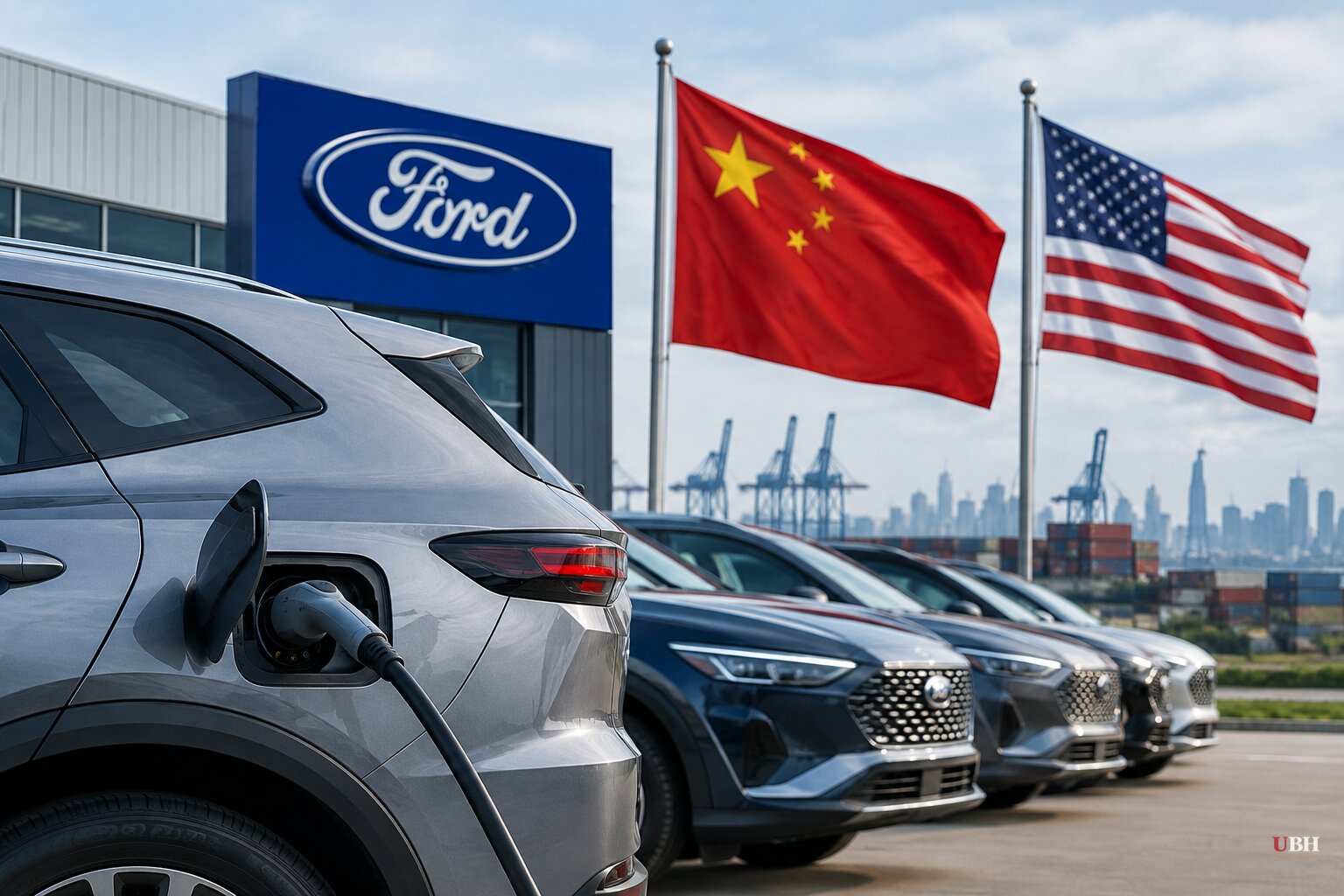
Since Transportation Secretary Sean Duffy sent Ford a letter on September 3 questioning the automaker's expanding ties to Chinese companies, the tension between Ford's global strategy and Washington's protectionist posture on China has been simmering in public view. Ford CEO Jim Farley addressed that tension Tuesday at the Automotive News Congress in Detroit, arguing the United States needs to move deliberately on Chinese automaker access before it's too late.
"As far as here in the United States, I think it's important for us to take our time to be considerate," Farley told the audience, according to the Epoch Times. "I watch what's happening in Europe right now, where that was not the case, and it's really something that they have to deal with now, and it's too late."
Farley's concern wasn't just economic. "These vehicles can drive themselves. They can take videos of everything," he said. "For your national security alone, it's critical that we think about how do we find the right balance."
The Numbers Behind the Warning
Farley's Europe comparison has data behind it. Automotive research firm JATO projects Chinese brands will top 1.3 million vehicle registrations in Europe in 2026, up from just over 50,000 in 2020. That's a roughly 26-fold jump in six years, with essentially no equivalent tariff wall to slow it down.
The U.S. currently maintains 100 percent tariffs on Chinese vehicle imports, a policy Farley credited with limiting China's dominance in materials used for domestic auto production. Farley called Chinese industrial growth "not just growth," but "industrial acceleration on a scale Europe has never experienced before."
The Awkward Part: Ford's Own China Bets
Farley's caution rings differently given Ford's own recent moves. In July, Ford announced a deal to jointly develop electric vehicles with Chinese automaker Geely for the European market. Ford also holds a limited technology-licensing and services agreement with CATL, the Chinese battery giant.
Duffy's September 3 letter raised these very partnerships. "While DOT recognizes the intense competitive pressures of the global market, the company's recent strategic decisions paint a troubling picture of a foundational American brand actively intertwining its future with Chinese state-backed enterprises," Duffy wrote, citing risks to manufacturing integrity, supply chain exposure, and reliance on technology from a foreign adversary.
Ford didn't take the letter quietly. The company called it a "wrongheaded attempt to capture headlines" and reiterated its support for the Trump administration's manufacturing and innovation agenda, pointing to its BlueOval Battery Park investment in Michigan as evidence of its American commitment.
Farley defended the dual-track approach directly on Tuesday. He said Ford will partner with Chinese companies "when the situation is capital-efficient and in areas where the automaker lacks expertise," while also competing with them head-on elsewhere. "Both can be totally fine," he said. "They aren't mutually exclusive."
The Case for Ford's Approach
There's a reasonable argument on Ford's side here. Chinese firms like CATL have a genuine technological edge in battery chemistry and cost, and locking American automakers out of that expertise entirely could leave U.S.-made EVs more expensive and less competitive globally, not less exposed to China. A licensing deal that brings battery know-how into a Michigan plant, built and staffed by American workers, is a different animal than importing finished Chinese vehicles duty-free. Farley's framing, that competing and partnering aren't mutually exclusive, reflects how most global manufacturers already operate.
But Duffy's underlying worry isn't fringe either. Connected vehicles that can be updated remotely, track location, and record video represent a genuinely different security exposure than a 1990s import competing on price and reliability. That's a real, unresolved policy question the existing 100 percent tariff wall doesn't fully answer, since it targets finished vehicles, not the software, batteries, or joint-venture technology embedded inside cars built domestically.
No investigation, penalty, or formal regulatory action against Ford has been announced by DOT or any other federal agency as of this writing. Duffy's letter is a warning, not a legal action, and Ford has not altered its Geely or CATL arrangements in response. Whether the Trump administration moves beyond letters to actual restrictions on U.S. automakers' China partnerships, and whether Congress weighs in with its own legislation, remains the open question hanging over Farley's Detroit remarks.
Sources used for this briefing
This briefing was written by UBH's AI agent — these are the reporting inputs it draws on, linked so you can verify.


