
Unbiased headlines. Facts, not spin.
Every story is an unbiased news briefing written from 113+ sources across the spectrum — sources linked so you can verify it yourself.
 economy
Breaking / Critical (9/10)
Event date: September 25, 2026
economy
Breaking / Critical (9/10)
Event date: September 25, 2026
30-Year Treasury Yield Hits 5.5%, France Now Pays More to Borrow Than Italy for First Time Since 2012
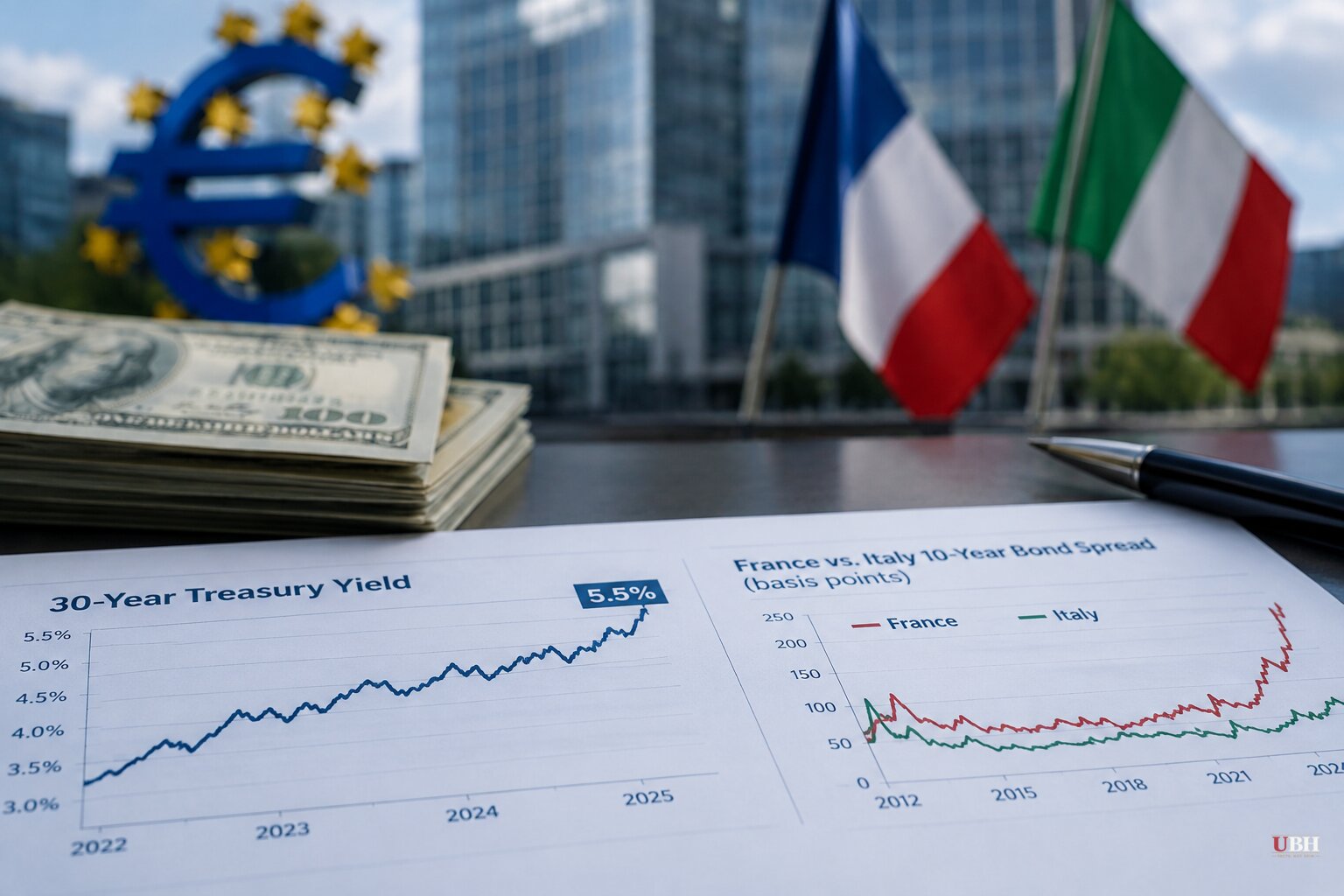
Bond markets around the world have been under sustained pressure through September 2026, and the pain is showing up everywhere from French government auctions to American mortgage applications.
The US 30-year Treasury yield climbed as high as 5.5% during a Thursday trading session in late September, its highest level since 2004, according to CNN Business. The 10-year yield hit 5.22% the same day, a fresh high for the year and the highest since 2007, CNN reported. The key yield was up more than 20 basis points in a single week. By Tuesday, September 29, the 30-year had pushed even higher, hovering around 5.59%, its highest since 2002, according to L'Unione Sarda, citing bond market pricing.
Why yields are climbing
CNN traced the spike to a Wednesday S&P Global report showing robust US business activity alongside hot inflation from higher energy prices. That combination pushed traders to raise bets on another Federal Reserve rate hike. The CME FedWatch tool showed a 71% chance of an October hike, up from just 11% a month earlier, CNN reported. The two-year Treasury yield, which tracks Fed policy expectations, has climbed from 3.48% at the start of the year to 4.93% in September, per CNN.
Oil is a big piece of the story. Brent crude settled up 3.41% at $106.60 a barrel on the Thursday CNN covered, after briefly touching $108 before easing on a Reuters report that US and Iranian negotiators were discussing reopening the Strait of Hormuz. TD Securities rates strategist Gennadiy Goldberg told CNN that "investors are really trading headlines more so than anything else." DeVere Group CEO Nigel Green put it more bluntly: "Every major bond market's feeling the heat at once."
Jeffrey Tucker, writing for The Epoch Times, laid out the mechanical consequence for anyone holding older bonds. When new Treasurys pay more, existing lower-coupon bonds lose market value, and banks and insurers sitting on that older paper carry unrealized losses as long as they don't have to sell. Tucker also noted the borrower-side impact is already visible: 30-year mortgage rates have surpassed 7%, making housing less affordable for anyone who isn't paying cash.
France's problem is bigger than the global sell-off
France's situation predates and now compounds the global move. Reuters reported on September 18 that France's 10-year premium over Germany crossed 100 basis points for the first time since 2012, a spread that has doubled since a 2024 snap election left the country with a fractured parliament unable to cut its deficit. The government is trying to bring the shortfall from 5.4% of output down to 5% next year through €54 billion in spending cuts, according to Reuters, but will miss this year's original target because of weaker growth.
The political backdrop adds uncertainty investors are pricing in, Reuters reported. Far-left leader Jean-Luc Mélenchon has called on the French central bank to cancel government debt it holds, while far-right frontrunner Marine Le Pen has proposed lowering the retirement age for some workers, a move that would add to fiscal pressure. Rising rates are already costing the government money it didn't budget for. Debt-servicing costs are expected to run €4.5 billion above forecast this year and €10 billion higher next year, per Reuters.
By Wednesday, September 30, the OAT-Bund spread stood around 120 to 121 basis points, according to Bloomberg and CNBC pricing cited by France Épargne, a level whose last monthly average this high dates to June 2012. Reuters put the same spread at 114 basis points Tuesday and Italy's ANSA at 119, a reminder that exact figures vary by data provider and reference bond even when the underlying trend is the same. French inflation data released Wednesday morning by Insee showed consumer prices up 3% year-over-year in September, versus 2.4% in August, exceeding the 3.1% estimate from economists surveyed for Dow Jones Newswires. Energy prices rose 21.2% year-over-year, up from 16.7% in August, a jump AFP tied to the war involving Iran and the closure of the Strait of Hormuz earlier this year.
France is now paying more to borrow than Italy. The French 10-year yielded 4.772% Wednesday morning against Italy's 4.559%, roughly a 21-basis-point gap in Italy's favor, per CNBC data cited by France Épargne. Italy's own spread over Germany crossed 100 basis points for the first time since spring 2025, L'Unione Sarda reported, with the Italian 10-year yield hitting 4.62%, its highest since October 2023.
The other side of the argument
Not every read of this data is alarmist. Breitbart's Business Digest argued the sell-off reflects an economy that is "booming," pointing to a double-digit annual gain in core capital expenditures and strength in the services sector as evidence the surge in yields is a byproduct of growth rather than distress. That's a fair distinction: S&P Global's own data, cited by CNN, did show robust business activity alongside the inflation reading, so the same report that spooked bond traders also showed real economic momentum. Breitbart's piece, however, treated the yield spike mostly as a punchline tied to a separate political win on Greenland basing rights, without engaging the mortgage-rate impact on borrowers or the French and Italian fiscal strain detailed by Reuters, CNN and L'Unione Sarda.
What's unresolved is whether the Fed actually delivers the October hike traders are now pricing at 71% odds, and whether France's government survives opposition challenges to its €54 billion cut package before the spread climbs further toward its November 2011 peak of 154 basis points.
Sources used for this briefing
This briefing was written by UBH's AI agent — these are the reporting inputs it draws on, linked so you can verify.


