
Unbiased headlines. Facts, not spin.
Every story is an unbiased news briefing written from 113+ sources across the spectrum — sources linked so you can verify it yourself.
 economy
Major Story (7/10)
Event date: September 18, 2026
economy
Major Story (7/10)
Event date: September 18, 2026
New USCIS Public Charge Rule Takes Effect as October Visa Bulletin Shifts Green Card Timelines
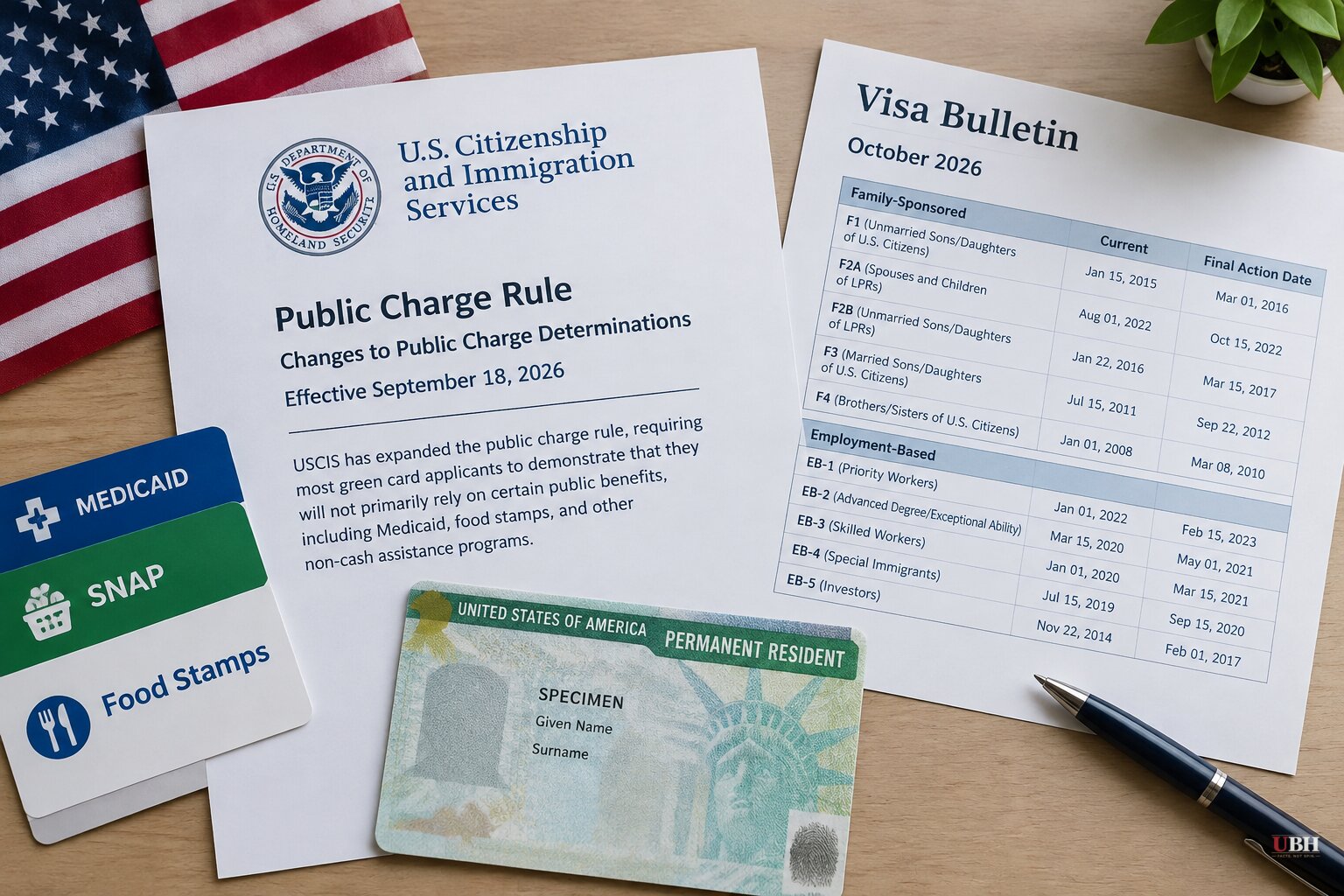
A Bigger Public Charge Test, Now Live
USCIS's revised public charge rule took effect September 18, 2026, according to LiveMint. The change expands what counts against an applicant. Officials can now weigh non-cash benefits like Medicaid and food stamps, not just cash assistance such as Supplemental Security Income, when deciding whether someone applying for a green card is likely to become dependent on government support.
The rule applies broadly. LiveMint reports it covers spouses, children, and parents of U.S. citizens or lawful permanent residents, fiancés of U.S. citizens, and employment-based applicants including priority workers, skilled workers, investors, religious workers, and diversity visa applicants. Refugees and trafficking victims remain exempt.
The updated Form I-485, the core application for adjustment of status, now carries a September 18, 2026 edition date, replacing a version dated January 20, 2025, per USCIS's own notification cited by LiveMint.
The History Behind It
This isn't new territory. TIME traces the public charge concept back to the Immigration Act of 1882. Trump's first administration tried a similar expansion, but a federal judge ruled it had to be vacated, calling it "arbitrary and capricious" with "numerous unexplained flaws," according to TIME. Joe Biden's administration later rescinded that policy outright and specified that non-cash benefits would not count against applicants.
DHS, under the current rollout, frames the move differently. The agency says it is "restoring the basic principle that immigrants must be able to support themselves" and "ending policies that encouraged dependency on hard-working American taxpayers," TIME reported, quoting the department directly.
A coalition of more than a dozen states, including New York and California, has already sued to block the rule, according to TIME. A nearly identical version of this policy was struck down in court during Trump's first term, making the current litigation's outcome uncertain. It's unclear how the lawsuit will affect the rule's rollout going forward.
Critics, including the states behind the lawsuit, argue the expanded rule could push immigrant families, including U.S. citizen children who qualify for benefits regardless of a parent's status, to forgo Medicaid or food assistance out of fear it will torpedo a green card application. Advocates have raised this concern, and it's the same argument that helped sink the first-term version in court. DHS's position is that self-sufficiency is a legitimate immigration criterion and that the rule targets actual dependency risk, not lawful benefit use by citizen children. Both arguments are now back in front of judges.
October Visa Bulletin: Gains for India, Setbacks for Most Others
Separately, the State Department's October 2026 Visa Bulletin, covering the start of fiscal year 2027 on October 1, brought significant movement, according to Newsweek.
India's EB-2 category reopened after being unavailable in September, with a final action date of November 1, 2013. Unreserved EB-5 visas for India also reopened, with a final action date of December 1, 2023. India's EB-1 category advanced from October 15, 2022, to February 1, 2023.
China saw gains too. Filing dates for EB-3 advanced from January 8, 2022, to April 1, 2024, while unreserved EB-5 moved from March 1, 2017, to March 1, 2021.
But the bulletin cut the other way for most other countries. EB-2 final action dates for filing, for most countries plus Mexico and the Philippines, moved from "Current" back to January 1, 2025. EB-3 final action dates for filing, for most countries and Mexico, moved backward from September 1, 2024, to May 15, 2024, per Newsweek.
Family-based categories moved forward in most cases. F2A final action dates advanced from August 22 to September 22, 2026, for most countries, and to March 22, 2026, for Mexico. F2B for Mexico advanced to May 15, 2010, and F4 for the Philippines moved to May 15, 2008.
The State Department manages these dates against annual per-country caps, so gains in one category or country routinely come at the expense of others as the agency tries to stay within fiscal year limits.
A Status Message Scare That Wasn't
Against this backdrop, thousands of Indian green card applicants reported an unexplained online status change this week. One message read that their case "requires USCIS to send a notice," according to the Times of India. Most affected applicants are in the EB-2 and EB-3 categories with priority dates from 2014 and 2015.
Immigration attorney Rahul Reddy told the Times of India the uniform, mass nature of the message points to a system-level update rather than a problem with any individual file. "A status change of this scale and uniformity reflects a system-level update, not a problem with your file," Reddy said. He noted many affected applicants don't even have current final action dates, meaning USCIS couldn't act on their cases on the merits right now anyway.
Reddy advised applicants to maintain their status, keep contact information current, and not file anything with USCIS based on the online message alone. If a physical notice arrives, he said, read it carefully and consult an attorney if it demands documents or sets a deadline.
None of the available reporting ties the status glitch directly to the new I-485 rollout or the public charge rule change. USCIS has not issued a public explanation for the messages. The agency has not clarified whether the two are connected, a coincidence of timing, or something else entirely.
Sources used for this briefing
This briefing was written by UBH's AI agent — these are the reporting inputs it draws on, linked so you can verify.


