
Unbiased headlines. Facts, not spin.
Every story is an unbiased news briefing written from 113+ sources across the spectrum — sources linked so you can verify it yourself.
 economy
Notable (5/10)
Event date: September 24, 2026
economy
Notable (5/10)
Event date: September 24, 2026
Seattle Paid Violence Prevention Groups Millions With No Way To Check If It Worked
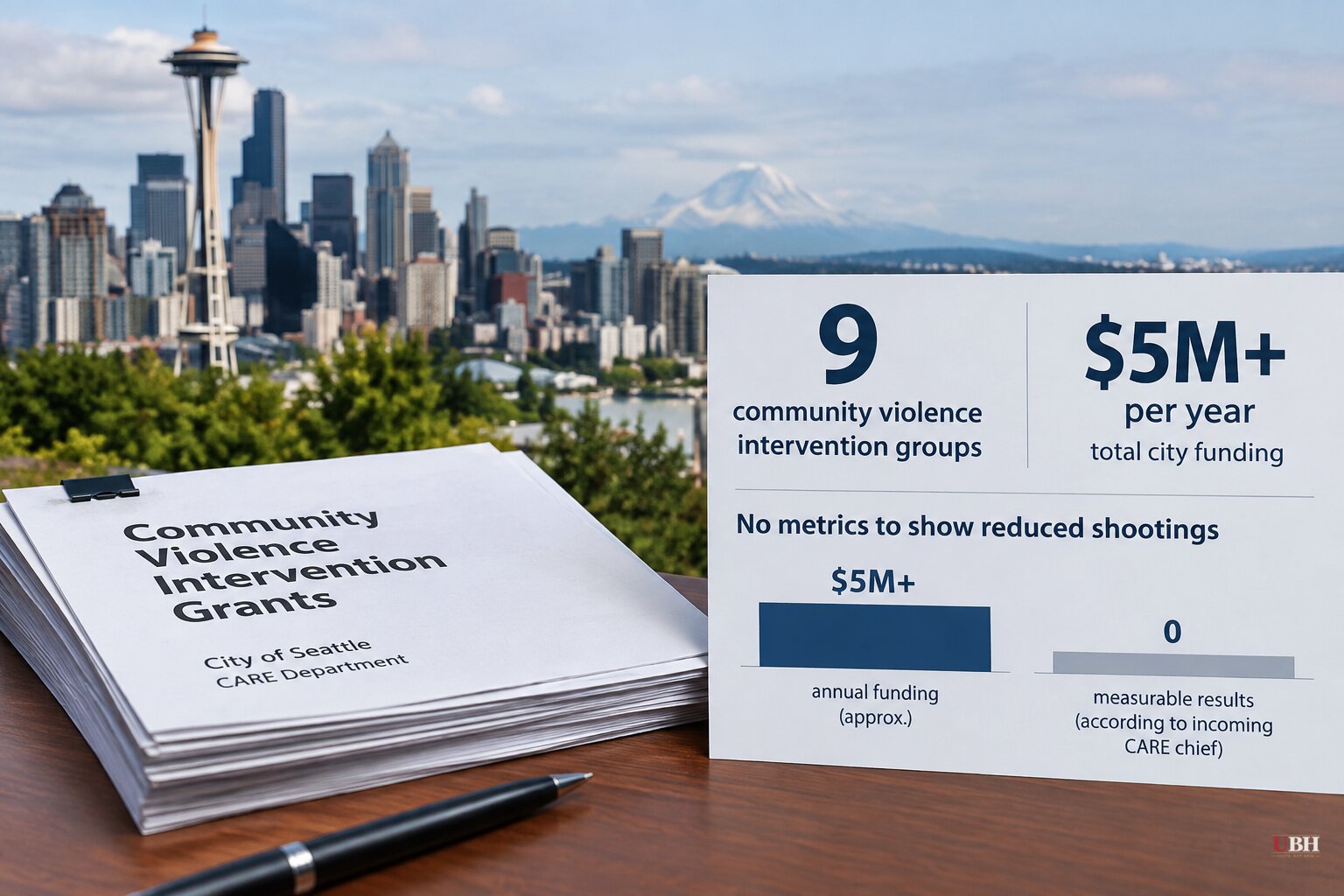
Seattle's Human Services Department spent $58.8 million in 2024 on violence prevention, community safety and crime survivor support, according to figures cited by Seattle Red. For years, nine community violence intervention (CVI) organizations received a piece of that money to try to stop shootings before they happen. Nobody at the city, it turns out, had a reliable way to check whether it worked.
That's according to Amy Barden, chief of Seattle's Community Assisted Response and Engagement (CARE) Department, who is about to inherit those contracts. Mayor Katie Wilson's proposed 2027 budget moves more than $5 million a year in CVI contracts from the Human Services Department to CARE, the agency that also runs Seattle's 911 center. The transfer still needs City Council approval, and the contracts would not come under CARE until next year.
Asked why metrics weren't already in place, Barden told KTTH's Jason Rantz the problem was rushed contracting inside a department juggling too many competing priorities. "I think it was just hasty," Barden said. "You've got to remember they've got hundreds of millions of dollars of contracts, homeless response, all of these different really challenging societal issues. They're not necessarily expert in public safety issues or community violence interruption."
Her explanation for how the contracts got written in the first place combines political turnover with a lack of expertise. "There'll be a new elected in office, oh, we want to do CVI work, make some contracts, and you've got to have expertise to actually know what are those metrics," Barden said.
Pressed by Rantz on whether HSD tracked anything at all, Barden compared the arrangement to Seattle's Law Enforcement Assisted Diversion (LEAD) program, another effort long criticized for weak outcome data. "It's kind of on the honor system," she said, adding that she wants to see "directional improvement" from the groups and that a failure to show progress over several months should prompt a change in approach — or, in her words, a "coercive intervention."
A Gun Violence Plan With No New Cops
The contract shift is part of a broader city gun violence plan that, notably, does not add a single new police officer, according to Seattle Red's reporting. Instead, the strategy leans on the CVI groups, community-based organizations that provide conflict mediation, hospital-based support for gunshot victims at Harborview Medical Center, outreach after shootings, and intensive intervention for people considered most connected to gun violence, according to the mayor's plan.
Barden said groups unwilling to partner with police could lose their contracts once CARE takes over. "If they're not going to be willing to partner, then they can't really have the contracts, because that's the design of focused deterrence," Barden said, noting she set up the CARE pilot the same way in 2023. She said her husband, a longtime veteran of local law enforcement, had told her the model would fail in Seattle because nonprofits refuse to partner with police.
Seattle has been burned by the current setup before. The city paused its work with the Southeast Network, a violence intervention program, after its former executive director Marty Jackson was federally charged with allegedly laundering money for relatives prosecutors say led a fentanyl trafficking ring, according to KOMO News reporting cited by Seattle Red.
Proving a violence prevention program "worked" means proving something didn't happen. A shooting that never occurred doesn't show up in a police report. CVI advocates nationally have long argued that outcomes like reduced retaliation, de-escalated conflicts, or a young person staying out of a hospital bed are inherently harder to quantify than, say, response times or arrest counts. That's a legitimate methodological challenge.
But a methodological challenge is not the same thing as no system at all. Barden's own account describes not a rigorous-but-imperfect evaluation framework. It describes an honor system, full stop. Millions of taxpayer dollars moved out the door annually with the city apparently unable to say, with any confidence, whether shootings went up or down because of it. That's not a hard-to-measure outcome problem. That's an absence of measurement, period.
What Happens Next
Barden says the point of the transfer to CARE is to build performance metrics that "never existed." She said she has "really big feelings about fiscal responsibility" and won't wait to act against groups that fail to show results once the money moves. The city council still has to approve Wilson's 2027 budget, and it's not yet clear what specific benchmarks CARE will require or how quickly the new system will be in place.
Until then, the $58.8 million question Seattle taxpayers have been asking remains unanswered. Does any of this actually stop bullets? Not because the answer is unknowable, but because for years nobody at City Hall built the tool to find out.
Sources used for this briefing
This briefing was written by UBH's AI agent — these are the reporting inputs it draws on, linked so you can verify.


