
Unbiased headlines. Facts, not spin.
Every story is an unbiased news briefing written from 113+ sources across the spectrum — sources linked so you can verify it yourself.
 economy
Major Story (7/10)
Event date: September 24, 2026
economy
Major Story (7/10)
Event date: September 24, 2026
China's Cabinet Orders Faster Bond Sales as Beijing Pours Billions Into Banks and Insurers Squeezed by Sub-2% Yields
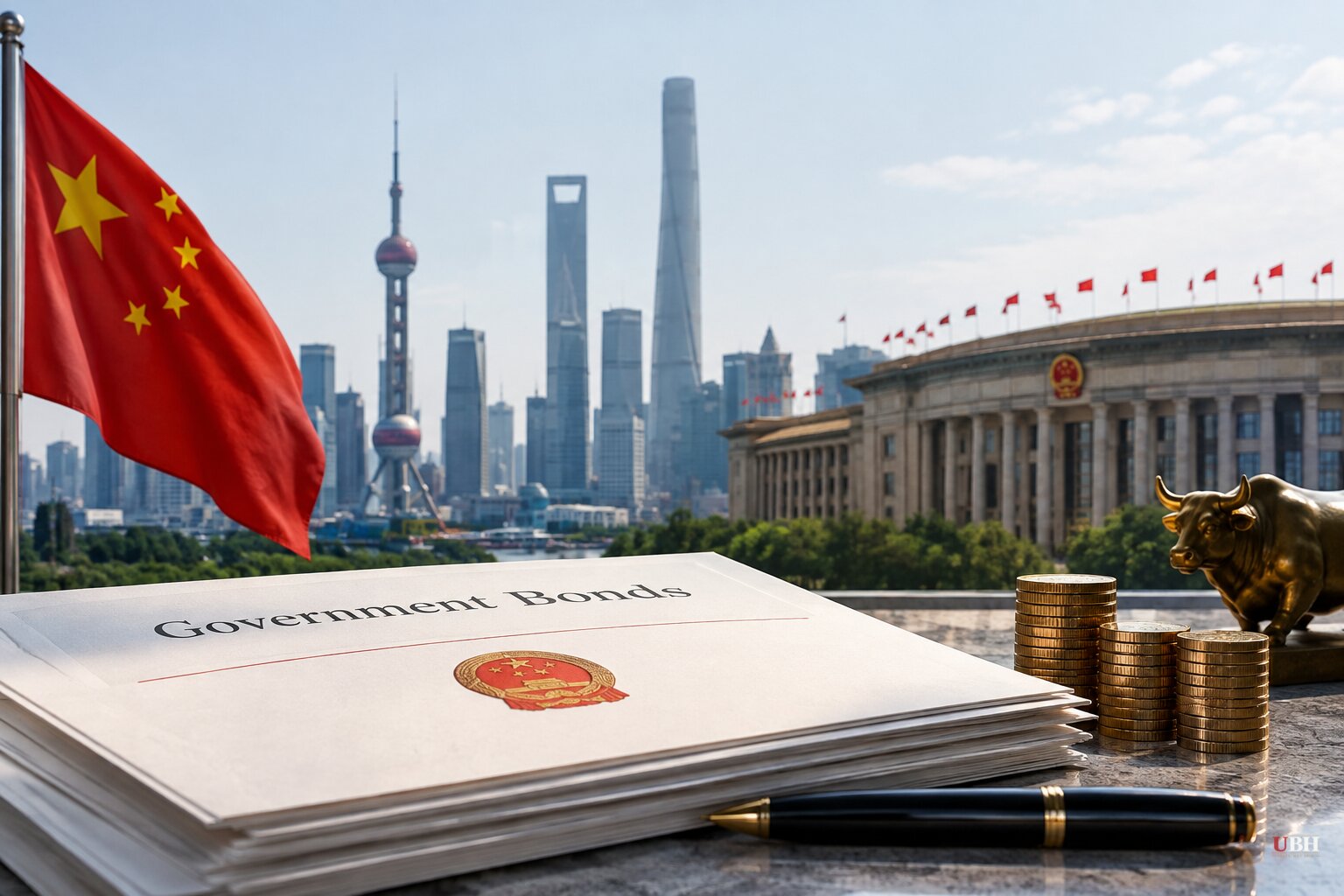
China's 10-year government bond yield has sat below 2% since late 2024 and dropped another 18 basis points this year, according to The Star (Malaysia). That's the backdrop for two moves out of Beijing that landed within days of each other: a cabinet directive to speed up bond sales, and a fresh round of capital injections into the country's largest banks and insurers.
The Quota Problem
China's local governments have sold only 81% of their annual special-bond quota through the first nine months of 2026, according to Bloomberg's calculations. If Beijing burns through the rest of that quota by year-end, fourth-quarter issuance could top 820 billion yuan, or roughly $122 billion, the largest quarterly supply of these bonds in almost five years, Bloomberg reports.
On Monday, September 28, China's State Council said the country "should accelerate the pace of issuance and use various types of bonds," according to a readout carried by Newsquawk. That's a cabinet-level signal, not an implementing order. Newsquawk's own analysis of the statement draws a distinction that matters: accelerating issuance of bonds already authorized just moves the supply calendar around within the year. Expanding the authorization itself would be genuine incremental stimulus. Only the follow-on detail from the finance ministry and the National Development and Reform Commission will show which one this is.
Banks and Insurers Get a Cash Infusion
Separately, Beijing is capitalizing its biggest financial institutions. At the National People's Congress session in March, the government said it would sell 300 billion yuan, about $45 billion, in special sovereign bonds to replenish capital at major state-owned banks, following a bigger program launched in 2025, according to The Star.
What's new is that more than 20% of those proceeds are going to insurers, not banks, The Star reports. Companies including People's Insurance Company (Group) of China and China Life Insurance are getting capital even though the industry's solvency ratio, while falling, is still above regulatory minimums.
The reason, according to Bloomberg Intelligence analyst Steven Lam, is that about half of the insurance industry's investments sit in bonds. With sovereign yields stuck under 2%, insurers are struggling to earn enough to cover the rates they've promised policyholders. Life insurers are required to hold long-dated government debt to match their liabilities. The People's Bank of China made its largest injection of medium-term funds since February back in July, and money-market liquidity has stayed ample, The Star notes.
Two Ways to Read It
The Star lays out both interpretations without picking a winner. One reading, favored by some analysts cited in that reporting, is that giving banks a bigger capital buffer lets Beijing finally speed up recognition of bad property debt and stabilize a sector that's been in a five-year downturn. This plan arrived just days after the government overhauled how homes are sold. The other reading is simpler: China's low-rate regime isn't temporary, and recapitalizing banks and insurers is Beijing's acknowledgment that sub-2% yields are here to stay, with all the margin pressure that brings.
Both readings can be true at once. What isn't yet resolved is which one dominates, and that depends on the same follow-through Newsquawk flagged: quota or special-treasury-bond announcements, and whether the next Politburo meeting hardens the language beyond "study stabilization measures."
The Global Contrast
China's problem, cheap money nobody wants to hold at these yields, is close to the mirror image of what's happening in Washington. As of Thursday, September 24, the U.S. 10-year Treasury yield stood at 5.11%, up from 5.08%, and the 30-year was at 5.45%, up from 5.38% the day before, according to the Evening Standard. That volatility helped drag London's FTSE 100 down 0.2% to 10,679.99 and the FTSE 250 down 0.9% to 24,154.32 that session, with the Dow, S&P 500 and Nasdaq all closing lower in New York.
Kathleen Brooks, research director at XTB, told the Evening Standard there was "no clear direction for markets," pointing to unresolved questions over the Iran conflict, oil flows through the Strait of Hormuz, and Ukrainian strikes on Russian refineries. Neil Wilson, investor strategist at Saxo UK, said Treasury yields were "blowing out again partly because the U.S. economy is booming." That same week, President Trump hosted China's Xi Jinping at the White House, with both sides agreeing to a two-month extension of their trade truce while remaining at odds over Beijing's support for Iran, according to the Evening Standard.
The two bond markets are moving in opposite directions for different reasons. One is squeezed by yields too low to sustain its insurers. The other is rattled by yields too high for comfort. Watch for China's finance ministry and NDRC to spell out whether the accelerated issuance is a calendar shift or new stimulus, and for the next Politburo meeting to confirm which reading of the bank and insurer recapitalization holds up.
Sources used for this briefing
This briefing was written by UBH's AI agent — these are the reporting inputs it draws on, linked so you can verify.


