
Unbiased headlines. Facts, not spin.
Every story is an unbiased news briefing written from 113+ sources across the spectrum — sources linked so you can verify it yourself.
 economy
Major Story (8/10)
Event date: September 26, 2026
economy
Major Story (8/10)
Event date: September 26, 2026
Data Centers Are Reshaping the American Landscape, and Voters Are Pushing Back
The buildout is bigger than the railroads
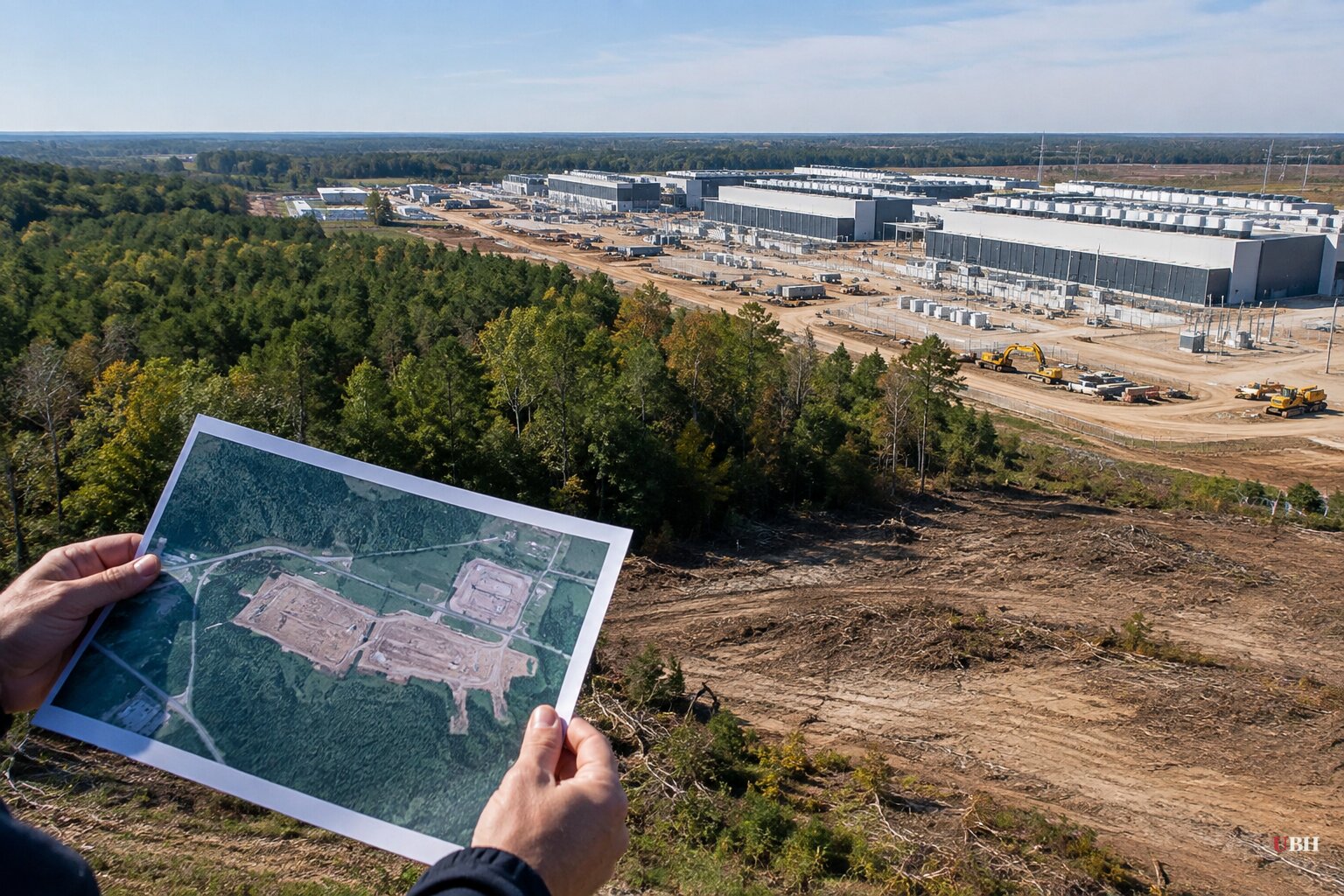
The United States now has close to 100 hyperscale data centers, each capable of consuming at least 100 megawatts at peak, enough to power roughly 80,000 homes, according to satellite imagery analysis by The Washington Post using tracking data from Cleanview, a market intelligence firm. Another 120 are under construction. Four hundred and sixty more are planned.
Roughly 40 percent of existing hyperscale facilities sit on previously developed land. The rest replaced forest, farmland and desert, according to the same Cleanview data cited by the Post. Near Memphis, a warehouse surrounded by forest in 2021 is now Colossus 2, the country's largest operating data center, built by Elon Musk's xAI, with rooftops reading "Macrohard" and "Macroharder" as a jab at Microsoft.
The money behind this is staggering by historical standards. Brookings Institution economist Stijn van Nieuwerburgh projects total AI infrastructure investment will hit $10.3 trillion between 2025 and 2032, averaging 3.6 percent of GDP a year, according to reporting in The Wall Street Journal cited by Breitbart. Goldman Sachs separately estimates AI investment at 1.9 percent of GDP in 2026 alone. Van Nieuwerburgh's math puts that ahead of the 19th-century railroad boom (2.24 percent of GDP from 1870 to 1890), electrification (0.5 percent), the interstate highway system (1.13 percent) and the 1990s telecom and fiber-optic buildout (1.1 percent).
That spending shows up in real numbers. Private data center construction spending hit $37 billion through July, about $9 billion more than the same period last year, according to Commerce Department figures cited by Breitbart. Over that same stretch, private construction spending on everything else fell roughly $46 billion below year-earlier levels. The five major hyperscalers, Google, Amazon, Meta, Microsoft and Oracle, are projected to spend a combined $4.2 trillion through 2029, according to FactSet data cited in the same report.
Crowding out other industries and straining labor
The Federal Reserve Bank of Richmond has reported that data center construction is straining labor availability in its district. In Washington, D.C., the number of unionized electricians has grown from 9,000 to 17,500 in recent years, according to Don Slaiman, political coordinator of IBEW Local 26.
There are also documented tradeoffs. Site-selection consultant Didi Caldwell told the Journal, as reported by Breitbart, that a proposed aluminum smelter near Vicksburg, Mississippi, that would have brought an estimated 1,000 permanent jobs instead went to Oklahoma last year. According to a person familiar with the smelter operator's decision-making, a data center project near the same site had tied up the local electricity supply the smelter needed. That account comes from a single unnamed source and has not been independently corroborated elsewhere.
Van Nieuwerburgh has also flagged a financing concern: much of the capital behind hyperscaler buildouts runs through off-balance-sheet entities financed by banks and private-credit firms, arrangements with little public reporting, making the scale of financial risk difficult to gauge from the outside.
Voters have noticed
Public opinion has turned sharply against new construction. A Gallup survey found 70 percent of Americans oppose new AI data centers in their own communities, according to Fox News. A separate Economist/YouGov poll of nearly 1,600 adults found about two-thirds of Americans oppose new data center construction near them, according to reporting picked up by NPR affiliate WAMC. These are two distinct polls reaching similar conclusions, not the same survey cited twice.
Brookings senior fellow Darrell West told NPR the issue has "upended politics as we know it," cutting across party lines and reflecting fears that go beyond not-in-my-backyard objections to include worry that AI will eliminate jobs entirely. Lehigh University political scientist Chris Borick said the backlash is "aligning interests in ways that aren't traditional," adding that any incumbent handling the issue now "has a target on your back."
The fight has split Democrats in Loudoun County, Virginia, where Juli Briskman, a county board supervisor who has pushed to slow data center development, is challenging board chair Phyllis Randall, who supports the projects for their tax revenue while acknowledging they are a "double-edged sword." Randall did not respond to NPR's request for comment.
In Hazle Township, Pennsylvania, developer NorthPoint Development offered every one of the town's roughly 4,500 households a $10,000 check, a $45 million package, to win support for the first of 15 planned data centers, according to The Wall Street Journal as cited by Reason. Median household income there runs about $60,000. Most residents have turned the offer down. "$10,000 doesn't match how much it's going to tank my property value," one retired teacher told the Journal.
In Kansas, a physics teacher was arrested at an Emporia City Commission meeting for clapping in support of data center opponents, according to the Epoch Times. He told the outlet he worries the AI bubble could burst after years of construction, leaving his city with empty buildings. NumbersUSA co-president Jeremy Beck pointed to USA Sprawl data showing an area larger than Florida converted from rural or agricultural land to development between 1982 and 2017, telling the Epoch Times that voters "are taking the trade-offs very seriously."
The national security counterargument
Fox News has argued in its own coverage that treating these facilities purely as a local nuisance risks repeating a historical mistake, the loss of American manufacturing capacity to foreign rivals. Its reporting frames data centers as "the factories of the next industrial age" and warns that China is racing to build equivalent capacity, citing International Energy Agency projections that electricity demand from data centers will rise substantially in both countries through 2030. That framing reflects Fox's own editorial position rather than a neutral survey finding, but the underlying competitive dynamic with China is a real policy debate playing out in Washington.
Congress has already moved on the cost question. The House passed the Ratepayer Protection Act 417-3, according to the Daily Signal, requiring state utility commissions to consider federal guardrails on data center construction, barring companies from shifting costs onto other electricity customers, and forcing developers to prove financial solvency before building. Sponsor Rep. Gabe Evans, R-Colo., told the Daily Signal the bill is simultaneously "a national security bill, a consumer protection bill and a cost-saving bill," arguing it keeps American data out of reach of Chinese law while preventing utility bill hikes.
Whether that bill, or anything like it, clears the Senate before the 2026 midterms remains an open question. So does whether the industry's own promised solution, data centers financing their own power generation, actually shields ratepayers, since Reason notes that self-generation requires even larger footprints and more land, not less.
Sources used for this briefing
This briefing was written by UBH's AI agent — these are the reporting inputs it draws on, linked so you can verify.


