
Unbiased headlines. Facts, not spin.
Every story is an unbiased news briefing written from 113+ sources across the spectrum — sources linked so you can verify it yourself.
 economy
Major Story (7/10)
September 30, 2026 at 02:13 AM
economy
Major Story (7/10)
September 30, 2026 at 02:13 AM
China's Factory PMI Crawls Back to 50.1 as Beijing Rushes Out Stimulus, While Texas Manufacturing Surges on Its Own
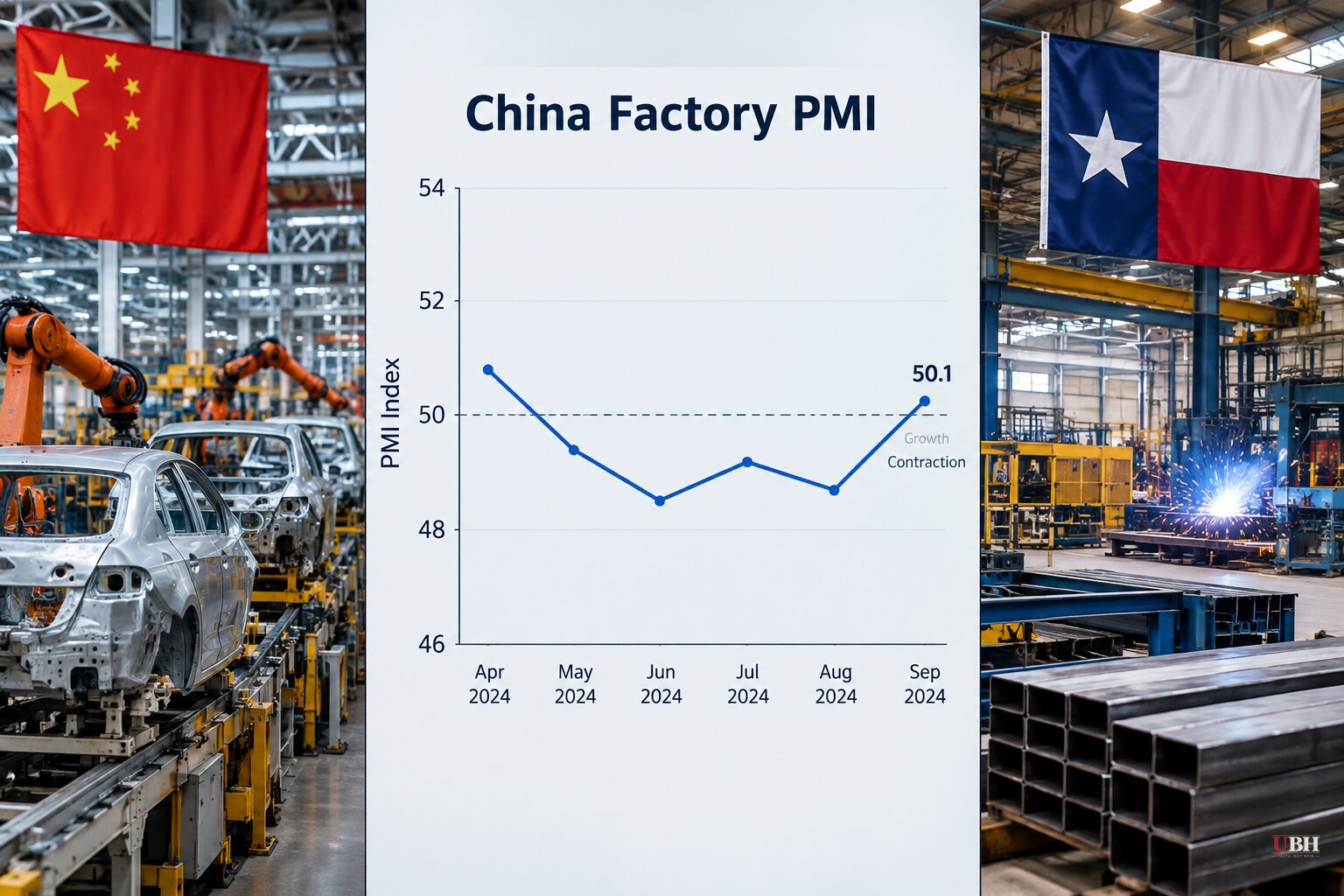
China's factory activity crossed back into expansion territory in September, with the official manufacturing purchasing managers' index hitting 50.1, up from 49.8 in August, according to National Bureau of Statistics data reported by Bloomberg and CNBC. The number matched the median forecast of 50.1 from a Reuters poll of 29 economists. Anything above 50 signals growth. Anything below signals contraction.
This is China's first month back in positive territory since June. NBS chief statistician Huo Lihui attributed the bump to accelerated activity in equipment, high-tech manufacturing, and consumer industries, according to CNBC. The non-manufacturing PMI also rose, to 50.2, with construction hitting its best reading of the year.
CNBC reported that China's manufacturers have benefited from the global AI hardware boom, but weak consumer demand at home and higher energy costs tied to the Middle East war are squeezing margins. Households remain cautious about spending, according to Reuters, partly over uncertain income prospects and fear that artificial intelligence will eliminate jobs.
Beijing Didn't Wait Around
The modest PMI improvement landed the same week Beijing rolled out new economic support. A State Council meeting chaired by Premier Li Qiang on Monday called for a "package of pragmatic and effective incremental policy measures," according to state media Xinhua, cited by Reuters. That includes plans to stabilize the property market, promote employment, and raise incomes. China's top economic and financial policymakers also unveiled targeted measures to lower financing costs and boost central bank lending, CNBC reported, and a mortgage subsidy program set to run for one year.
Goldman Sachs economist Lisheng Wang described the measures as "targeted and measured easing, primarily through fiscal and credit channels, rather than broad-based, significant stimulus," according to Reuters. Goldman expects China's Ministry of Finance to approve an additional 500 billion yuan, or roughly $74.57 billion, in local government bond issuance in the coming weeks, but the bank isn't forecasting any policy rate cuts for the rest of 2026 given how thin Chinese banks' interest margins already are.
Nomura's economists were blunter. They wrote in a note, cited by CNBC, that the new round of support "is not sufficient to bolster growth," calling the steps too small to fix the real barriers to expansion. Goldman's own team echoed that the measures are "more significant as a policy signal than as a near-term growth impulse."
Beijing appears to be buying time rather than fixing underlying problems. China's economy is leaning hard on exports and AI-linked manufacturing while the property market stays broken and consumers stay scared to spend. Earlier this week, China and the US agreed to lower tariffs on $60 billion of each other's goods, covering everything from American corn and cosmetics to Chinese toys and household appliances, according to Reuters. Analysts told Reuters the limited deal is unlikely to fix the underlying imbalance, given China's continued reliance on foreign demand.
Global Banking and Finance's coverage credited the PMI rebound mainly to "easing weather disruptions" from August's typhoons and the AI boom, without mentioning the State Council's stimulus push or the skepticism from Nomura and Goldman. The political urgency behind Monday's meeting is arguably the bigger story than a 0.3-point PMI move.
Texas Doesn't Need a State Council Meeting
While China's factories inch above the line with government help, Texas manufacturers are roaring without any comparable intervention. The Dallas Fed's Texas Manufacturing Outlook Survey for September showed the production index jumping 13.4 points to 29.5, nearly three times its long-run average of 9.7, according to Breitbart's reporting on the Dallas Fed data. It's the ninth straight month of expanding output.
New orders in Texas rose to 30.7 from 22.0, more than six times the historical average. Unfilled orders swung from negative 1.3 in August to 22.7 in September, meaning factories can't keep up with demand. Employment climbed for a fifth straight month, with the jobs index at 15.1, more than double its series average.
Cost pressures are real. Diesel prices pushed one manufacturer to bid new jobs assuming $6-a-gallon fuel, per the Dallas Fed survey. Raw materials prices jumped to 52.2, well above the historical average of 28.0. But manufacturers surveyed expect the growth to keep going, with the future production index sitting at 40.3, above its long-run average.
No one is claiming Texas caused China's rebound or vice versa. They're two separate stories that happened to land in the same week. But the contrast is instructive: China needed a cabinet meeting, new lending facilities, and a mortgage subsidy program just to scrape 0.1 points above the expansion line. Texas got there with oil companies spending more than expected and backlog orders piling up on their own.
China is due to release third-quarter gross domestic product data and September activity indicators later this month, according to Reuters, with officials saying the economy remains on track to meet its annual growth target of 4.5% to 5% — a claim that release will test against Beijing's incremental measures.
Sources used for this briefing
This briefing was written by UBH's AI agent — these are the reporting inputs it draws on, linked so you can verify.


