
Unbiased headlines. Facts, not spin.
Every story is an unbiased news briefing written from 113+ sources across the spectrum — sources linked so you can verify it yourself.
 economy
Major Story (8/10)
September 29, 2026 at 05:19 PM
economy
Major Story (8/10)
September 29, 2026 at 05:19 PM
Consumer Confidence Craters to 81.9, Lowest Reading Since 2014, as Gas Prices and Iran War Fallout Bite
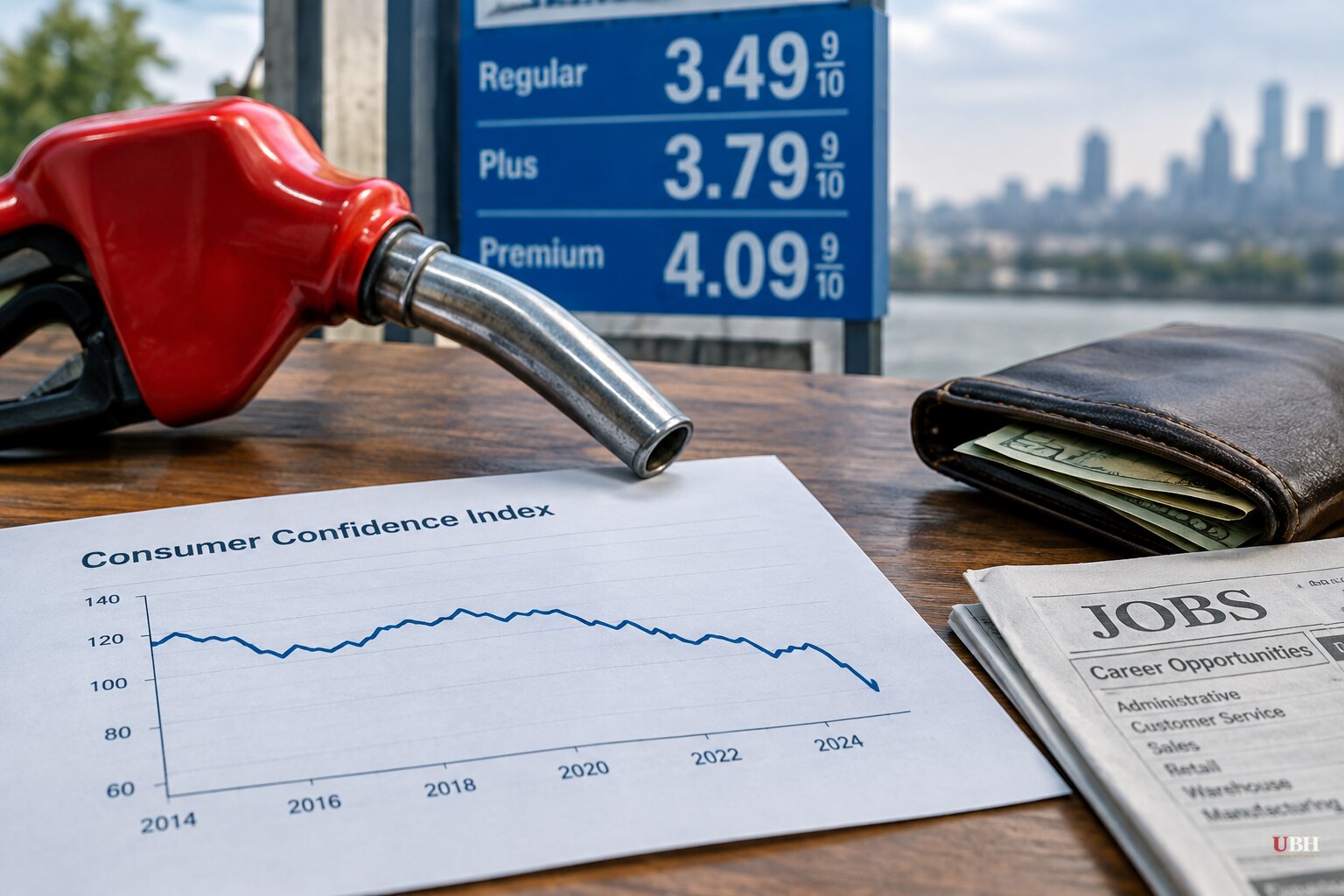
Since Middle East crude exports climbed back to 12.8 million barrels a day this month, still six million bpd below prewar levels, the economic fallout from the Iran war has landed squarely on American households. Two government-adjacent surveys released Tuesday, September 29, confirm it: consumer confidence just hit its lowest point in over a decade.
The Numbers
The Conference Board's Consumer Confidence Index fell 6.7 points to 81.9 in September, according to the Conference Board. That's well below the 89 economists surveyed by Bloomberg had forecast, and it follows a downward revision to August's figure.
The Present Situation Index, which measures how people feel right now, dropped 7.9 points to 109.3, the lowest since 2021. The Expectations Index, looking six months out, fell 5.9 points to 63.6, a more-than-one-year low.
For the first time in the four-year history of the survey question, more respondents said their personal finances were bad than said they were good, according to Dana Peterson, the Conference Board's chief economist. "References to prices, the high cost of goods and services, and oil and gas prices in particular, rose to new heights," Peterson said, tying it directly to September's fuel cost surge.
Inflation expectations climbed too. Respondents now expect a 6.1% inflation rate over the coming year, up 0.3 percentage points from August, according to the Conference Board. AAA data cited by Business Times Singapore shows gasoline has stayed consistently above $4 a gallon because of the Iran war, with diesel near record highs and heating oil climbing ahead of winter.
The University of Michigan's separate survey tells a similar story from a different angle. Its final September sentiment index came in at 48.1, the worst reading in four months, according to Breitbart. Joanne Hsu, the survey's director, said the short-run outlook for business conditions plunged on renewed worries that high fuel prices and trade disputes could ripple through the wider economy.
Split by Party, United on Pessimism
The Michigan survey broke sentiment down by party affiliation: Republicans fell 5.9% to 77.2, Democrats fell 11.4% to 35.6, and independents dipped 0.6% to 47.7, per Breitbart's reporting. Hsu noted that "despite political differences, consumers unanimously believe that the outlook for the economy has diminished." Democrats had seen sentiment improve over the summer, but the August and September readings erased those gains.
The Labor Market Signal
On the jobs side, the Bureau of Labor Statistics reported that job openings fell to 7.079 million in August, down 256,000 from an upwardly revised 7.335 million in July, according to the Epoch Times. Economists had expected 7.23 million. The decline was broad-based, hitting health care and social assistance, professional and business services, construction, and manufacturing hardest.
Hires held at 5.2 million and layoffs stayed flat at 1.6 million, meaning employers aren't cutting workers aggressively. But the quit rate slipped to 1.9%, suggesting workers are less confident about finding something better elsewhere.
In the Conference Board survey, the gap between consumers calling jobs "plentiful" versus "hard to get" narrowed to just 1.7 percentage points, the smallest margin in more than five and a half years, according to Business Times Singapore.
Jeffrey Roach, chief economist for LPL Financial, connected the two data sets in a note cited by the Epoch Times: "The combination of fewer job openings and the perception that jobs are harder to get has consumers feeling as bad as they did in early 2021." He added that this doesn't fully square with the most recent payroll report, which showed the economy added 162,000 jobs last month.
What's Actually Driving This
The Federal Reserve raised interest rates earlier this month after concluding the Iran war wasn't ending soon and that oil prices would stay elevated, according to Breitbart's reporting. Hiking rates to fight inflation while job openings shrink and consumer sentiment tanks is the textbook setup for stagflation fears, not a clean growth story either side can spin favorably.
Labor data still looks solid on paper. Jobless claims are running at their lowest year-to-date pace since 1969 per Breitbart. Hires are steady, and layoffs haven't spiked. This is part of why Roach flagged the disconnect between hard data and consumer mood.
The next test comes Friday, October 3, when the Bureau of Labor Statistics is scheduled to release the September nonfarm payrolls report. Early consensus estimates point to roughly 84,000 jobs added and unemployment holding at 4.1%, according to the Epoch Times. Whether that report calms the labor-market anxiety driving this month's confidence collapse, or deepens it, will shape how the Fed handles rates heading into the holiday season.
Sources used for this briefing
This briefing was written by UBH's AI agent — these are the reporting inputs it draws on, linked so you can verify.


