
Unbiased headlines. Facts, not spin.
Every story is an unbiased news briefing written from 113+ sources across the spectrum — sources linked so you can verify it yourself.
 economy
Major Story (7/10)
October 1, 2026 at 12:09 AM
economy
Major Story (7/10)
October 1, 2026 at 12:09 AM
South Korea Moves to Cut Reliance on Both China and the Dollar
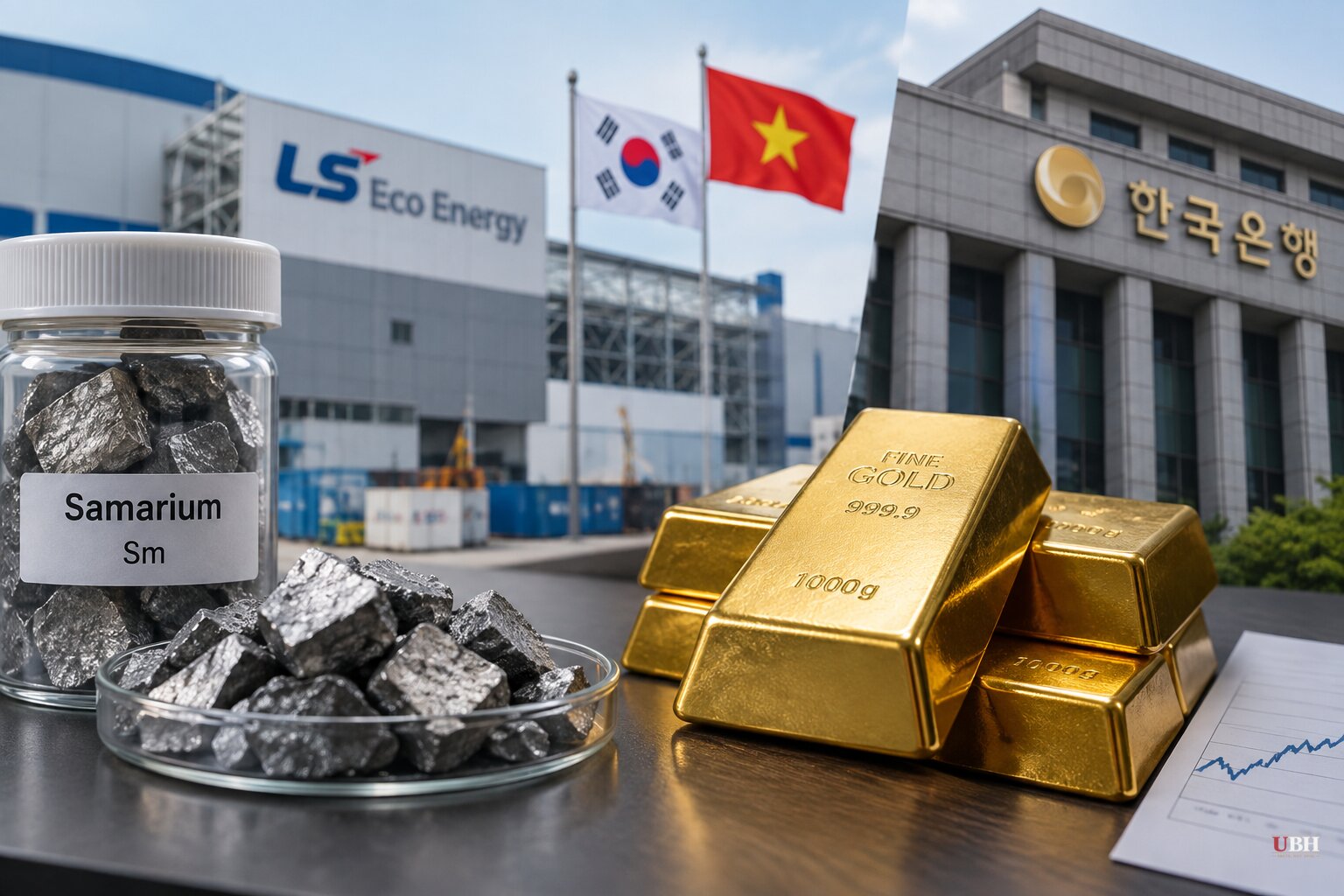
South Korea is making two moves this week that point in the same direction: less dependence on single points of failure, whether that's China's grip on rare earths or the U.S. dollar as the only safe-haven asset worth holding.
The Rare-Earth Play
LS Eco Energy, a unit of the LS Group conglomerate, disclosed in a Korea Exchange filing dated September 30 that it will invest 11.6 billion won, roughly $8.3 million to $8.6 million depending on which outlet's exchange-rate conversion you use, to build a samarium metal production facility in Vietnam. The plant will sit at the company's existing LSCV site in Ho Chi Minh City and is expected to produce about 240 metric tons of samarium metal a year, according to Business Korea, BigGo Finance, and TechNode, all citing the same filing. That's enough raw material to manufacture an estimated 700 to 1,000 tons of samarium-cobalt (SmCo) permanent magnets annually. Pilot production is targeted for December, per mk.co.kr and The Elec.
Samarium isn't the rare earth most people know. Neodymium gets the headlines because it's in EV motors. But SmCo magnets handle something NdFeB magnets can't: heat. Tech Times reports SmCo magnets hold their magnetic properties at service temperatures up to 350°C, with a Curie point as high as 850°C, compared to a roughly 150°C ceiling and 400°C Curie point for standard neodymium-iron-boron magnets. That makes SmCo the material of choice for jet engines, missile actuators, and radar systems, applications where failure isn't an option.
The timing isn't an accident. A Pentagon procurement rule, DFARS 252.225-7052, expands on January 1, 2027, 93 days from now, to bar defense contractors from using magnets whose rare earths were mined, refined, separated, or melted anywhere in China, Russia, Iran, or North Korea, according to Tech Times. That closes a loophole: a magnet assembled in Japan or Europe from Chinese-processed metal will no longer qualify. Tech Times puts China's share of global rare-earth metallization capacity at roughly 95%; TechNode pegs China's broader processing dominance at around 90%. Either way, the message is the same: almost nobody outside China does this at scale.
LS Eco Energy isn't doing it alone either. The supply chain runs through Australia's Lynas, described by Business Korea and mk.co.kr as the only company outside China that separates and commercially produces rare earths. Lynas supplies the raw material, LS Eco Energy processes it into metal in Vietnam, and the output feeds LS Cable & System's magnet plant. The two companies cemented the partnership in July by each buying 30 billion won in the other's convertible bonds, and TechNode reports LS Eco Energy's board approved a 58% stake in a new joint entity, with the deal expected to close by mid-October. LS Eco Energy CEO Lee Sang-ho, romanized elsewhere as Sangho Rhee, said the company expects South Korea, despite having no domestic rare-earth resources of its own, to become a core node in the global supply chain through high-value metal and component manufacturing.
A fair skeptic would point out that 240 tons a year is small next to China's processing footprint, and that the whole chain still runs through one external supplier, Lynas, meaning Seoul is swapping one dependency for a narrower one rather than eliminating dependency altogether. LS Eco Energy's own disclosures don't address what happens if Lynas's output, political situation in Australia, or shipping routes get disrupted. The company says it plans to add dysprosium, terbium, and neodymium-praseodymium to its lineup, but none of that is built yet.
The Gold Play
Separately, the Bank of Korea is preparing its own hedge against the dollar. According to ZeroHedge, citing the office of Rep. Chung Tae-ho of the Democratic Party of Korea, the BOK will buy roughly one ton of domestically produced gold in December, worth about 200 billion won ($140 million), with the first transaction scheduled for December 14 once the bank finishes setting up its domestic gold-trading system. That would be the central bank's first physical gold purchase since it halted buying in February 2013.
Context matters here. The BOK held 104.4 tons of physical gold as of the end of August, worth $14.88 billion and representing 3.4% of its foreign exchange reserves, per ZeroHedge. One additional ton adds less than 1% to that position, hardly a seismic shift in reserve composition. The bank had already bought $250 million in gold ETFs in the second quarter, and it officially announced in August it would resume physical purchases, citing mounting geopolitical risk and criticism that its gold holdings trail those of other central banks.
The 2013 halt is worth remembering too. The BOK built up its gold position aggressively before that, then faced sharp political criticism from lawmakers when prices fell, according to ZeroHedge. That history is a reasonable reason for caution: a central bank buying into a rally risks the same backlash if gold prices reverse, and one ton is a token-sized bet by comparison to what some other reserve managers, including China's own central bank, have been doing in recent years.
Both moves share a logic even if they're unconnected in mechanism: don't bet everything on one supplier or one currency. The rare-earth plant answers a hard U.S. defense deadline. The gold purchase answers a softer, more open-ended worry about currency and geopolitical risk. Neither is large enough yet to be transformative. The questions worth watching are whether LS Eco Energy's Vietnam output actually clears DFARS compliance before the January 1, 2027 deadline, and whether the Bank of Korea's December 14 gold purchase becomes the start of a sustained buying program or stays a one-off.
Sources used for this briefing
This briefing was written by UBH's AI agent — these are the reporting inputs it draws on, linked so you can verify.


