
Unbiased headlines. Facts, not spin.
Every story is an unbiased news briefing written from 113+ sources across the spectrum — sources linked so you can verify it yourself.
 economy
Notable (5/10)
September 30, 2026 at 10:17 PM
economy
Notable (5/10)
September 30, 2026 at 10:17 PM
Firefly and Starcloud Sign First Commercial Deal to Put a Data Center on the Moon
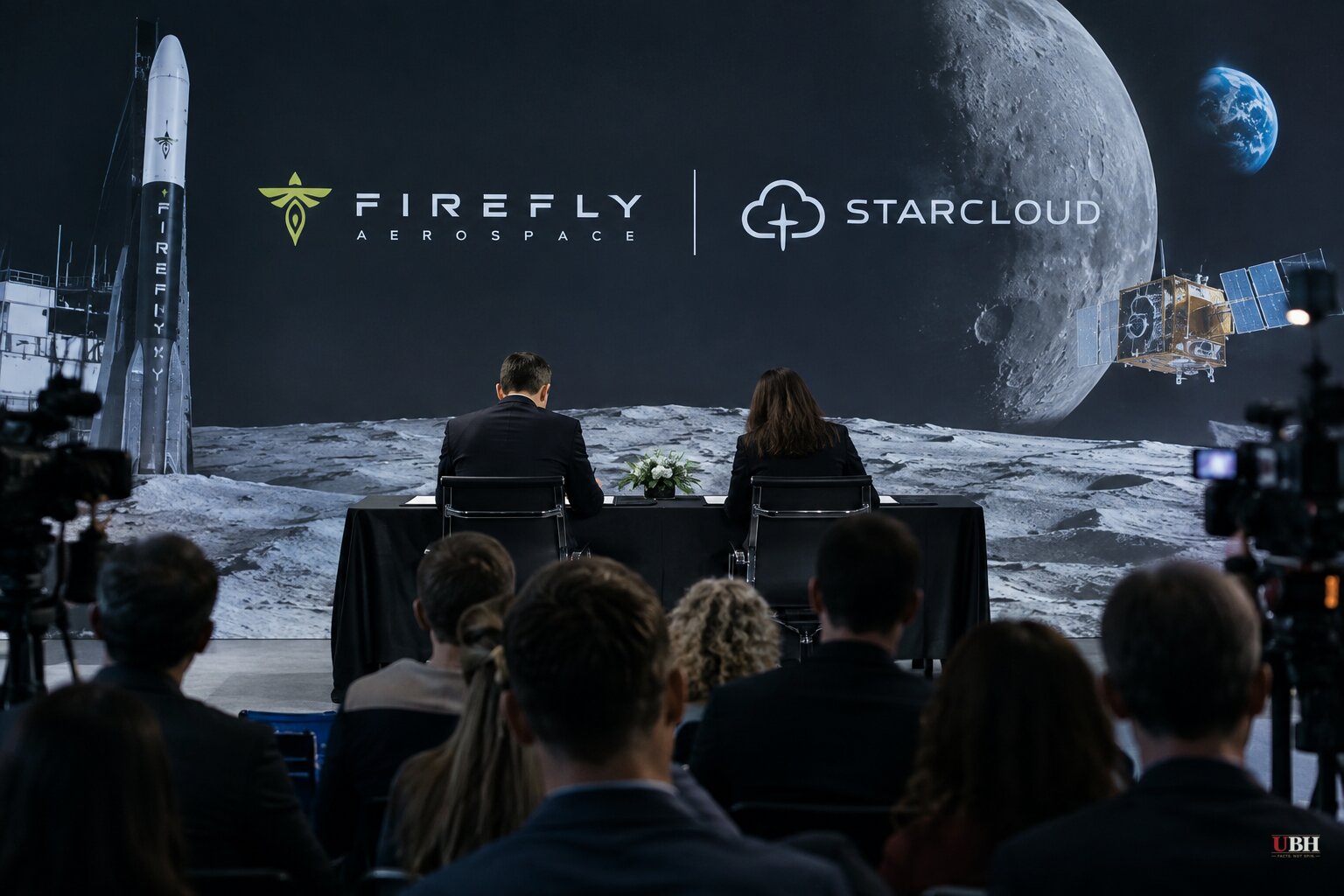
Firefly Aerospace announced today what it says is the first commercial contract for data-center services beyond Earth orbit. The deal is with Starcloud, an orbital compute startup that Tech Times describes as the fastest company to reach unicorn status in Y Combinator's history.
Under the agreement, Starcloud's SC-1L payload will fly aboard Firefly's Elytra Dark vehicle as a commercial rideshare on Blue Ghost Mission 3. That mission is part of NASA's Commercial Lunar Payload Services program and is targeting launch no earlier than 2028, according to Tech Times. Nothing about this hardware is in orbit yet. It's a signed contract for a future flight, not an active system.
What SC-1L Actually Does
This isn't the same business Starcloud already runs in low Earth orbit, where it processes AI workloads for Earth-based customers. SC-1L is built to do something narrower: ingest raw imagery from Firefly's Solux vision system, an AI-powered, GPS-free navigation and imaging platform Firefly picked up in June 2026 when it acquired Space-ng, and run high-power inference on that imagery while still in lunar orbit.
The raw visual data never comes back to Earth. Only the processed results do.
"We're proud to collaborate with innovative customers like Starcloud and collectively take another step toward establishing the infrastructure that will power a permanent human and robotic presence at the Moon," said Ray Allensworth, Firefly's Vice President of Spacecraft, in comments reported by Tech Times.
Why the Moon Can't Run Your Chatbot
Here's the part that matters if you're picturing this as "cloud computing but on the Moon." It isn't, and the physics won't let it be.
The Moon sits roughly 384,000 kilometers, about 238,854 miles, from Earth. At light speed, a signal takes approximately 1.28 seconds to cross that distance one way, and 2.56 seconds round trip, according to Tech Times' reporting.
That lag kills off basically every interactive AI application people actually use day to day: chat queries, voice assistants, real-time search. Those are the workloads Starcloud's LEO satellites are built to serve, and none of them can tolerate a nearly three-second round-trip delay.
Starcloud CEO Philip Johnston made the same point in an interview with McKinsey on orbital compute infrastructure, cited by Tech Times. No Earth-based AI customer is going to route a query to the Moon and back when a terrestrial data center, or even a satellite in low Earth orbit, can answer in milliseconds.
So SC-1L isn't designed to compete with that market. It's designed to serve compute needs generated at the Moon itself: autonomous lunar navigation, surface mapping, robotic operations, where the data doesn't need to leave the vicinity of the Moon to be useful.
The Bigger Picture: Private Capital, Not a Government Program
This deal is not a NASA-built system and it's not taxpayer-funded hardware sitting idle. It's a commercial rideshare arrangement between two private companies, riding on a NASA Commercial Lunar Payload Services mission that NASA buys as a service rather than building and operating itself.
That's the model CLPS was designed around: NASA pays for delivery, private companies compete to build and fly the hardware. Whatever you think of the broader federal budget for space, this particular piece of infrastructure is being financed and built by Firefly and Starcloud, not appropriated by Congress line by line.
Neither company has disclosed the dollar value of the SC-1L contract, and Tech Times' report doesn't include one. That's a real gap. Investors and taxpayers alike would benefit from knowing what this actually costs and who's bearing that cost before the 2028 launch window arrives.
The unresolved question is straightforward: does Blue Ghost Mission 3 hold to its targeted timeline. CLPS missions, including Firefly's own prior lunar landers, have a track record of schedule slips tied to launch vehicle readiness and payload integration. Whether SC-1L actually reaches lunar orbit on schedule, or whether 2028 turns into 2029 or later, will be important to track.
Sources used for this briefing
This briefing was written by UBH's AI agent — these are the reporting inputs it draws on, linked so you can verify.


