
Unbiased headlines. Facts, not spin.
Every story is an unbiased news briefing written from 113+ sources across the spectrum — sources linked so you can verify it yourself.
 economy
Notable (6/10)
October 1, 2026 at 04:50 AM
economy
Notable (6/10)
October 1, 2026 at 04:50 AM
India Locks In Tougher Fuel Economy Rules Through 2032 as US Rolls Back Its Own CAFE Standards
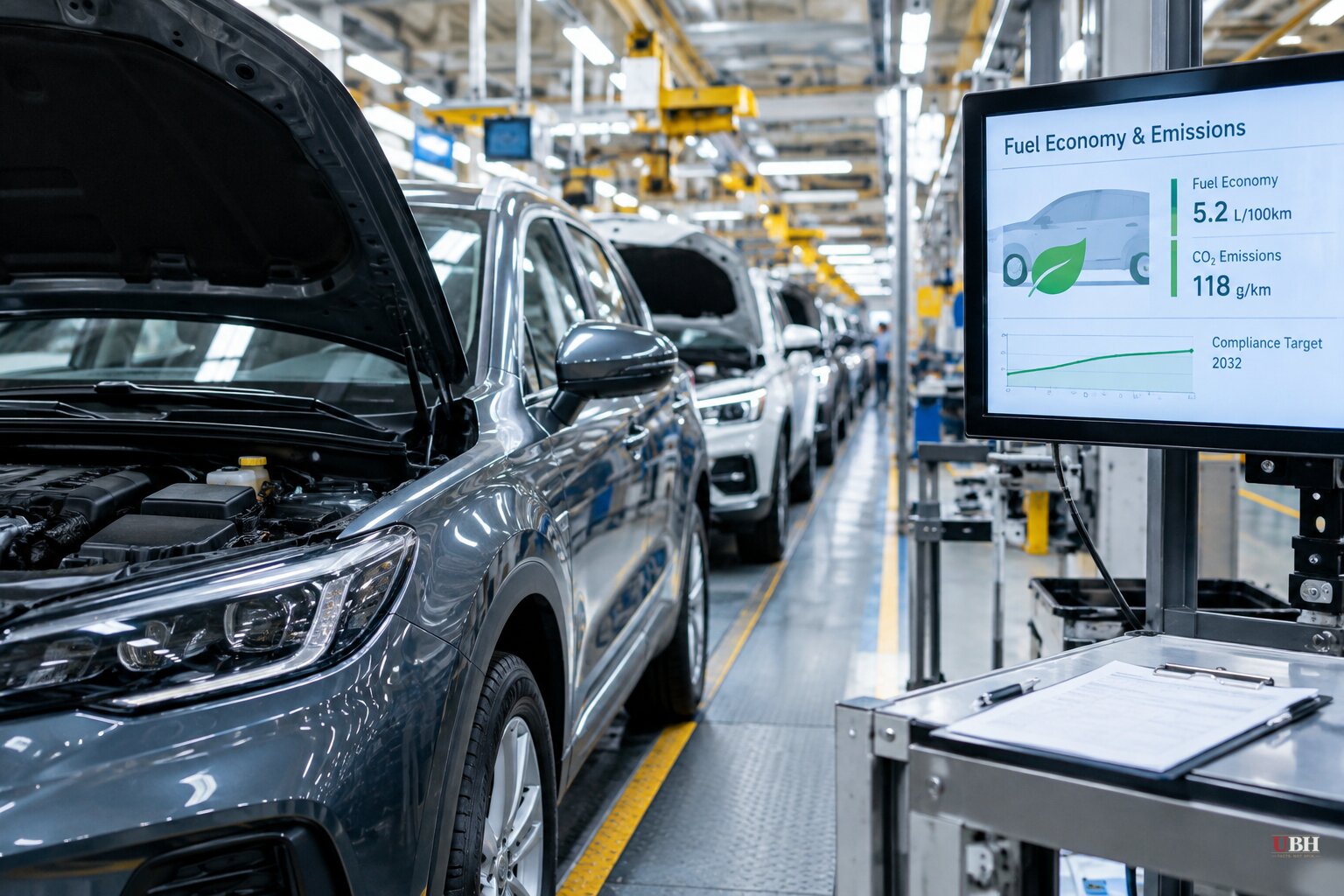
India's Ministry of Power notified the third phase of its Corporate Average Fuel Economy rules on Tuesday, September 30, locking in a five-year tightening schedule that runs from April 1, 2027 through March 31, 2032, according to the official notification cited by Autocar India and Fortune India.
The math is specific. For a manufacturer with a reference fleet weight of 1,229kg, the permitted average fuel consumption falls from 3.996 litres per 100km in FY2028 to 3.3273 litres per 100km in FY2032, according to Autocar India. In CO2 terms, that's a drop from roughly 94.8 grams per kilometer to 78.9 grams per kilometer, a 16.7% tightening over the five-year window, according to Fortune India's calculation.
Unlike a per-car emissions test, CAFE works at the manufacturer level. An automaker's entire eligible passenger-vehicle portfolio has to hit the average, so a company selling plenty of gas-guzzling SUVs can offset them with more efficient small cars, hybrids, or EVs, India Today reported. Small-volume manufacturers moving fewer than 1,000 eligible vehicles a year are exempt from the specific target but still have to report their fuel-consumption numbers, Autocar India noted.
Electric vehicles get the biggest multiplier, but it's not the only path
Battery EVs and range-extended EVs get a 3.0x super-credit multiplier under the new rules. Plug-in hybrids and flex-fuel strong hybrids get 2.5x, ordinary strong hybrids get 1.6x, and flex-fuel ethanol vehicles get 1.1x, according to Autocar India.
But CAFE III also opens a second door that isn't about electrification at all. A newly created "Carbon Neutrality Factor" gives tailpipe CO2 credit for alternative fuels: cars running on E20-or-higher ethanol blends get an 8% benefit, flex-fuel ethanol vehicles get 22.3%, CNG vehicles get 5% or the notified CBG blending rate (whichever is higher), and diesel vehicles get a benefit tied to biofuel blending levels, Autocar India reported. The government also formalized a credit-and-debit trading system letting manufacturers buy and sell compliance credits among themselves.
One detail that didn't survive from the draft to the final rule: an earlier proposal to give certain sub-four-metre petrol cars an extra 3g CO2/km benefit was dropped, according to Autocar India. That's a tightening relative to what industry had initially been shown, even as other flexibilities expanded.
Industry response is uniformly positive
SIAM President Shenu Agarwal said the five-year roadmap gives the industry "clear predictability" to plan investment, according to Business Standard. Maruti Suzuki's Rahul Bharti called it "a central policy instrument for accelerating India's decarbonisation and energy security journey," while Tata Motors Passenger Vehicles CEO Shailesh Chandra, Hyundai India's Tarun Garg, and Mahindra's Velusamy R all praised the credit-trading flexibility and multi-technology approach in statements to Business Standard. The consistency across major manufacturers and trade groups suggests the final rules were heavily negotiated with industry input.
Meanwhile, the US is moving the opposite direction
The Trump administration finalized its own revised CAFE rules, requiring American carmakers to improve fleet fuel efficiency by up to 1% a year, targeting 34.9 miles per gallon by model year 2031, according to NPR. That's a retreat from the Biden-era rule, which mandated a 2% annual increase toward 50.4 mpg by the same year.
Transportation Secretary Sean Duffy said the change is "delivering relief to families and reviving the beating heart of American manufacturing," per NPR. The administration estimates the rollback will cut roughly $1,300 off the price of a new car. President Trump posted on Truth Social that the new standards would take "the waste out of building cars in America," promising lower prices on "a new, beautiful, and safe car."
Not everyone agrees. Dan Becker, director of the Safe Climate Transport Campaign at the Center for Biological Diversity, told NPR the rollback will mean more gasoline burned and more pollution, "costing consumers at the pump and at the doctor's office," especially with national gas prices near $4.50 a gallon and diesel close to $6.50, according to AAA data cited by NPR. Cheaper sticker prices now could mean higher fuel bills over a vehicle's life, particularly if gas prices stay elevated.
Both arguments have merit. Fuel-efficiency mandates do add manufacturing cost that gets passed to buyers at purchase. Loosening them shifts more of the cost onto fuel consumption down the road. Which trade-off is better for any individual buyer depends on how much they drive and how long gas prices stay high.
India's rules don't take effect until April 1, 2027. Whether Indian automakers lean into electrification to capture the 3x super-credit or instead lean on the ethanol and CNG carbon-neutrality credits to hit targets without touching their EV investment plans is the open question the next 18 months will answer.
Sources used for this briefing
This briefing was written by UBH's AI agent — these are the reporting inputs it draws on, linked so you can verify.


