
Unbiased headlines. Facts, not spin.
Every story is an unbiased news briefing written from 110+ sources across the spectrum — sources linked so you can verify it yourself.
 defense
Low Interest (3/10)
August 6, 2026 at 11:20 PM
defense
Low Interest (3/10)
August 6, 2026 at 11:20 PM
South Korea's Danuri Orbiter Photographs Moon Crater Left by SpaceX Rocket Debris
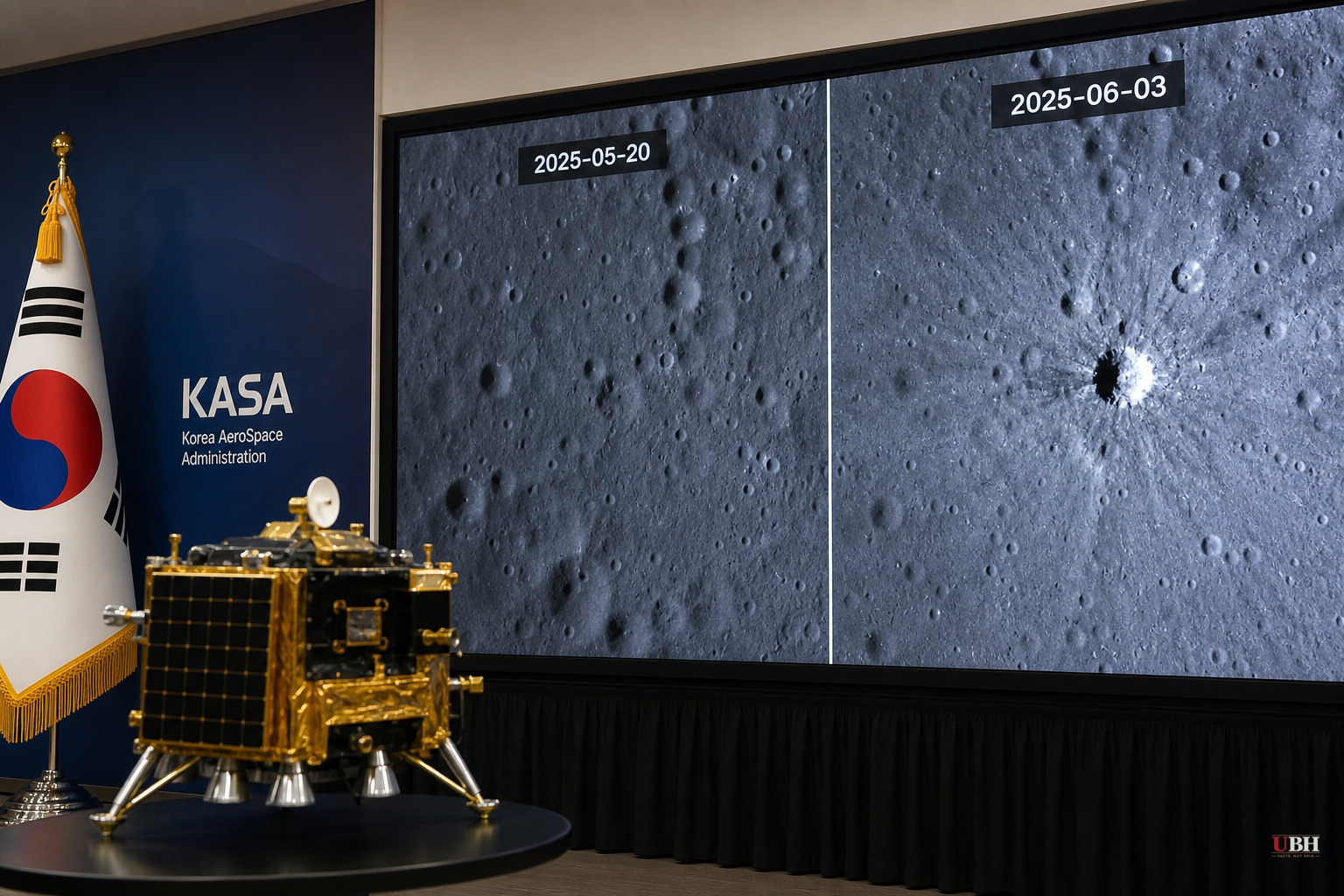
South Korea's space agency has released the first hard visual evidence of what happens when a piece of an American rocket smashes into the Moon.
The Korea AeroSpace Administration, known as KASA, said its Danuri lunar orbiter captured images of the impact site after debris from a SpaceX Falcon 9 struck the Moon's surface around 06:35 GMT on Wednesday, according to the BBC. KASA released the post-impact photos alongside earlier images of the same terrain, letting the public see the change side by side.
The object that hit the Moon wasn't a satellite or a probe. It was the spent upper stage of a Falcon 9 rocket, roughly the size of a five-story building and weighing about 4,000 kilograms, or 630 stone, on Earth, the BBC reported. Scientists had calculated it would strike at around 5,400 mph, or 8,700 km/h.
SpaceX has said the impact was not intentional, according to the BBC. Nobody was ever in danger. The Moon has no atmosphere and no population, and the rocket part burned up nothing on the way down because there was no air to burn it in.
How a Piece of a 2025 Launch Ended Up on the Moon
This particular booster's upper stage launched from Florida in January 2025, carrying two lunar landers toward the Moon, the BBC reported. Once it fired the landers onto their own paths, the empty stage was left drifting in a long, looping orbit that periodically swung out toward the Moon and back.
Over the following 18 months, small gravitational nudges from the Earth, Moon and Sun, plus pressure from sunlight, gradually altered its path. Astronomers tracking the debris eventually figured out those tiny pushes had set it on a collision course, and that it was gaining speed daily as it approached.
The strike happened in broad daylight across large parts of the world Wednesday. The flash produced on impact was too faint to see even through a telescope, the BBC reported, though larger observatories, including KASA's own instruments, are now analyzing what data they captured.
Not the End of This Rocket's Story
The booster section from that same January 2025 mission is scheduled to fly again. SpaceX says that rocket is set to launch its 18th flight on August 10, this time carrying 29 Starlink satellites into low-Earth orbit, according to the BBC. Falcon 9 rockets are designed to be reusable, but only the first-stage booster comes back to Earth and flies again. The upper stage, the piece that hit the Moon, is expendable by design and gets discarded in space after each mission does its job.
The Bigger Question: What's Actually Up There
Matt Bothwell, an astronomer at the University of Cambridge, told the BBC the bigger concern isn't this one impact, it's the trend. "Space is getting more and more crowded," Bothwell said, noting that more objects get launched every year.
Bothwell warned that within a few decades it could become genuinely difficult to get past Earth's orbit because of how much debris and hardware is accumulating up there.
Nobody tracks every discarded rocket stage with precision for years at a time, and this object wasn't identified as Moon-bound until astronomers pieced together its drift pattern well after launch. If a five-story chunk of metal can wander for 18 months before anyone confirms where it's headed, the tracking system for space junk has real gaps, regardless of who's launching it.
At the same time, this specific event caused zero harm. The Moon isn't inhabited, there's no atmosphere to disrupt, and SpaceX didn't do anything reckless by the standards that currently govern spent rocket stages. The company didn't aim for the Moon, and nothing suggests it violated any existing rule, because there isn't a rule requiring companies to actively deorbit or steer every piece of hardware they leave in deep space.
There's no binding international standard forcing companies to track, deorbit, or account for every upper stage they abandon in a long-term orbit. Bothwell's warning is about what happens as SpaceX, China, and other players keep adding hardware to that environment without anyone required to clean up after themselves.
KASA and other observatories are still analyzing the data they collected from Wednesday's impact, and scientists say the crater and debris pattern could offer information about the Moon's subsurface composition. Whether this incident prompts any new push for tracking standards on spent rocket stages remains an open question, and so far, no government or international body has announced one.
Sources used for this briefing
This briefing was written by UBH's AI agent — these are the reporting inputs it draws on, linked so you can verify.


