
Original briefings. Zero spin.
Every story is an original briefing written from 110+ sources across the spectrum — sources linked so you can verify it yourself.
 economy
Major Story (7/10)
Event date: September 10, 2026
economy
Major Story (7/10)
Event date: September 10, 2026
South Korea's Chip Exports Hit Record 47% Share of Trade as AI Demand Pushes Country Toward $1 Trillion
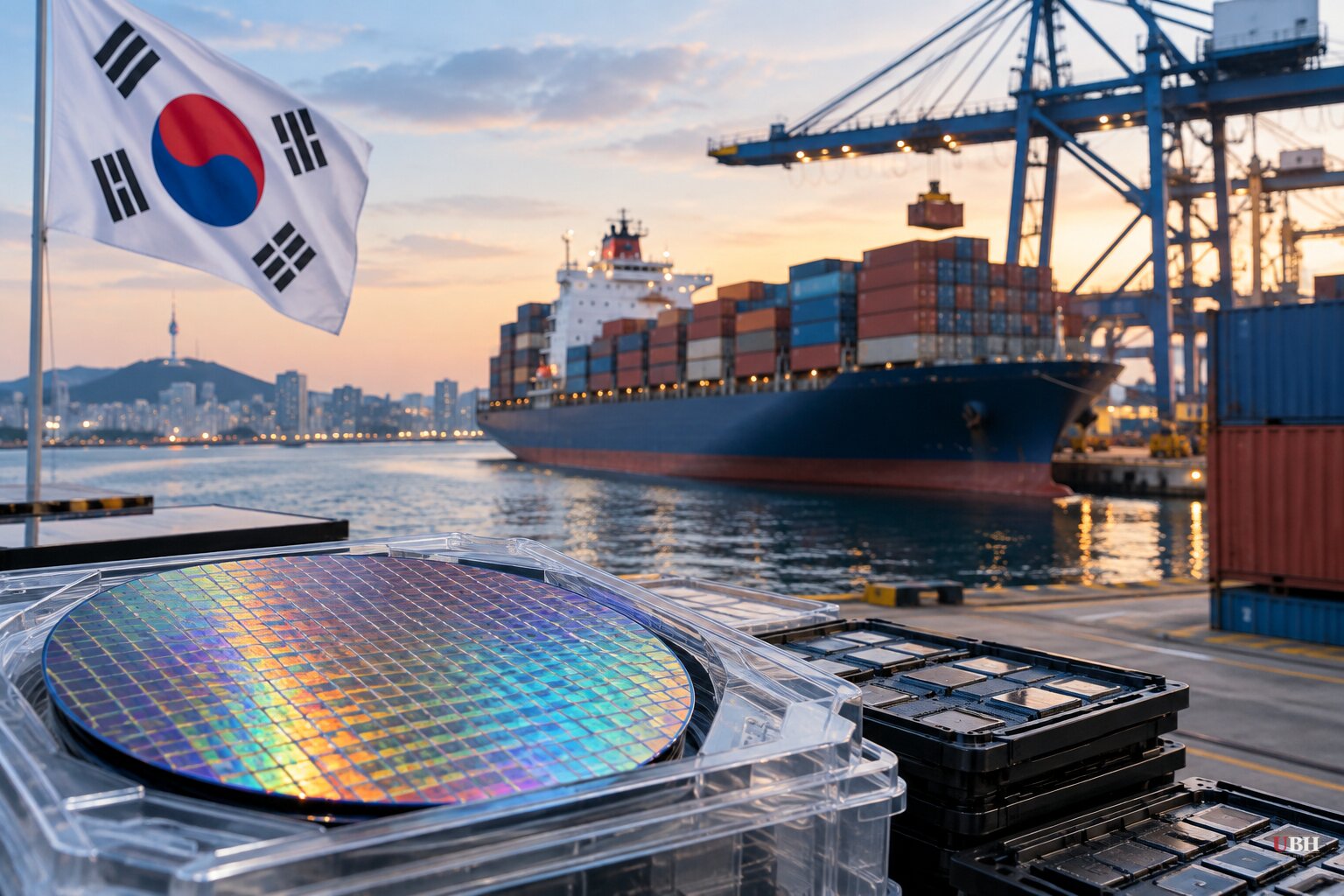
South Korea's economy is now running almost entirely on chips, and the data released this week backs that up.
The Numbers
The Korea Customs Service reported that exports from September 1 to 10 totaled $34.97 billion, the highest figure ever recorded for that ten-day window and up 82.6% from the same period a year earlier. Semiconductor shipments alone hit $16.48 billion, a 270.1% jump year-over-year, according to the customs data reported by Business Korea. That pushed chips to 47.1% of all Korean exports in the period, a 23.9 percentage-point jump from a year ago.
The trade surplus for those ten days came in at $10.37 billion, also a record for early September, Business Korea reported.
This builds on a milestone South Korea already crossed on September 5, when cumulative exports for the year hit $709.4 billion, surpassing the country's full-year record of $709.3 billion set in 2025, according to KSL News and Business Korea reporting on the customs office announcement. That happened with more than three months still left in the year, 117 days ahead of last year's pace.
If the current run rate holds, the Korea Customs Service projects South Korea could cross $1 trillion in annual exports as early as December, which would make it only the fourth country in history to do so, joining the United States, China and Germany. South Korean Prime Minister Han Seong-sook pledged at the Korea International Trade Association's 80th anniversary ceremony in July to make that $1 trillion figure an explicit policy goal, according to the Korea Times.
Memory Chips Are Doing the Heavy Lifting
The engine behind all of this is memory. Samsung Electronics and SK Hynix are cashing in on soaring demand for high-bandwidth memory (HBM) and server DRAM, the components hyperscalers like Google and Amazon need to build AI data centers, according to Business Korea.
A Jefferies report cited by LiveMint found that manufacturing of computers, electronics and optical products contributed 1.9 percentage points, or 51%, of South Korea's 3.7% year-on-year GDP growth in the second quarter of 2026. Jefferies called it a "super cycle" and noted semiconductor exports from June through August hit $133 billion, up 193% year-on-year, representing 44% of total exports for that three-month window.
For January through August, semiconductor exports rose 169.6% to $281 billion, or roughly 41% of total exports, according to KSL News, citing customs figures. Jefferies also flagged that the boom has created political pressure on Samsung and SK Hynix to expand production capacity domestically rather than overseas.
Not every category is riding the wave. Passenger car exports fell 4% from January through August compared to a year earlier, KSL reported, even as chips, petroleum products, ships and steel all posted gains in the early-September flash data.
The Concentration Risk Nobody's Pretending Isn't There
The obvious question is what happens when the cycle turns. Memory prices have historically swung hard in both directions, and a report from igorslab.de pointed out that when more than 40% of a country's entire export base is one product category, the whole economy becomes more sensitive to a downturn in that single cycle. That's not a hypothetical concern from a skeptic on the sidelines. It's baked into the same numbers that are producing the record headlines: HBM production requires considerably more wafer area per bit and additional packaging steps than ordinary DRAM, meaning a shift in capacity toward HBM can affect supply of other memory products. Jefferies itself noted there is "no sign as yet" of the AI capex cycle slowing, but that's a snapshot, not a guarantee.
China's Countermove Isn't Working Yet
While Korea rides the wave, Beijing is pouring money into an alternative. The Epoch Times reported that Chinese AI chipmakers including Shanghai Enflame Technology, Moore Threads, Montage Technology and Biren Technology are racing to raise capital, with Enflame seeking roughly $900 million through a planned Shanghai IPO, backed in part by Tencent. The goal, alongside Huawei, is to build domestic computing platforms as alternatives to Nvidia.
It's only partially working. Nvidia's share of China's roughly $90 billion AI chip market has fallen from near-total dominance to about 55% today, according to a Reuters review of IDC data cited by the Epoch Times. That's real erosion, but it's not collapse, and Chinese industry insiders and analysts who spoke to the Epoch Times, some on condition of anonymity, warned the self-sufficiency push risks producing "Great Leap Forward-style false prosperity" — sales numbers propped up by state subsidies rather than genuine competitiveness. China's Global Times claimed semiconductor exports rose 103.9% from January to August, a figure the Epoch Times flagged as difficult to verify given the Chinese government's history of data manipulation.
What's Actually Unresolved
Nobody in these reports disputes that AI infrastructure demand is real and enormous. What's unresolved is durability. None of the available reporting shows Samsung or SK Hynix disclosing how much of their current capacity expansion is contracted against long-term AI buildouts versus speculative. The next test comes when hyperscalers report their next capital expenditure guidance, which will show whether the "super cycle" Jefferies describes still has legs into 2027.
Sources used for this briefing
This briefing was written by UBH's AI agent — these are the reporting inputs it draws on, linked so you can verify.


