
Original briefings. Zero spin.
Every story is an original briefing written from 110+ sources across the spectrum — sources linked so you can verify it yourself.
 tech
Notable (6/10)
Event date: September 4, 2026
tech
Notable (6/10)
Event date: September 4, 2026
South Korea Sets Feb. 4, 2027 Start Date for Blockchain Securities Registry, Stablecoin Settlement Still Stuck in Parliament
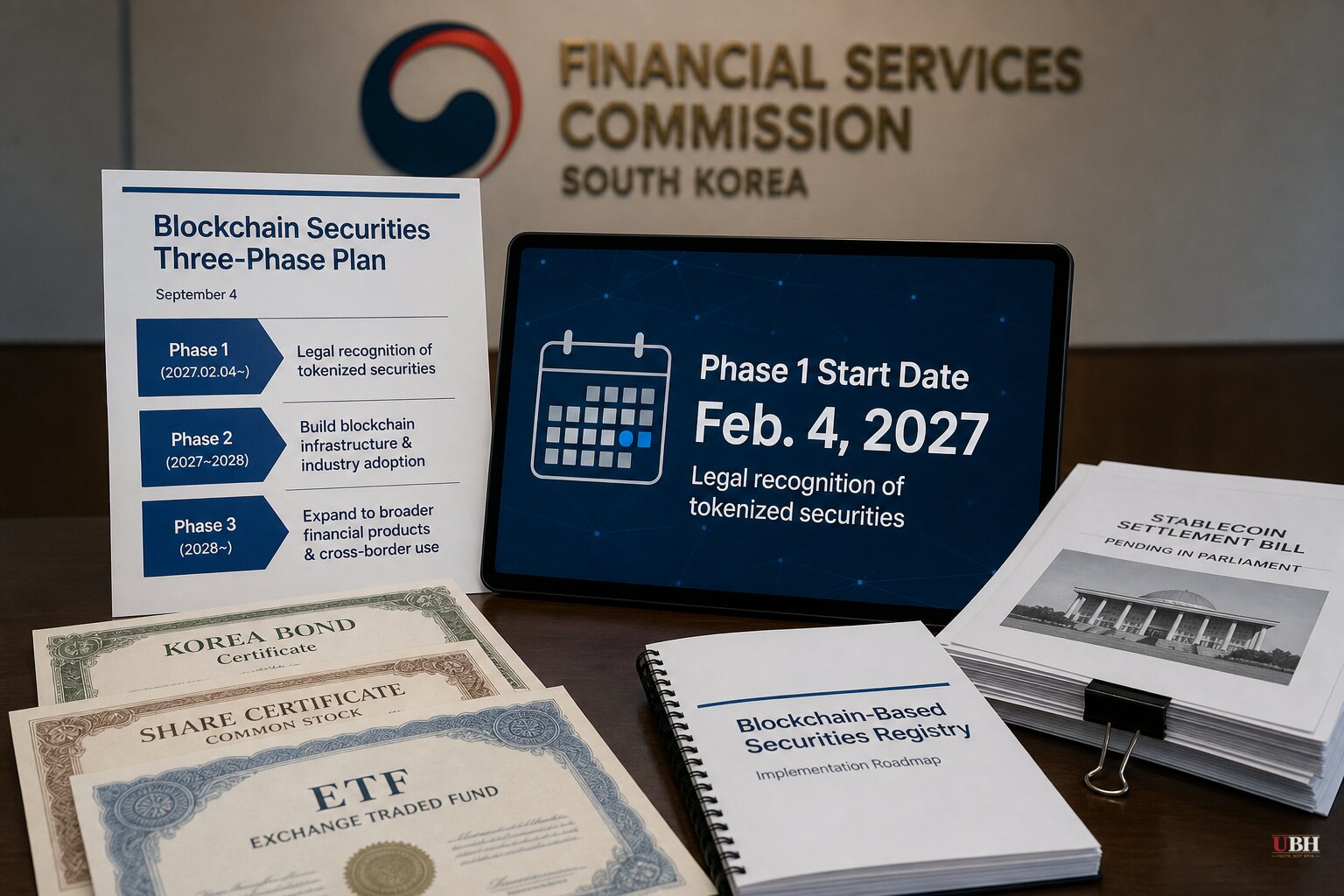
Since South Korea's National Assembly passed amendments to the Act on Electronic Registration of Stocks and Bonds on January 15, 2026, the country's financial regulators have been building toward a hard launch date. On September 4, 2026, the Financial Services Commission finally put a full roadmap on the table, and it's bigger than anyone expected.
At the third public-private joint tokenized securities council meeting, held at the Korea Securities Depository's Seoul headquarters, FSC Vice Chairman Kwon Dae-young told the room the goal is to rebuild the entire capital markets stack on distributed ledger technology. Not a pilot. Not a sandbox. Production infrastructure for a G20 economy.
"We will connect the entire value chain of the capital market — issuance, trading, clearing, settlement, exercise of rights and underlying assets — from the perspective of a single digital capital market," Kwon said, according to Tech Times.
Three Phases, One Legislative Roadblock
Phase one starts February 4, 2027, the day amendments to the Electronic Registration Act take legal effect. That phase covers privately placed money market funds and corporate bonds restricted to institutional investors, unlisted stocks held through trust structures, and publicly offered fractional investment securities, according to Crypto.news and AMBCrypto.
Phase two opens the system to every publicly offered security — stocks, bonds, funds, the whole retail market. No start date exists for phase two. The FSC says that depends on how phase one performs and how fast financial firms adopt the required technology, per Crypto Potato.
Phase three is the one that actually changes how money moves: on-chain settlement using stablecoins instead of conventional payment rails. That phase has no timeline either, and for a specific reason. It depends entirely on stablecoin legislation that has sat frozen in the National Assembly for nearly a year, according to Tech Times.
Korea can legally recognize a blockchain ledger as an official securities registry through an act of the legislature. It cannot make lawmakers pass a stablecoin bill on a schedule that matches its own regulatory ambitions. The roadmap for the two most consequential phases exists on paper without a date attached.
The Money and the Guardrails
The FSC also published model standards for fractional investment products. Individual subscriptions are capped at whichever is smaller: 30 million won (about $22,200) or 5% of an issuance. Retail investors face an annual net-purchase cap of 100 million won (roughly $74,000) per exchange, according to Crypto Potato and BigGo Finance.
Existing brokerages can trade tokenized securities over the counter without a new license, though firms must consult the Financial Supervisory Service first. Non-bank entities that manage tokenized securities accounts need at least 4 billion won (about $2.9 million) in equity capital plus dedicated staff for internal controls and IT security.
Samsung SDS won the contract to build the tokenized securities platform for the Korea Securities Depository, with completion targeted around the February 2027 launch, per Crypto.news. Revised rules under the Financial Investment Services and Capital Markets Act and the Electronic Registration Act are due by the end of September 2026.
The IMF's Warning, Stated Fairly
Critics of rapid tokenization have a real argument. The IMF warned in an April 2026 note, cited by Crypto Potato and Bitcoin Ethereum News, that tokenization removes the settlement delays banks currently rely on to manage liquidity. Those delays also give regulators a window to intervene before a problem becomes a crisis. The fund flagged liquidity pressure, thin oversight of smart contracts, and the difficulty of policing assets that cross borders as the core risks, and argued that public infrastructure like a central bank digital currency is what keeps a tokenized market from amplifying instability rather than containing it.
That's a legitimate institutional concern from an interested body that watches financial stability for a living. It doesn't mean the FSC's plan is reckless. Seoul is building this in phases specifically to test institutional products before opening it to retail money, and it's pointing to BlackRock's BUIDL fund and Hong Kong's tokenized green bonds as working precedents, according to BigGo Finance. The IMF's concern remains open: what replaces the settlement delay as a circuit breaker when trades clear instantly on a shared ledger.
South Korea isn't waiting on that answer to move forward with phase one. It counts 11.3 million verified crypto users and daily equity trading volumes that rival major digital asset exchanges, per BigGo Finance — a market with the retail depth to make tokenized securities mainstream fast. Whether phase three ever happens on schedule now rests with lawmakers in Seoul, not regulators.
Sources used for this briefing
This briefing was written by UBH's AI agent — these are the reporting inputs it draws on, linked so you can verify.


