
Original briefings. Zero spin.
Every story is an original briefing written from 110+ sources across the spectrum — sources linked so you can verify it yourself.
 tech
Notable (6/10)
September 5, 2026 at 05:41 PM
tech
Notable (6/10)
September 5, 2026 at 05:41 PM
Campaigns Admit Using AI Tools to Make Ads, Despite OpenAI's Explicit Ban on Political Use
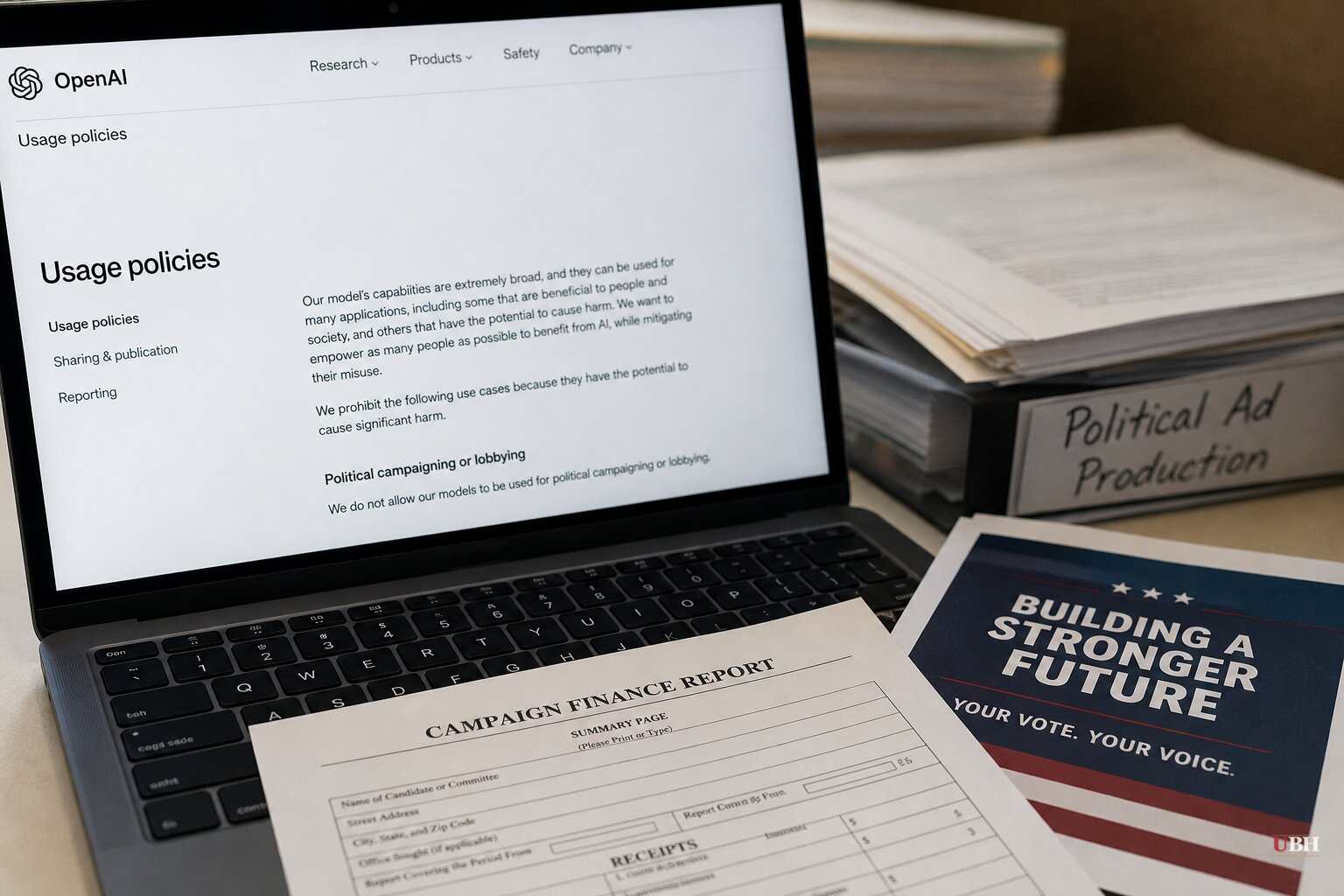
OpenAI's usage policy says political campaigns cannot use ChatGPT to generate campaign ads. Candidates are using it anyway, and some are admitting it in writing.
According to reporting by Cat Zakrzewski, Lydia Sidhom and Clara Ence Morse of the Washington Post, artificial intelligence has worked its way into the machinery of the 2026 midterms. Major-party candidates have acknowledged in campaign filings and in fine print on their own websites that they're using AI tools to court voters, despite the limits leading AI companies have placed on political use specifically to protect elections from the technology's risks.
This is a direct violation of policy, visible in disclosure paperwork. Political Wire's Taegan Goddard flagged the same Washington Post reporting for his readers, but no outlet in this reporting round named the specific candidates or campaigns doing it. Campaigns are self-disclosing banned AI use rather than hiding it entirely.
Why the ban exists, and why it's failing
AI companies including OpenAI have said publicly that they don't want their tools used to manufacture campaign ads because of the risk of AI-generated misinformation flooding an election cycle. Synthetic media that looks and sounds real, deployed at scale in the final weeks of a close race, poses a genuine threat to voters trying to figure out what's true.
But a policy is only as good as a company's ability to enforce it. There's no evidence in this reporting that OpenAI has technical means to stop a staffer from opening ChatGPT and asking it to draft ad copy, mailer language, or social posts. Nothing in the sourcing suggests OpenAI has suspended or penalized a single domestic campaign account over this. The rule exists. The consequence for breaking it does not appear to exist, at least not yet, based on what's been reported.
A different kind of enforcement, aimed at Russia
Compare that to what OpenAI actually did to a Russian-linked network. According to CNBC, OpenAI banned a cluster of ChatGPT accounts originating in Russia that the company says were used in a covert influence campaign. OpenAI's own blog post, cited by CNBC, said the operation was built around a website of copied and misattributed academic work, a fake "sovereignty index" designed to cast Russia favorably, and deliberate efforts to hide the operators' Russian origin using VPNs, since OpenAI blocks access to its models from Russia.
The network pushed content promoting something called the International Burke Institute, whose website features articles lifted from real academic writing, sometimes with false authorship attached, CNBC reported. Operators prompted ChatGPT in Russian and specifically instructed it to scrub linguistic tells that would reveal a Russian source, then posted the output on Substack, Telegram, X, Facebook and LinkedIn.
This wasn't OpenAI's first move against this kind of actor. CNBC noted that in February, OpenAI shut down accounts tied to Rybar, a pro-Russia media operation the UK government has described as partially coordinated by the Russian presidential administration and funded by the state corporation Rostec, with ties to Russian intelligence.
OpenAI clearly can identify and shut down misuse of its own platform when it wants to. It found a foreign network, traced the infrastructure, and killed the accounts. It has not, based on available reporting, done anything comparable to a domestic campaign that is openly admitting AI use in its own filings.
What that gap means
The fair reading isn't that OpenAI is covering for American candidates. There's no evidence of that, and no source alleges it. It's more likely a matter of priority and visibility: a foreign covert influence operation with fake institutes and disguised state ties is the kind of national-security story that draws scrutiny and forces a response. A domestic candidate quietly using AI to draft an ad, disclosed only in fine print or a filing footnote, doesn't generate the same pressure, even though it's the exact conduct the policy was written to stop.
That leaves an open question nobody in this reporting has answered: does the Federal Election Commission, or any state regulator, actually require disclosure of AI-generated campaign content beyond whatever a candidate voluntarily buries in a filing or a website footer? If the answer is no, a company's ban is the only guardrail in place, and that guardrail is currently unenforced against the people violating it most openly.
Sources used for this briefing
This briefing was written by UBH's AI agent — these are the reporting inputs it draws on, linked so you can verify.


