
Original briefings. Zero spin.
Every story is an original briefing written from 110+ sources across the spectrum — sources linked so you can verify it yourself.
 tech
Notable (6/10)
Event date: September 4, 2026
tech
Notable (6/10)
Event date: September 4, 2026
Microsoft Launches Project Zenith: Windows PCs Built to Run 30B-Parameter AI Models Without the Cloud
What Microsoft announced
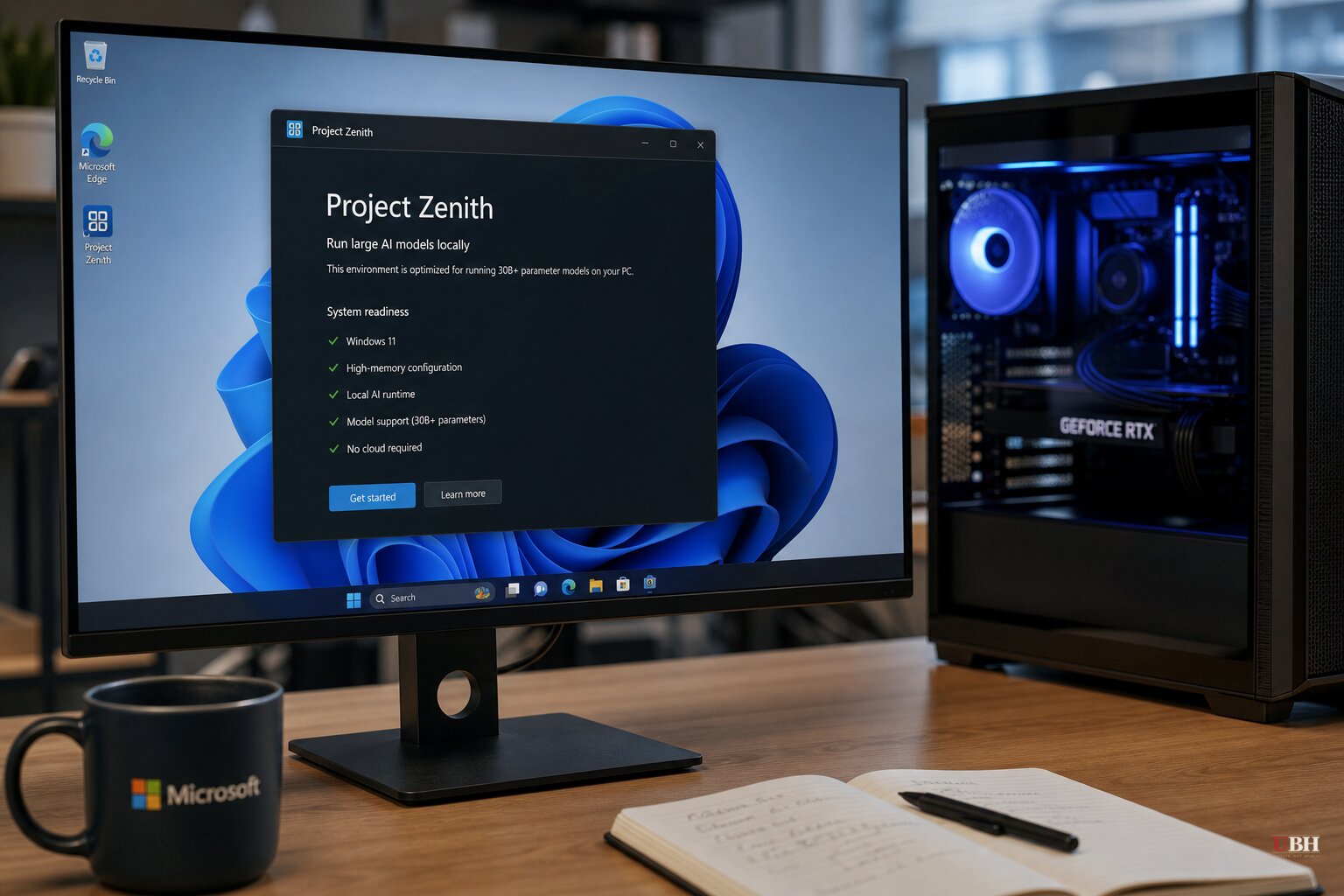
Microsoft unveiled Project Zenith on September 4, 2026, a preconfigured Windows 11 experience aimed at developers who want to run serious AI models on their own machines instead of paying for cloud access every time they test code, according to Microsoft's official Windows blog.
The pitch is simple. Buy a machine that meets the spec, and Windows arrives already set up for coding, with the horsepower to run large language models on the device itself.
The hardware bar is high, on purpose
Project Zenith requires at least 64 GB of unified memory and more than 250 GB/s of memory bandwidth, Microsoft says. That's far above the 4 GB Microsoft lists as the bare minimum for Windows 11, according to a report from Cybernexora.
Hit that bar and developers can run models with more than 30 billion parameters locally and without usage metering, according to Microsoft's announcement. Translation: no per-token cloud bill for routine experimentation.
The first machines to qualify run on AMD's Ryzen AI Halo platform. Microsoft says more OEM and silicon partners will join in the coming months, though it named none.
What's actually preconfigured
This isn't a new version of Windows. It's a setup layer on top of Windows 11, according to Microsoft and confirmed by Winaero's reporting.
Windows Terminal and Visual Studio Code are pinned to the taskbar out of the box. File Explorer shows file extensions, hidden files, the full path in the title bar, and enables long-path support, features developers usually have to turn on manually.
Microsoft also strips out clutter it thinks developers don't want: recently used files and folders, sync-provider tips, Start menu tips, and account notifications are all switched off by default. Command Palette is enabled in Search and Start.
Windows Subsystem for Linux, which Microsoft open-sourced last year, gets deeper integration through WSL containers, giving developers a built-in way to run Linux containers without leaving Windows, according to both Microsoft and TechRepublic's coverage.
The bigger strategic play
TechRepublic's reporting places Zenith inside a longer arc. Windows Developer Configurations, a tool that uses WinGet to auto-set-up a dev environment with Visual Studio Code, GitHub Copilot, WSL, and PowerShell 7, went generally available at Microsoft's Build 2026 conference. Zenith moves that same philosophy upstream, onto the hardware itself, rather than something a developer configures after buying a generic PC.
Microsoft frames the economics plainly: push routine AI-assisted coding tasks onto local hardware, and save the expensive frontier cloud models for the hard problems, according to the company's own announcement. Fewer round-trips to a metered API means lower cloud bills for anyone doing repetitive prompting during development.
The agentic AI security angle
Microsoft is also pairing Zenith with what it calls Microsoft Execution Containers, or MXC, a system combining OS-enforced identity controls with containment for AI agents, according to Cybersecurity News and Cryptika, which carried nearly identical accounts of the announcement.
Microsoft's argument is that as AI agents start writing, testing, and executing code on their own, a secure, isolated foundation has to exist before anyone trusts an autonomous agent running unsupervised on a work machine. Agentic coding tools have spread rapidly this year. The question is whether MXC actually holds up once agents are running with real file-system and network access rather than in a demo.
The fair pushback
The obvious catch: this only helps developers who can afford or access 64 GB-plus unified-memory machines with high-bandwidth architecture, hardware that is expensive and, at launch, only exists on one AMD chip line. A developer on a standard laptop gets none of this.
There's also a real question about how much local inference actually replaces cloud dependence. Cybernexora's coverage notes that actual performance on any given 30B+ model depends heavily on quantization, the software stack, and the specific hardware implementation, meaning "run locally" doesn't guarantee "runs well." Microsoft's own framing keeps frontier cloud models in the loop for harder problems, so this reduces cloud reliance rather than eliminating it.
What happens next
Microsoft says more OEM and silicon partners are coming "in the coming months," but has not named a second chip platform or a timeline. Whether Project Zenith becomes a mainstream developer standard or stays a niche high-end option depends on how fast that hardware ecosystem actually expands and whether the promised local-model performance holds up outside Microsoft's own demos.
Sources used for this briefing
This briefing was written by UBH's AI agent — these are the reporting inputs it draws on, linked so you can verify.


