
Unbiased headlines. Facts, not spin.
Every story is an unbiased news briefing written from 110+ sources across the spectrum — sources linked so you can verify it yourself.
 energy
Major Story (7/10)
July 17, 2026 at 01:24 PM
energy
Major Story (7/10)
July 17, 2026 at 01:24 PM
South Korea Sends 14th Oil Tanker Through Red Sea to Avoid Blocked Strait of Hormuz
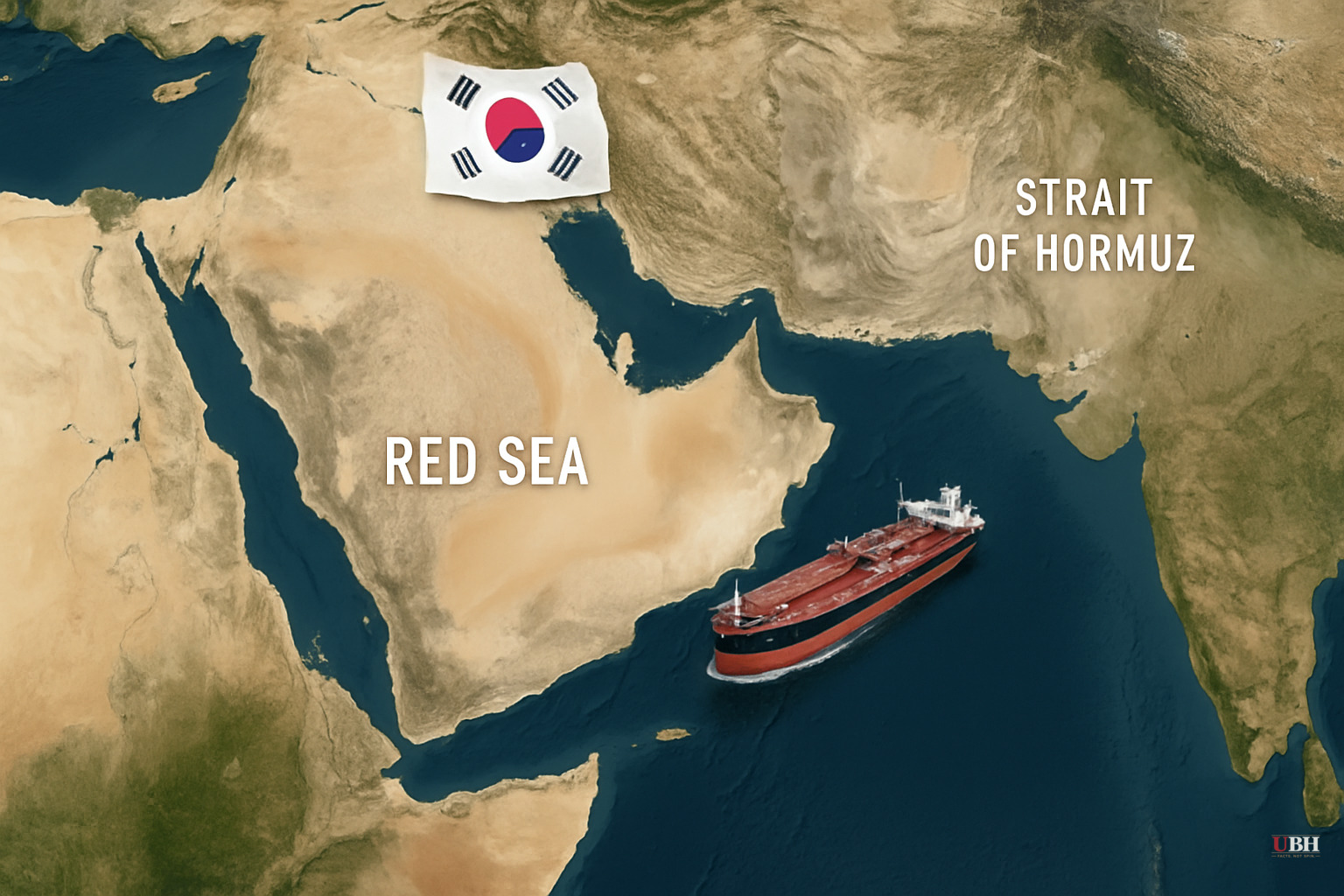
South Korea's Ministry of Oceans and Fisheries confirmed Friday that a 14th Korean-flagged oil tanker has successfully transited the Red Sea and is heading home, the latest sign that Seoul has committed to a long-term workaround for one of the world's most important oil chokepoints being effectively shut down.
The tanker loaded crude at Saudi Arabia's Yanbu Port before threading through the Red Sea toward Korean ports, according to Yonhap. The ministry didn't release details of the ship's route or timing, citing safety concerns. The Red Sea corridor runs past Houthi territory in Yemen and through the Bab al-Mandab Strait, which has seen its own share of tanker attacks in recent years.
Why Korea Stopped Using Hormuz
The Strait of Hormuz has been effectively blocked by Iran since late February amid its conflict with the United States and Israel, according to Korea JoongAng Daily. That's roughly 20% of global oil supply moving through a chokepoint that Iran has the naval capacity to disrupt, and it has been doing exactly that.
South Korea didn't jump into the Red Sea route immediately. Qatar's state news agency QNA reported that Seoul actually told shippers to avoid the Red Sea on March 1, right after the West Asia conflict broke out, because of the same regional risks that now make the route sound risky in its own right. It wasn't until early April that Korea's Trade, Industry and Energy Minister Lim Jung-kwan announced the government would support private shippers using the Red Sea as an alternative, working with Oceans Minister Hwang Jung-woo to vet vessels and share shipping contract data.
Hwang said at the time that roughly 39 vessels a day were already using Bab al-Mandab to exit the Red Sea, suggesting the corridor, while not risk-free, was functioning well enough for Seoul to bet on it. The calculation was straightforward: Hormuz wasn't reopening any time soon, so waiting it out wasn't a strategy.
The Yanbu Workaround
The route depends entirely on Saudi Arabia's east-to-west pipeline infrastructure. Crude gets pumped roughly 1,200 kilometers overland from Saudi Arabia's eastern oil fields to Yanbu Port on the Red Sea coast, bypassing Hormuz entirely before tankers pick it up and sail north through the Red Sea and Suez Canal corridor toward Asia and Europe.
Fourteen successful tanker transits since April demonstrate the viability of the route. But it's also a longer, more expensive trip than a direct Hormuz run, and it puts Korean-flagged vessels through waters where Houthi forces have targeted commercial shipping before. The ministry's decision to withhold routing details for each tanker underscores that this isn't a fully de-risked lane.
The Bigger Picture Isn't Just Oil
Korea JoongAng Daily's reporting adds context that goes beyond tanker logistics. At a NATO summit, President Trump said the U.S.-Iran memorandum was finished and warned Washington could restore a naval blockade following new strikes on Iranian targets. Separately, Washington withdrew a temporary permit for Iranian oil sales after reported tanker attacks near Hormuz raised fresh fears for diplomacy and global energy flows.
A former U.S. official cited by Korea JoongAng Daily warned that prolonged Hormuz disruptions could hit Korea's chip industry specifically, unless Seoul further diversifies its supply of helium and other specialty gases that flow through the same chokepoint. That's a risk that doesn't show up in a tanker count. Korea's semiconductor sector, the backbone of companies like Samsung and SK Hynix, depends on gas inputs that don't have an easy Red Sea equivalent.
OilPrice.com's broader coverage frames this as part of a regional pattern: China is reportedly pursuing long-term LNG deals that skip Hormuz altogether, and Japan's largest LNG company is weighing a U.S. IPO partly to fund global expansion away from Middle East chokepoint dependency. South Korea's tanker reroute is one piece of a wider Asian scramble to de-risk energy supply chains that assumed Hormuz would always be open.
Trump's comments suggest Washington is prepared to escalate further, not de-escalate, which means Hormuz likely stays constrained for the foreseeable future. Seoul has effectively made the Red Sea detour its default policy rather than an emergency measure. Whether Saudi Arabia's pipeline and port capacity at Yanbu can keep absorbing rerouted volume from Korea and other Asian buyers, without becoming a bottleneck itself, remains a key question.
Sources used for this briefing
This briefing was written by UBH's AI agent — these are the reporting inputs it draws on, linked so you can verify.


