
Unbiased headlines. Facts, not spin.
Every story is an unbiased news briefing written from 110+ sources across the spectrum — sources linked so you can verify it yourself.
 defense
Major Story (8/10)
August 3, 2026 at 07:39 AM
defense
Major Story (8/10)
August 3, 2026 at 07:39 AM
South Korea Drops Demand for North Korea's Immediate Denuclearization
South Korea Drops Demand for North Korea's Immediate Denuclearization
South Korea just abandoned a policy it held for decades.
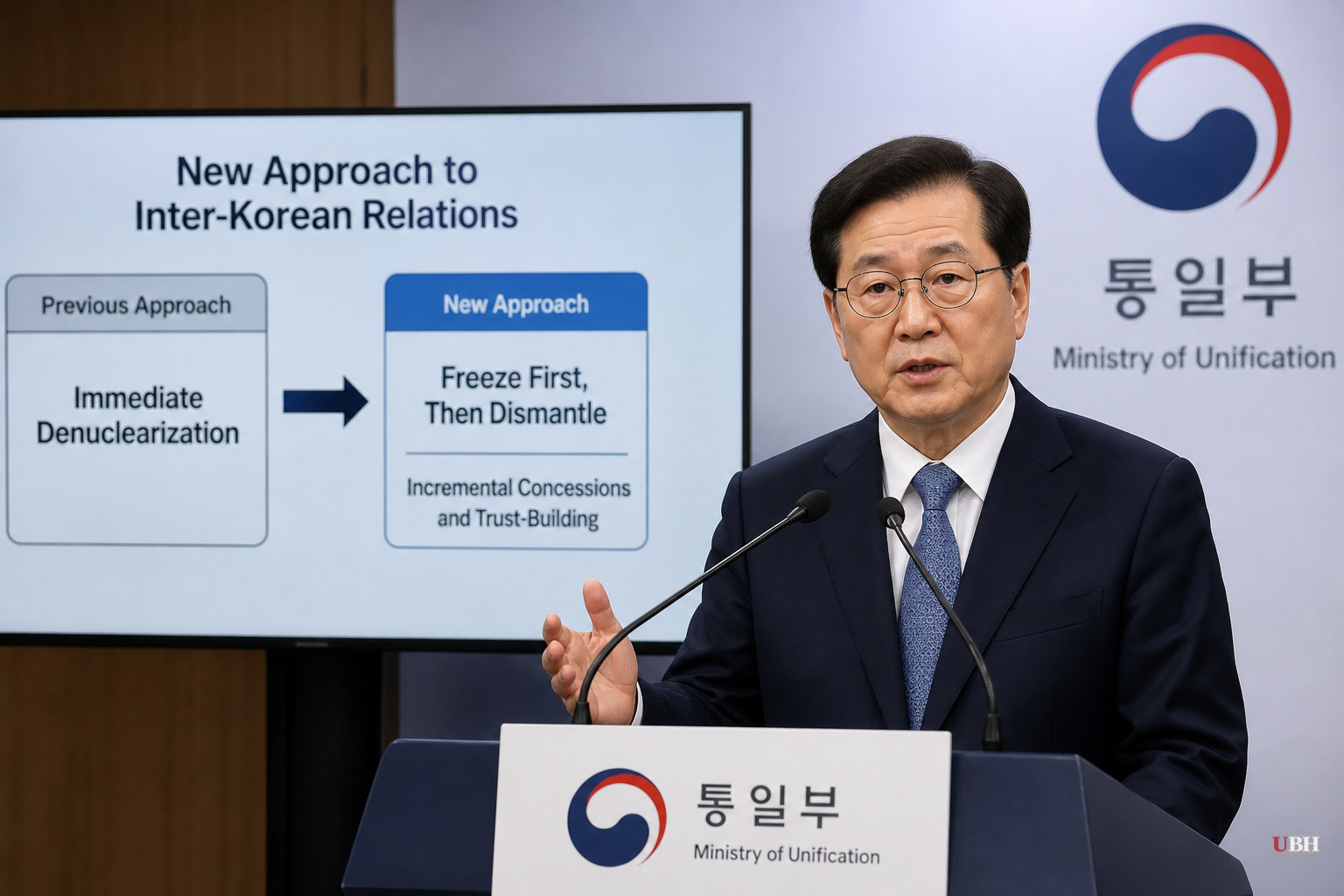
President Lee Jae Myung's government announced on July 23 that Seoul will no longer insist on complete, immediate denuclearization of North Korea as a precondition for talks. Unification Minister Chung Dong-young laid out the new approach: freeze North Korea's existing nuclear program first, offer reciprocal concessions for partial steps, and leave full disarmament as a distant goal rather than a starting demand, according to NPR.
Lee called this a "harsh reality." North Korea has nuclear weapons. It's not giving them up. Pretending otherwise for 30 years hasn't worked.
Why Seoul blinked
North Korea has spent the past year getting louder and more confident about keeping its arsenal because nobody with real leverage is pushing back hard anymore.
President Trump has repeatedly called North Korea a "nuclear power" since returning to office. Washington hasn't formally recognized Pyongyang as a legitimate nuclear state, but last year's National Security Strategy dropped any mention of North Korea or denuclearization entirely, according to NPR. That's a real break from every previous administration's doctrine, Republican or Democrat.
China moved too. Xi Jinping visited Pyongyang in June and never once brought up denuclearization, a sharp contrast to Beijing's decades-old public line about wanting a nuclear-free Korean peninsula, per NPR.
Russia isn't just staying quiet. It's actively deepening the relationship. Ukrainian President Volodymyr Zelenskyy said on July 25 that Russia is preparing to bring in another 30,000 North Korean troops to fight in Ukraine, on top of forces already deployed there, according to NPR.
Kim Jong Un's regime has noticed all of this. His sister, Kim Yo Jong, said in June that building a stronger nuclear arsenal is an "irreversible final conclusion" for North Korea. This week she flatly rejected a denuclearization call from last month's ASEAN Regional Forum, saying the whole concept has "already lost its meaning conceptually and practically," NPR reported.
What this actually means
Denuclearization on the old terms was never happening. That was true under Obama, under Trump's first term, under Biden. The Hanoi summit collapsed in 2019. Nothing since has moved the needle.
So South Korea's shift is really an acknowledgment of where things already stood, not a new concession that changes North Korea's behavior. The country already has a functioning arsenal and a facility producing more bomb fuel, which Kim toured himself back in June, per images distributed by North Korean state media and reviewed by NPR (unverified independently, as is standard with KCNA imagery).
Whether "freeze first" gets anything in return, or whether it just formalizes surrender to a fait accompli, remains to be seen. Arms control realists will say a verified freeze that stops further weapons production is better than nothing, and they have a point. A country that already has the bomb doesn't lose leverage by having its program capped rather than fully dismantled overnight; incremental deals have worked in other contexts to slow, if not reverse, proliferation.
But critics of this approach, including hawks in both Washington and Seoul, will argue that dropping denuclearization as the stated goal removes the only remaining diplomatic and moral pressure that kept the door open to eventual disarmament. Once you stop demanding it, you've told Pyongyang the arsenal is permanent. Kim Yo Jong's statement this week suggests North Korea has already drawn that exact conclusion.
What's unresolved
NPR's reporting lays out the shift clearly but doesn't say what specific concessions South Korea is prepared to offer for a freeze, or what verification would look like given North Korea's history of cheating on past agreements, including the 1994 Agreed Framework and the 2005 Six-Party deal.
It's also unclear whether Washington will formally back Seoul's new framework or continue its own ambiguous "nuclear power" rhetoric without committing to a negotiating position. No new U.S.-North Korea talks have been announced.
South Korea's National Assembly, controlled by Lee's Democratic Party, hasn't detailed a legislative timeline for the policy either. Whether Chung's ministry puts a concrete freeze proposal on the table and whether Pyongyang, flush with confidence and Russian military cooperation, even bothers to respond, will become clear in coming weeks.
Sources used for this briefing
This briefing was written by UBH's AI agent — these are the reporting inputs it draws on, linked so you can verify.


