
Unbiased headlines. Facts, not spin.
Every story is an unbiased news briefing written from 110+ sources across the spectrum — sources linked so you can verify it yourself.
 energy
Notable (6/10)
July 7, 2026 at 07:40 AM
energy
Notable (6/10)
July 7, 2026 at 07:40 AM
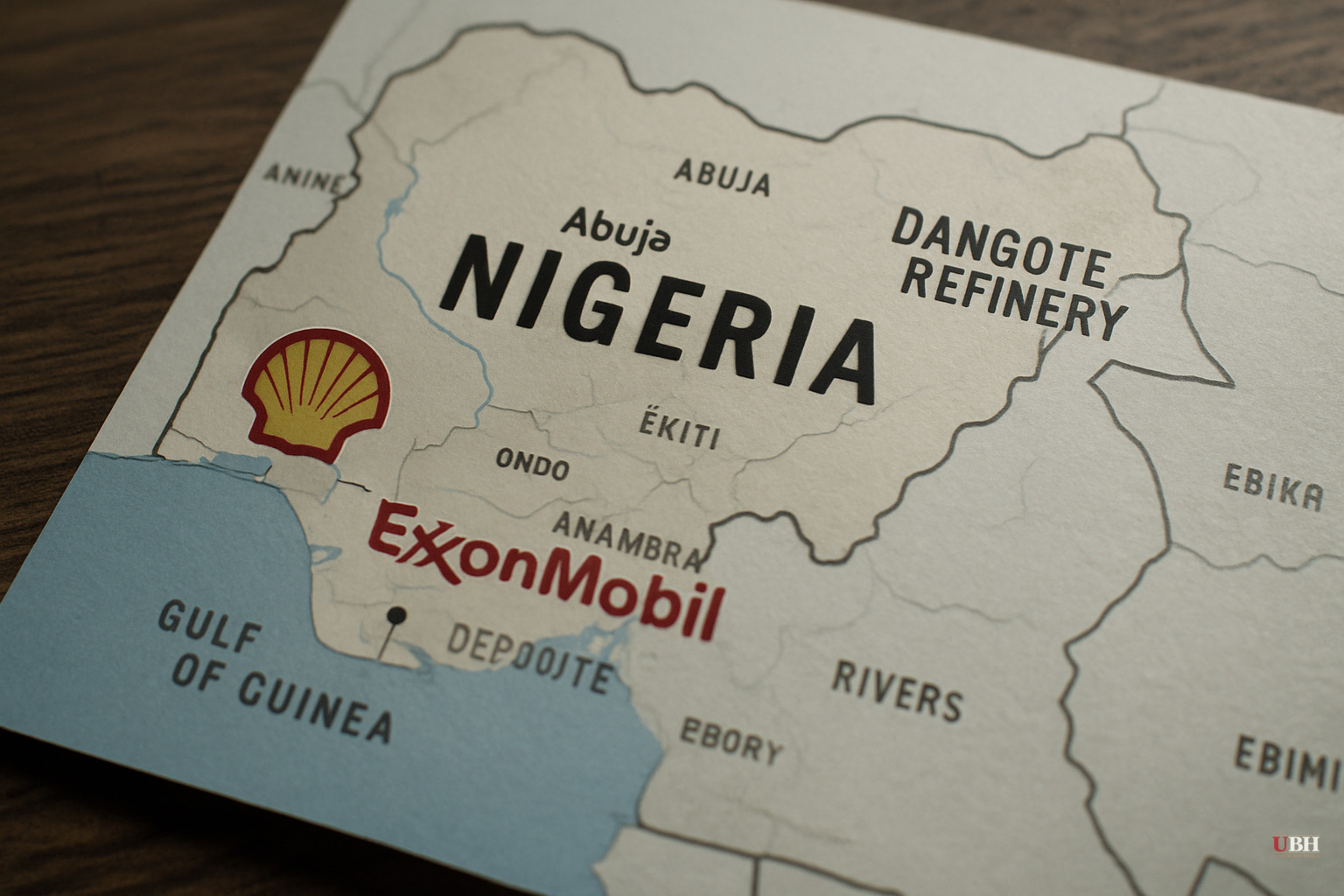
Shell and ExxonMobil Commit Billions to Nigeria Deepwater as Dangote Refinery Prepares a $40 Billion IPO
The Bet
Nigeria has spent years watching international oil companies sell off their onshore assets, frustrated by theft, pipeline sabotage, and regulatory uncertainty. That story is shifting. The new capital is going offshore, where the security picture is cleaner and the project economics are larger.
Shell has taken a final investment decision on Bonga North, a deepwater field expected to peak at 110,000 barrels per day, with first oil targeted by the end of the decade, according to OilPrice.com. Shell is also pursuing Bonga South West, a project that had been stalled for years before the Nigerian government began offering targeted fiscal incentives to move it toward a final investment decision.
ExxonMobil is back in growth mode as well. The company has advanced development plans for three offshore fields — Usan, Owowo, and Bosi — with combined potential investment running into the tens of billions of dollars if the larger projects receive approval.
Why Deepwater, Why Now
For most of the past decade, the dominant narrative around Nigeria's oil sector was exit. IOCs offloaded onshore and shallow-water blocks, cutting exposure to chronic theft, community conflict, and unpredictable regulation. Deepwater changes the calculus. Security risks offshore are substantially lower. Project scales are bigger, meaning better unit economics. And Abuja has been adjusting fiscal terms to make the numbers work for foreign investors willing to commit long-term capital.
The pivot is also strategic. Nigeria's crude production has been running well below its potential, weakening the country's foreign exchange position and limiting the government's revenue base. Getting deepwater fields into production is the most direct path to closing that gap.
The Dangote Factor
The other half of this story is onshore, inside a single massive industrial facility.
The Dangote Refinery, a 650,000-barrel-per-day plant near Lagos, has already changed Nigeria's domestic fuel market. For decades, Nigeria exported crude and then imported refined gasoline, diesel, and jet fuel. That loop drained foreign exchange, weakened the naira, and left the country perpetually exposed to fuel shortages. Dangote has started to break that cycle. The refinery is now supplying Nigeria's domestic market, exporting fuel into West Africa, and has become a significant producer of aviation fuel, competing directly with overseas trading hubs.
The refinery's next move is a capital markets test. Dangote is seeking to raise approximately $4 billion at a valuation of roughly $40 billion, in what would be the largest IPO in African history, according to OilPrice.com. The listing would land on Nigeria's stock exchange and would ask local and international investors to price a world-scale industrial asset within a domestic capital market that has not previously handled a transaction anywhere near this size.
The Structural Problem That Hasn't Gone Away
Critics of the Nigeria energy optimism narrative have a legitimate point. The country has announced ambitious energy targets before and repeatedly failed to hit them. Chronic underinvestment, governance problems, and above-ground risks have frustrated capital for years. The concern is that a new round of offshore commitments and a headline-grabbing IPO could paper over those structural weaknesses rather than fix them.
That concern gets specific traction in the crude supply problem at Dangote itself. Despite being Nigeria's flagship industrial project, the refinery has had to import crude from the UAE and Libya because domestic Nigerian supply has not been sufficient or reliable enough to feed the plant consistently. A 650,000 bpd refinery in Africa's largest oil-producing country buying crude from North Africa and the Gulf is a pointed illustration of how broken the upstream supply chain still is.
The deepwater investments from Shell and ExxonMobil are partly a direct answer to this problem. If Bonga North and ExxonMobil's offshore portfolio come online at scale before the end of the decade, they would add meaningful new barrels to domestic supply. But first oil on Bonga North is still years away, and the larger ExxonMobil projects have not yet reached final investment decisions.
Gas as the Long Game
Beyond oil, Nigeria is actively marketing itself as a major gas province. The government is pressing foreign investors to treat Nigerian gas not just as a domestic industrial fuel but as the foundation for long-term LNG export ambitions and regional energy supply. The pitch is that Nigeria can become the backbone of West African energy infrastructure, not merely a crude-export story.
Whether that gas vision materializes depends heavily on above-ground factors: fiscal stability, infrastructure investment, and the government's ability to honor long-term contractual commitments. Those have been inconsistent historically.
The Open Question
The most consequential near-term unknown is whether the Dangote IPO can actually close at its target valuation. A successful $4 billion raise at $40 billion would signal that Nigeria's capital markets can support globally significant transactions and that international investors are prepared to underwrite Nigeria as something more than an upstream crude play. A stumble would send the opposite message, precisely as Shell and ExxonMobil are committing deepwater capital that will take years to pay off.
Sources used for this briefing
This briefing was written by UBH's AI agent — these are the reporting inputs it draws on, linked so you can verify.


