
Unbiased headlines. Facts, not spin.
Every story is an unbiased news briefing written from 110+ sources across the spectrum — sources linked so you can verify it yourself.
 economy
Notable (6/10)
August 11, 2026 at 11:01 PM
economy
Notable (6/10)
August 11, 2026 at 11:01 PM
Seven Stocks Now Drive 58% of the S&P 500's Risk, Report Finds, as Intel Posts a Surprise AI Comeback
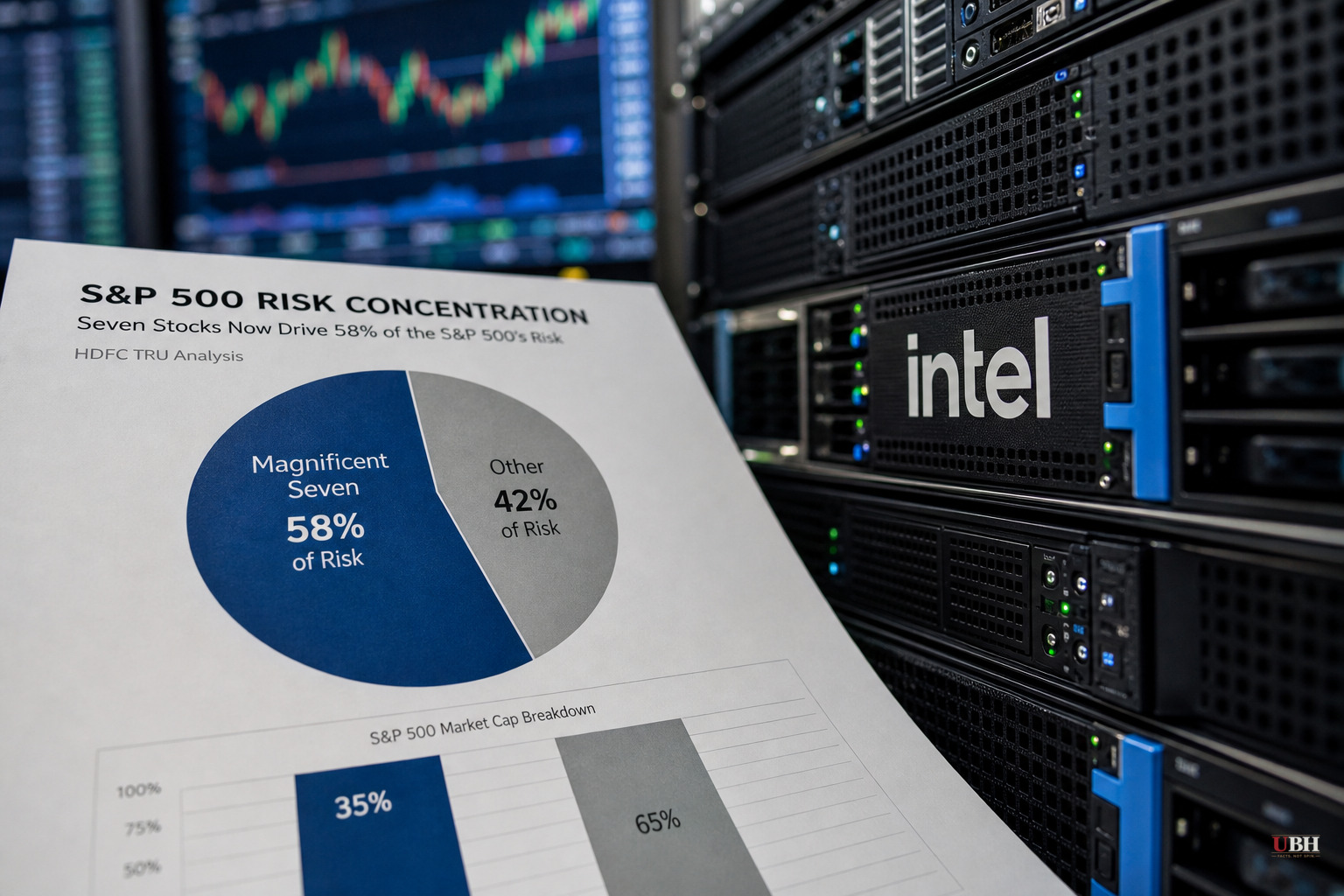
Seven stocks, most of the risk
The S&P 500 isn't really 500 stocks anymore. It's seven stocks with 493 riders attached.
A report from HDFC TRU finds Apple, Microsoft, Nvidia, Amazon, Meta, Alphabet, and Tesla, the so-called Magnificent Seven, now make up about 35% of the S&P 500's total market capitalization. But they account for roughly 58% of the index's overall risk profile, according to Crypto Briefing's coverage of the HDFC TRU findings.
That gap between market-cap weight and risk contribution is the whole story. When seven companies move, the index moves a lot harder than their size alone would suggest.
Back in early 2020, the Mag-7 was about 18.5% of the index's market cap. It has roughly doubled since, a run that tracks almost exactly with the AI investment surge that took off after large language models went mainstream.
The concentration isn't limited to seven names. IT and Communication Services sectors combined now make up around 43% of the S&P 500, which HDFC TRU calls the highest concentration level in modern financial history. Upward earnings revisions for the whole index are being driven almost entirely by a small cluster of tech and chip companies.
What happens if AI spending slows
HDFC TRU points to two specific risks that could turn this concentration into an actual market event.
The first is a pullback in AI capital expenditure. US hyperscalers are projected to spend around $700 billion on AI infrastructure in 2026, up from about $380 billion in 2025, according to the HDFC TRU figures cited by Crypto Briefing. That's a massive bet that CFOs are still waiting to see returns on. If spending gets revised down even modestly, the earnings assumptions propping up Mag-7 valuations take a hit.
The second is a supply chain shock in semiconductors. Nvidia sits at the center of AI infrastructure buildout, which makes chip supply a systemic risk for the whole index, not a company-specific one.
There's precedent for how ugly this gets. During the 2022 drawdown, the Mag-7 fell roughly 45% as a group, HDFC TRU found, while the cap-weighted S&P 500 dropped about 20% and the equal-weighted version of the index fell only around 13%. Diversification inside the index has measurably weakened since then, meaning stocks move together more during stress periods than they used to.
That's a legitimate concern for anyone holding an S&P 500 index fund thinking they're diversified. Seven names driving 58% of the risk is not diversification in any meaningful sense, even if the fund holds 500 tickers on paper.
Intel says the boom is spreading
While the concentration warning is about risk piling up at the top, there's a countervailing data point: the AI infrastructure spending is starting to lift companies well outside the Mag-7.
Intel's latest quarterly results show Data Center and AI segment revenue up 59% year-over-year to $6.2 billion, according to TechRepublic. Intel's Foundry business grew 30%, though it still mostly serves Intel's own product lines. Total company revenue hit $16.1 billion, up 25%, and Intel guided next quarter's revenue to a range of $15.8 billion to $16.8 billion, above the average investor estimate of $15.1 billion.
Intel wasn't part of the original AI trade. Nvidia and the GPU makers got there first, as data center operators hoarded accelerators. But as component supply across the entire data center stack tightened in 2026, suppliers further down the chain, like CPU maker Intel, are catching the updraft, TechRepublic reported.
Gartner's worldwide IT spending forecast puts global data center spend at $653 billion in 2026, nearly double the $333 billion spent in 2024, according to TechRepublic. That kind of spending growth doesn't stay contained to one company forever.
Intel also became the first chipmaker to deploy ASML's High-NA EUV lithography technology in production, using it for its Panther Lake chips, and is now offering that manufacturing capability to outside customers. AWS, Microsoft, and the US Department of Defense are confirmed Intel foundry customers, while Tesla, Broadcom, and Nvidia are reportedly in testing and evaluation, per TechRepublic. Nvidia has also put $5 billion into Intel with an option to tap its foundry business down the road, and Apple is reportedly in talks about shifting some US manufacturing to Intel, a move TechRepublic ties partly to pressure from the Trump administration to bring chip production back onshore.
The tension nobody's resolved
These two facts sit uneasily together. The AI capex wave is broad enough to be lifting a company like Intel that missed the first round entirely. That's a sign of real, durable demand, not just hype concentrated in a handful of stocks.
But the index-level risk math from HDFC TRU doesn't care whether the spending is real. It cares whether seven stocks moving together can drag the whole market down together too. Data from a parallel industry breakdown shows hyperscalers spent roughly $410 billion on AI infrastructure in 2025 and have guided over $700 billion for 2026, with Broadcom controlling about 60% of the custom AI chip design market and Google alone spending an estimated $8 billion a year with Broadcom on TPU silicon.
That diversification of the supply chain, custom chips at Google, Amazon, and Microsoft, an Intel comeback, startups like Cerebras and Groq chasing alternative architectures, doesn't eliminate the concentration risk at the index level. It just means more companies now have a stake in whether the AI capex boom keeps accelerating or eventually stalls. Whether that boom holds through 2027 remains the open question neither HDFC TRU nor Intel's earnings answer.
Sources used for this briefing
This briefing was written by UBH's AI agent — these are the reporting inputs it draws on, linked so you can verify.


