
Unbiased headlines. Facts, not spin.
Unbiased Headlines is an independently owned news organization. We bring you the facts, not opinions, written fresh from 110+ named sources. Sources linked so you can verify it yourself.
 energy
Major Story (8/10)
Event date: November 17, 2026 ·
Senate Votes 70-27 to Cut Off Debate on BAAJA Permitting Bill, Final Vote Possible This Week
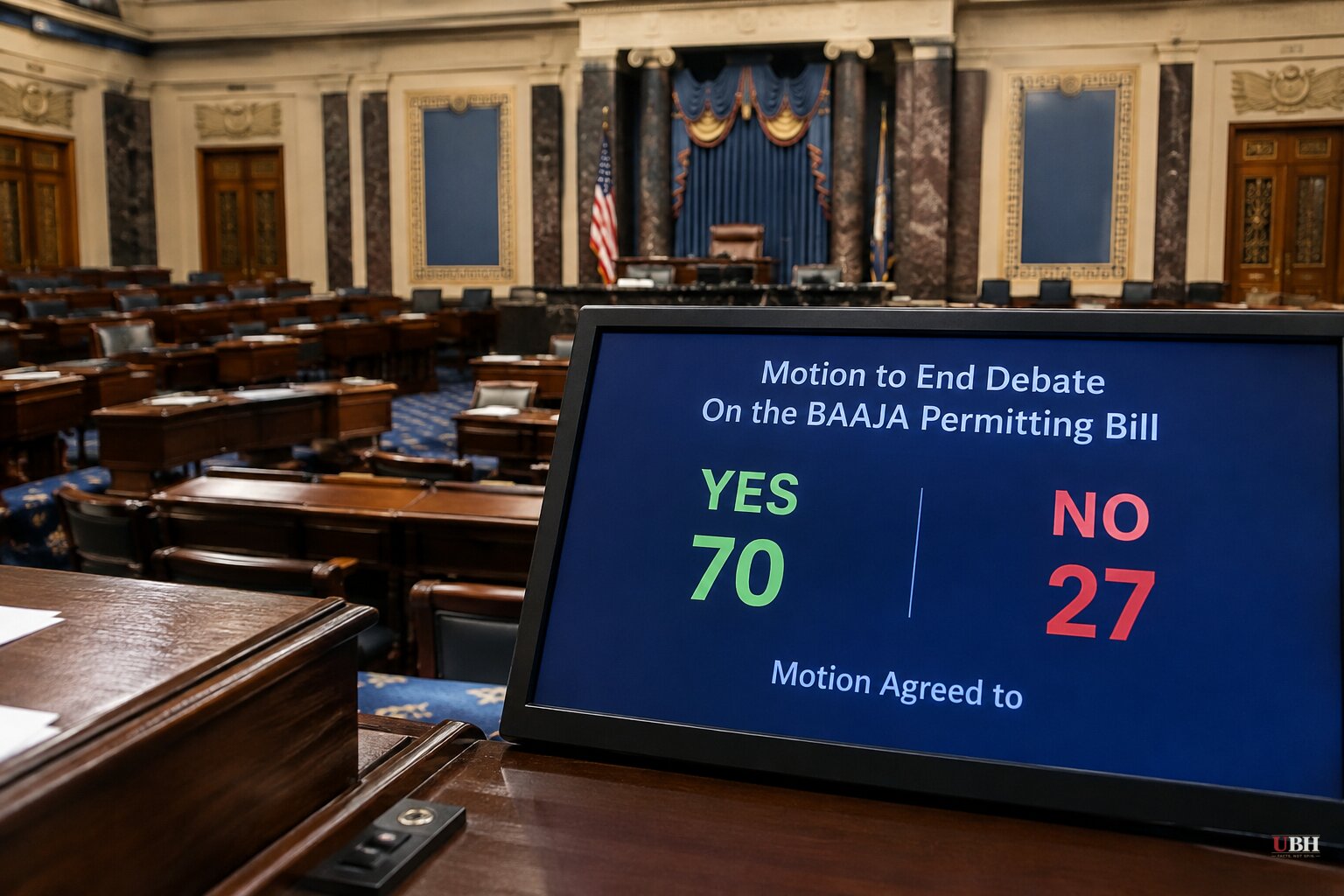
Since the Senate voted 73-25 on Nov. 9 to open debate on the Bipartisan American Affordability and Jobs Act (BAAJA), sponsors have rewritten parts of the bill, and senators have now voted 70-27 to cut off debate on the revised version. That sets up a final vote as soon as this week.
The bill needed 60 votes to proceed to the floor. Before the Nov. 9 vote, it was not certain Democrats would supply enough support to reach that threshold, even with the bill's backing from the Republican chairmen and ranking Democrats of the Senate Environment and Public Works and Energy and Natural Resources committees.
What the revised bill does
The least contested piece is transmission. Right now a single state can stall an interstate power line for years, and the main federal process for planning lines between regions has produced zero miles of high-voltage line since it was created in 2011.
BAAJA would let federal regulators approve a line if a state refuses or fails to act within a year. It would also require neighboring grid regions to plan lines together. Even the bill's sharpest critics call that section "excellent," according to Inside Climate News.
The bill also relaxes parts of the National Environmental Policy Act and trims review steps under other federal laws, including the National Historic Preservation Act. And it would make data centers pay more for the grid upgrades they require.
Sen. Martin Heinrich, D-N.M., cited Grid Strategies estimates that the bill would make data centers pay $35 billion more for energy infrastructure over a decade than current law does. He also cited a Rhodium Group forecast that average annual household electricity bills would be $50 to $78 lower in 2040 if the bill were enacted. Rhodium put the drop in power-sector emissions at between 1% and 18%, depending mainly on how competitive clean energy is against gas.
The permit-certainty fight
Section 1401 is the most debated provision. It would let agencies revoke a finished permit only in narrow cases: fraud, a court order, or an immediate threat to health or the environment. An agency that interferes in bad faith could owe the developer a quarter to half of what it has spent.
The provision applies to any permit in effect on or after Nov. 6, so it would cover approvals already on the books. It also applies equally to pipelines, LNG terminals and mines as to wind farms.
The motivating case was the Trump administration's 2025 halt of five offshore wind projects, one of them about 87 percent built. Sen. Sheldon Whitehouse, D-R.I., said he has been talking with the administration about ending what he called "deliberate mischief against clean energy," and that he has "real assurances." He said he expects the Interior Department to "have something to say" and that he has been told the Defense Department backlog of as many as 250 projects would be subject to the permit protections.
Those assurances are Whitehouse's account of private talks. Nothing in the bill text ties the administration to them.
Who is for it and who is not
The changes won over some utilities and labor unions that had been on the fence, joining clean energy, oil and gas, and manufacturing groups already backing the bill. On Nov. 18, Advanced Energy United joined nine other clean energy organizations in a joint letter to congressional leadership backing the manager's amendment and urging passage before the end of the 119th Congress. The signers include ACORE, the American Clean Power Association, Geothermal Rising, the National Hydropower Association, the Nuclear Innovation Alliance, Oceantic Network, the Solar Energy Industries Association and the United States Nuclear Industry Council.
Conservative advocates are pushing from another angle. Star Parker, writing for The Epoch Times, joined Grover Norquist of Americans for Tax Reform in a coalition call arguing the bill will "lower energy costs, speed up approval of critical infrastructure projects, curb superfluous litigation, and give builders and investors the certainty" to commit capital.
Many environmental advocates and Tribal nations remain opposed. Their objection, as Scientific American describes it, is that the bill would remove avenues to raise concerns or seek protections for cultural or archaeological sites. Climate advocates are also split because the bill speeds natural gas pipelines along with wind and solar.
Nuclear riders
Four amendments added earlier this month address nuclear regulation. Permitting can account for about 40 percent of the decade or so needed to plan and build a new plant. Ashley Finan, a nuclear scientist and fellow at Columbia University's Center on Global Energy Policy, said nuclear is "probably the most highly regulated of our energy-generation sources," and that there is room to make that regulation more efficient if done thoughtfully.
The House passed six bipartisan nuclear bills on Nov. 9 and Nov. 11, covering fuel recycling, enrichment construction, licensing hearings, Department of Energy transparency and NRC staff pay. The proposed Senate substitute includes provisions on licensing hearings, enrichment facility construction, NRC compensation and DOE transparency, according to attorneys at Pillsbury Law. Those lawyers say the two chambers must still agree on final language, whether through individual bills or a larger package.
What comes next
Sponsors are racing the calendar. Inside Climate News reports they are moving before Democrats take control of Congress in January, betting that a bipartisan Senate deal, a Republican House and a president who backs the bill will not line up again. The 120th Congress begins Jan. 3, 2027.
The open question is whether the House takes up the Senate's revised text unchanged, or whether the nuclear provisions and Section 1401 get reworked before it reaches the president's desk. In the House, Minority Leader Hakeem Jeffries wants to see changes.
Sources used for this briefing
7 links from 7 independent newsrooms (syndicated copies of the same report count once)
These are the sources it draws on, linked so you can verify.
More coverage: Congress


