
Unbiased headlines. Facts, not spin.
Every story is an unbiased news briefing written from 110+ sources across the spectrum — sources linked so you can verify it yourself.
 health
Notable (6/10)
July 1, 2026 at 05:33 PM
health
Notable (6/10)
July 1, 2026 at 05:33 PM
Senate Committee Advances Bipartisan Bill Banning Disability-Based Organ Transplant Discrimination
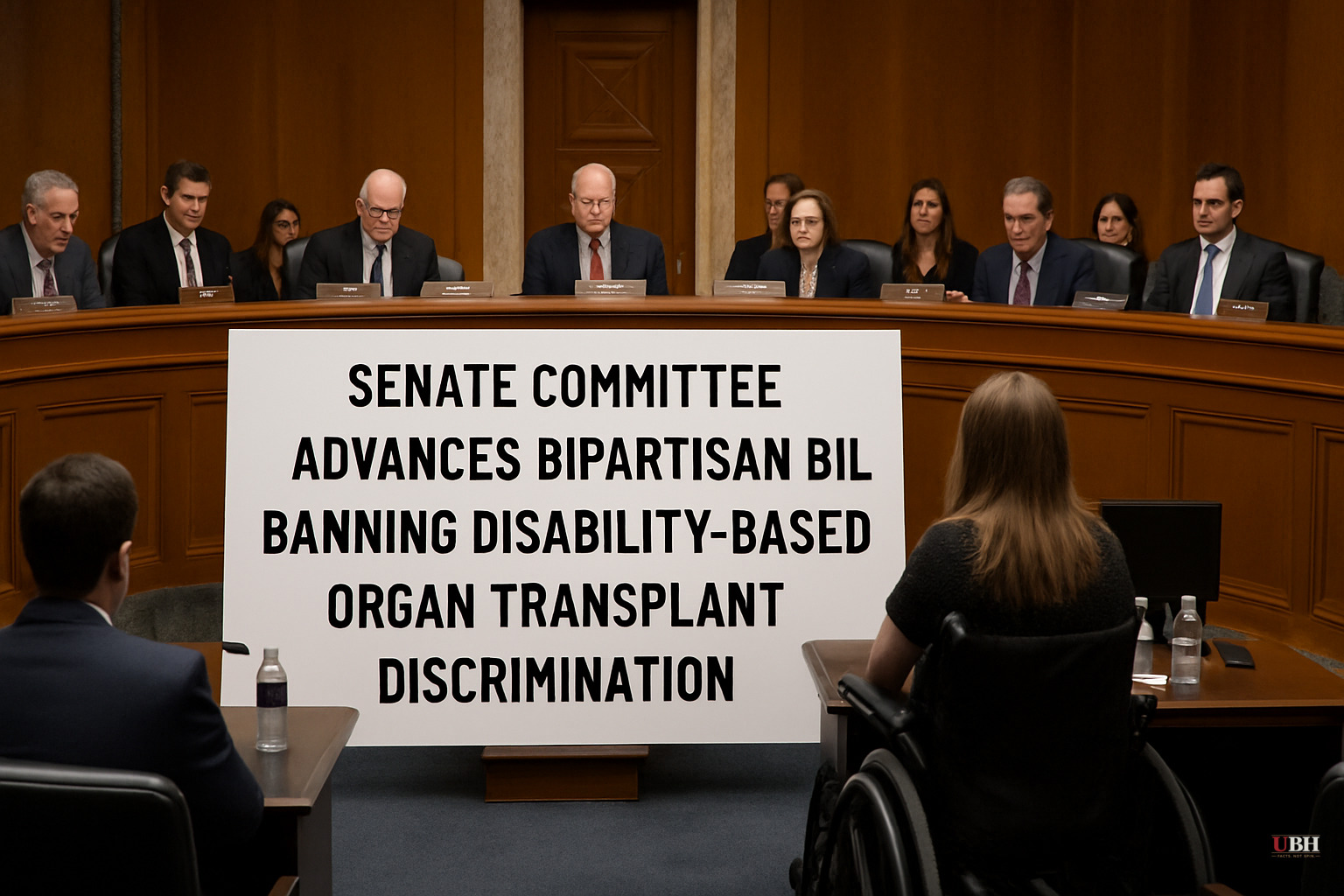
The Charlotte Woodward Organ Transplant Discrimination Prevention Act bars covered entities, including hospitals, transplant centers, and insurance providers, from denying organ transplants, refusing referrals, blocking waiting-list placement, or declining insurance coverage for a transplant solely because a patient has a disability.
It builds on protections already written into the Americans with Disabilities Act of 1990, Section 504 of the Rehabilitation Act, and Section 1557 of the Affordable Care Act. The new legislation clarifies those existing rights and adds a mechanism that matters in practice: expedited injunctive relief through federal courts for patients and families who face discrimination during the transplantation process.
The bill also requires covered entities to recognize a patient's support network as a factor in post-operative care assessments and to make reasonable modifications to policies and procedures to improve accessibility.
The House passed the bill, sponsored by Rep. Kat Cammack (R-FL) and Rep. Debbie Dingell (D-MI), according to Cammack's office. The Senate HELP Committee voted to advance the companion bill, sponsored by Sen. Maggie Hassan (D-NH), on June 22, 2026, with what Hassan described as "strong bipartisan support." A full Senate floor vote has not yet been scheduled.
Charlotte Woodward is an adult with Down syndrome who received a heart transplant more than a decade ago and has since advocated publicly against transplant discrimination. The legislation is named for her.
Baby Zion Sarmiento is the other name. Zion was born in Ocala, Florida in June 2021 with Down syndrome and a congenital heart defect. After 40 days in the NICU and five open-heart surgeries, he was denied a heart transplant because of his disability, according to Cammack's office. He died. Cammack has cited Zion's case as her direct motivation for introducing the legislation.
"His life was worth saving," Cammack said, "and we're fighting to end discrimination in the organ transplant system so the same thing never happens again."
More than 25 states already have laws prohibiting organ transplant discrimination against people with disabilities, according to Hassan's office. State laws vary significantly in scope and enforcement, and patients in states without strong protections, or patients who simply can't afford to litigate in state court in time, have had limited recourse.
The federal bill sets a national floor. States can go further; they cannot fall below the baseline the bill would establish.
Some medical professionals and bioethicists have argued that disability cannot be entirely removed from transplant decision-making, because a patient's overall health profile, including conditions associated with certain disabilities, can legitimately affect post-operative survival odds. Organs are scarce. Every transplant committee makes triage decisions, and critics of broad anti-discrimination mandates worry that requiring committees to disregard disability entirely could, in edge cases, result in worse aggregate outcomes when two patients are otherwise comparable.
The sponsors directly anticipated this objection. The legislation prohibits denials based solely on disability. A transplant center that can show a denial was based on documented medical criteria beyond the disability itself is not prohibited from making that call. The bill targets decisions driven by assumptions about a disabled person's quality of life or presumed inability to comply with post-operative care, not decisions grounded in specific clinical findings.
Dingell put it plainly: "It's unthinkable that people with disabilities are passed over for life-saving transplants based on discriminatory and subjective assumptions about their ability to comply with post-operative care."
The bill now moves to the full Senate. No floor vote date has been announced as of July 1, 2026. If it passes the Senate and is signed into law, the key operational question becomes enforcement—specifically, whether the Department of Health and Human Services and the Department of Justice have the capacity and the will to bring actions against transplant centers that violate the statute, given that the expedited injunctive relief mechanism puts the initial burden on individual patients and families to initiate federal court proceedings, often while the patient is critically ill.
Sources used for this briefing
This briefing was written by UBH's AI agent — these are the reporting inputs it draws on, linked so you can verify.


