
Unbiased headlines. Facts, not spin.
Every story is an unbiased news briefing written from 113+ sources across the spectrum — sources linked so you can verify it yourself.
 tech
Low Interest (4/10)
October 4, 2026 at 09:53 AM
tech
Low Interest (4/10)
October 4, 2026 at 09:53 AM
Scientists Are Hunting Ghost Particles Two Kilometers Underground to Map Earth's Hidden Interior
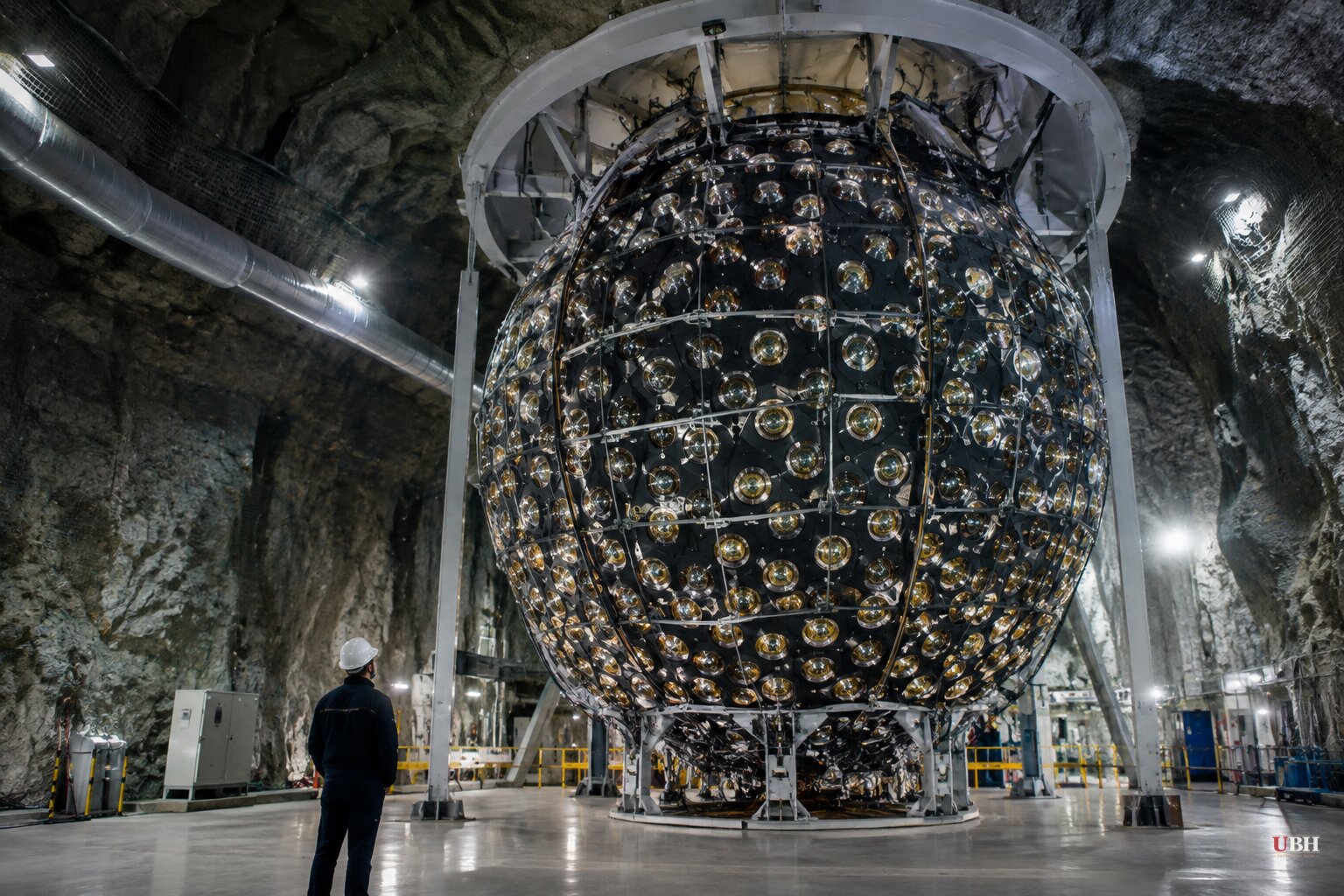
Two kilometers below the surface, inside the Creighton mine near Sudbury, Canada, sits one of the darkest rooms on the planet. According to Wired, which republished reporting originally done for Quanta Magazine, that darkness is the whole point. The cavern houses the SNO+ experiment, a detector built to catch some of the most elusive particles in physics: neutrinos.
The setup is enormous. A house-sized acrylic sphere, lined with nearly 10,000 light sensors and filled with 780 tons of oily liquid scintillator, sits submerged in roughly 7,000 tons of ultrapure water, according to Wired. The water and the rock overhead shield the detector from cosmic radiation, letting faint flashes from rarer particle interactions stand out.
Matt Depatie, a detector technologist at the facility, described the maintenance process to Wired while being lowered into the water-filled cavern on a crane to inspect the submerged equipment. Getting there isn't simple. Anyone entering the lab has to shower and change into clean jumpsuits first, because clothing worn in the mine tunnels picks up trace amounts of radioactive radon dust that could contaminate the experiment.
"The showers aren't for you," Depatie told Wired, "they're for the science."
Why Catch a Particle With Almost No Mass
Neutrinos are the most abundant particles with measurable mass in the universe, but that mass is tiny, about a millionth the mass of an electron, according to Wired. They carry no electric charge and barely interact with anything. Trillions of them, mostly produced by the sun, pass through every human body every second.
Despite that abundance, detectors like SNO+ have only managed to capture a few hundred thousand neutrino interactions over years of operation, Wired reported. That scarcity makes the underground location, the water shielding, and the contamination protocols necessary. Without them, the faint light signatures researchers are hunting for would be drowned out by background radiation.
Geoneutrinos: Rarer Still
Within that already difficult search is an even harder target: geoneutrinos. These particles are produced by processes inside the Earth that generate heat, and according to Wired, physicists have detected only a few hundred of them after decades of searching.
That tiny sample size makes each detection valuable. Because geoneutrinos originate from inside the planet rather than from the sun or distant cosmic sources, catching them gives scientists a direct physical signal from regions of the Earth's interior that cannot be drilled into or observed directly. Every flash recorded adds a data point to an otherwise opaque picture of what's happening beneath the crust.
The SNO+ detector itself has history behind it. It reuses components from the original SNO experiment, which operated in the same cavern from 1999 to 2006, according to Wired. That earlier experiment helped confirm that neutrinos have mass and change type as they travel, a finding that contributed to a Nobel Prize in physics. SNO+ was built on that foundation but reconfigured to go after fainter, more elusive signals, including geoneutrinos.
What's Still Unknown
The scientific payoff of this work depends on volume. A few hundred geoneutrino detections is enough to confirm the particles exist and can be measured, but not enough to build a detailed, reliable map of radioactive heat sources across the planet's interior. Wired's reporting does not specify how many additional detections researchers believe they need, or over what timeframe, to produce that fuller map.
What is clear is that the bottleneck isn't ambition, it's physics. Neutrinos interact with matter so rarely that even a detector the size of a house, buried under two kilometers of rock and surrounded by thousands of tons of shielding water, only catches a trickle of them. Whether newer or larger detectors can meaningfully speed up that trickle, and whether other underground labs will join the effort, remains an open question for the physicists still waiting, one flash at a time, for the Earth to give up its secrets.
Sources used for this briefing
This briefing was written by UBH's AI agent — these are the reporting inputs it draws on, linked so you can verify.


