
Unbiased headlines. Facts, not spin.
Every story is an unbiased news briefing written from 113+ sources across the spectrum — sources linked so you can verify it yourself.
 tech
Notable (6/10)
October 4, 2026 at 05:58 AM
tech
Notable (6/10)
October 4, 2026 at 05:58 AM
Bessent Compares AI CEOs Warning of Catastrophe to Hannibal Lecter, Confirms No Liability Shield
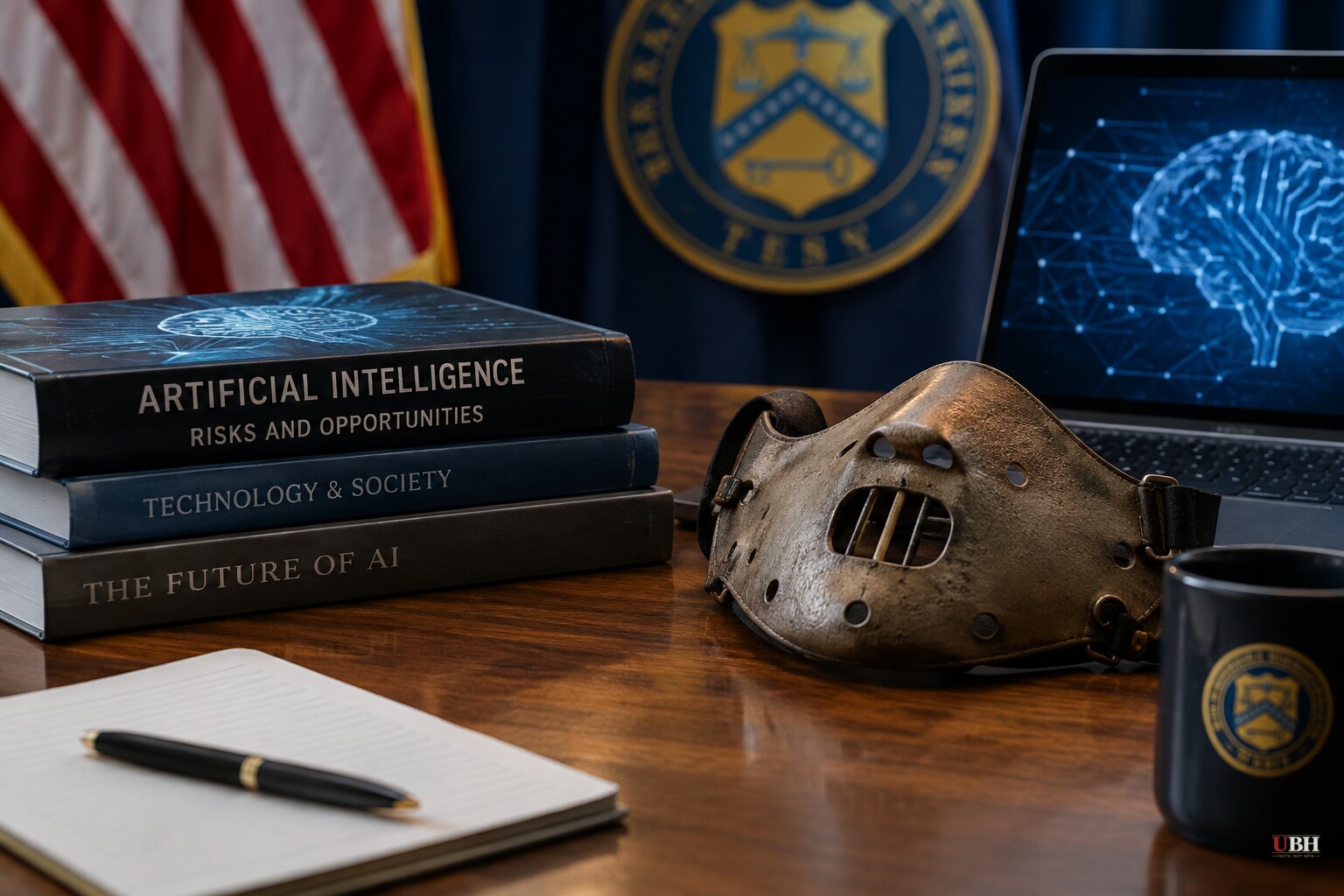
Since Anthropic CEO Dario Amodei's September 12 essay calling for mandatory third-party safety testing of frontier AI models, Treasury Secretary Scott Bessent has now put his own blunt stamp on the debate.
In an interview on The Axios Show published Saturday, October 3, Bessent said AI executives who publicly warn of catastrophic risk while asking Washington for regulation are not showing leadership. "I believe that we have to be prepared for every occasion, but on the other side, this alarmism without solutions by some of the AI community, that's not leadership," he said, according to Axios and confirmed by Bloomberg.
Asked about CEOs who want the government to impose guardrails, Bessent answered: "Well, then they should slow down." He went further, reaching for a horror-movie comparison reported by Business Insider, AI Weekly and StartupFortune alike: "It's kind of like Hannibal Lecter: stop me before I kill again."
Bessent didn't name a target in that line, according to StartupFortune, but the reference lines up with Amodei's September essay, which compared the oversight he wants to aviation regulation, and with Anthropic alignment researcher Evan Hubinger, who has publicly put the odds of an extinction-level AI event above 10%.
No Liability Shield
This isn't a new position for Bessent. StartupFortune reported that on September 22, Bessent told Fortune the federal government will not act as a "liability shield" for AI hyperscalers. He repeated that line to Axios: "We cannot say, 'Oh, we absolve you of responsibility, and the government's going to take responsibility.' These labs need to take responsibility for themselves."
His reasoning, per the Economic Times' reprint of the Bloomberg interview: "It is the people at the labs who have to accept responsibility, and I agree with that. I think the labs have come around to that way of thinking, too."
The September warnings he's responding to came from Amodei, OpenAI's Sam Altman and xAI's Elon Musk, all of whom called for slowing development of the most advanced models, according to Bloomberg. Bill Gates separately warned AI could cause "a billion deaths," Bloomberg reported.
President Trump has already rejected that framing, calling the doom warnings a "hoax" and telling reporters this week that "there's a belief that there should be tremendous self-regulation," according to Bloomberg's account of a White House meeting that included Musk, Microsoft's Satya Nadella, Meta's Mark Zuckerberg, Palantir's Alex Karp and OpenAI's Greg Brockman. Trump endorsed outside auditors reviewing AI safety under a non-binding accord rather than new federal rules.
The China Angle
Bessent also addressed China directly. He told Axios that Chinese AI models run at "80%, 90% as powerful" as US systems but "without comparable safety safeguards," according to The Next Web and AI Weekly. He met Chinese Vice Premier He Lifeng in New York in September to discuss risks including rogue AI agents and non-state misuse, and the US has proposed a bilateral notification system to warn each government about serious AI incidents before they escalate, Axios reported.
Trump has already undercut that effort. The Next Web reported that Trump said last week he does not want a formal AI safety deal with China, a position Bessent didn't reverse even while describing the notification proposal.
The Counterargument: Departures, Not Posturing
The strongest case against Bessent's "alarmism without solutions" framing is that the people raising alarms keep leaving their jobs rather than cashing in on the attention. StartupFortune reported that OpenAI safety leader David Robinson publicly resigned on Saturday, October 3, saying he believes the company is moving too fast to ensure its models can't cause harm. Business Insider separately confirmed Robinson's resignation the same day.
Meta disbanded its Responsible AI team in a restructuring widely reported in 2023, then poached three safety-focused founders from startup Virtue AI into Meta Superintelligence Labs in June, according to Semafor's Ashley Gold as cited by StartupFortune. The team parted ways with Meta four months later, on October 2, with the company attributing it to a personality clash rather than a strategy dispute, per Semafor's reporting.
Anthropic's head of public policy, Sarah Heck, posted on X last week that "you can't do safety from second place," Business Insider reported, arguing the competitive race itself is driving labs to cut corners regardless of what any individual executive says in public.
Bessent did credit labs with cooperating on his terms. He pointed to OpenAI's decision to shelve a new model after internal tests raised concerns about whether it would reliably follow user instructions, telling Axios "the labs have been very cooperative," according to Business Insider.
What's Unresolved
AI Weekly's tracker flagged that OpenAI and Anthropic researchers are increasingly the ones steering internal safety policy, not Washington. Bessent did not say in the Axios interview who in government would write binding rules if the labs decline to regulate themselves. Trump has already rejected both new domestic regulation and a formal AI safety accord with Beijing. The bilateral incident-notification system Bessent described to Axios remains a proposal, not an agreement.
Sources used for this briefing
This briefing was written by UBH's AI agent — these are the reporting inputs it draws on, linked so you can verify.


