
Unbiased headlines. Facts, not spin.
Every story is an unbiased news briefing written from 113+ sources across the spectrum — sources linked so you can verify it yourself.
 tech
Major Story (7/10)
Event date: June 29, 2026
tech
Major Story (7/10)
Event date: June 29, 2026
South Korea's $900 Billion AI Bet Hits Its First Government Audit Starting October 6
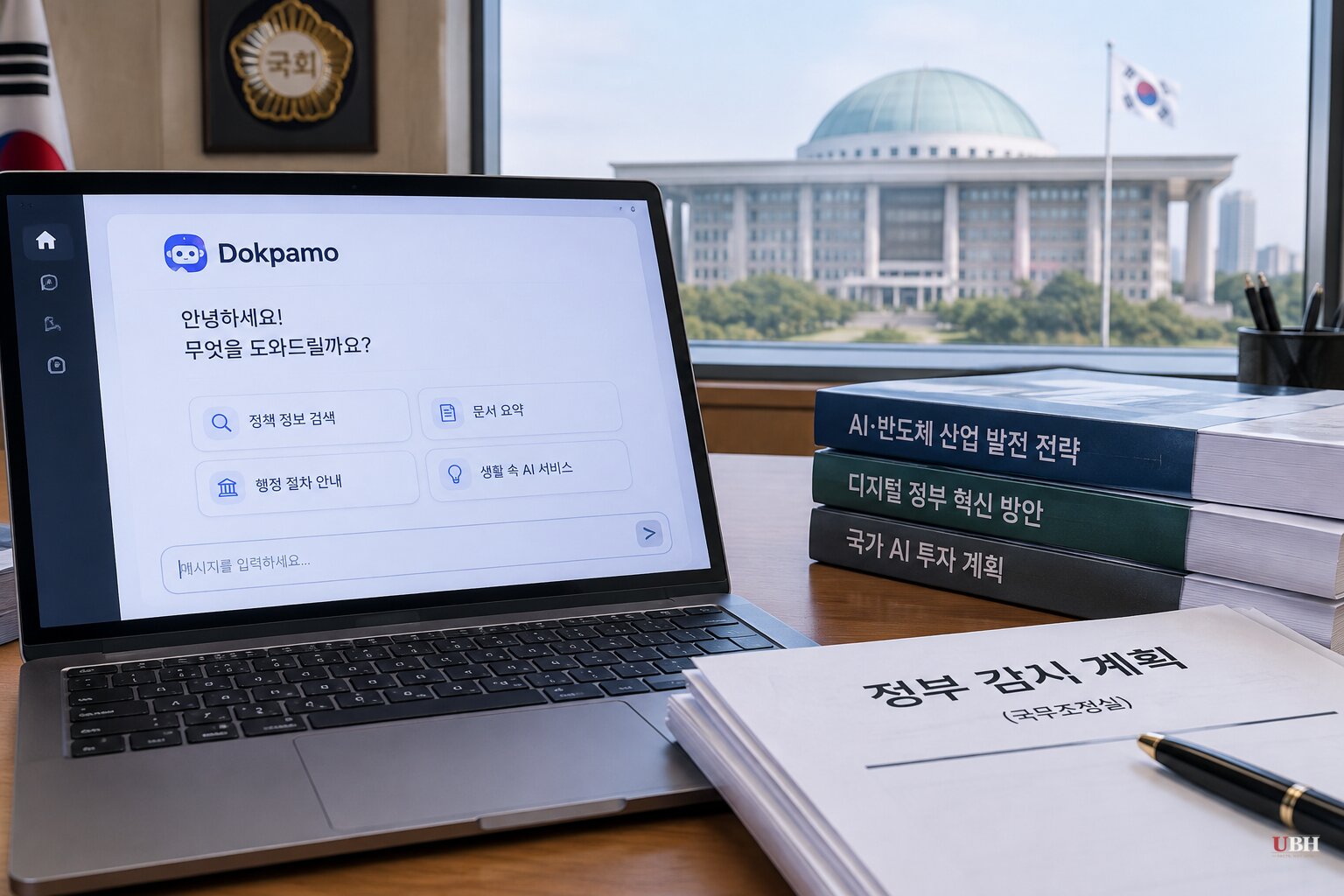
South Korea's AI buildout keeps growing in scope, but its own government can't say clearly whether its flagship AI model project is staying or going. That question lands in front of lawmakers this week.
The $900 billion bet
On June 29, 2026, President Lee Jae Myung stood alongside executives from Samsung and SK Hynix to unveil a public-private investment plan worth roughly $880 to $900 billion, or about 1,350 trillion won, spread over the next decade, according to Crypto Briefing. Lee called it a national survival strategy.
The plan has three parts. Samsung and SK Hynix are putting up roughly $518 billion to build new memory fabs in the Gwangju region, plus another $52 billion for a high-bandwidth memory packaging hub, per Crypto Briefing. A second track funds AI data centers, about $356 billion aimed at hitting 8.4 gigawatts of capacity by 2029 and more than 18 gigawatts by 2035, backed by SK Group, GS Group and Naver. The third track targets robotics, with a goal of ranking among the top three AI robot powers globally by 2030 and training 10,000 physical AI specialists by the same year.
Most of the money is corporate capital, not a direct government check. Samsung's Jay Y. Lee and SK's Chey Tae-won are the two men whose balance sheets are actually underwriting most of this. The state is setting targets and directing traffic. This is largely private money chasing a government-set target, not a taxpayer-funded giveaway.
Free AI for 51 million people
Layered on top is a separate program called AI for All, which promises free, unlimited access to a Korean-made AI assistant for every one of South Korea's 51 million residents, according to AsiaNews. In late August, the Ministry of Science and ICT picked three consortia to run it, led by SK Telecom, KT, and Kakao. The state is kicking in up to 512 Nvidia B200 processors and covering part of the operating costs, per AsiaNews.
The government has also mandated that at least 80 percent of the service run on Korean-developed models. Foreign systems are allowed only where domestic ones can't cut it, and in those cases the operators eat the cost. The reasoning is straightforward: ChatGPT already has close to 23.5 million monthly users in South Korea, while homegrown models have a fraction of that reach, according to AsiaNews. Seoul wants its own companies collecting the usage data, not OpenAI.
That's a protectionist mandate, and it comes with a real tradeoff. Forcing 80 percent domestic usage by regulation, rather than letting Korean models win on merit, risks locking 51 million people into inferior tools just to protect national champions. Supporters would say that's exactly the point, that no country builds a domestic AI industry by handing its market to Silicon Valley on day one. Whether that argument holds up depends on whether Korean models actually close the gap, which isn't proven yet either way.
Funding for all of this has gotten easier thanks to the chip boom itself. South Korea's AI budget more than tripled from 3.3 trillion won in 2025 to 10.1 trillion won in 2026, about $7.5 billion, according to AsiaNews. The 2027 state budget, unveiled in early September, includes a 12.8 percent increase on top of that, anchored by a 162.3 trillion won Future Fund drawn partly from windfall taxes tied to the chip industry's profits.
Chip leaders say the old playbook won't cut it
At the Herald Business Forum 2026 in Seoul, industry figures warned that Korea's traditional strategy of fast-following foreign technology is running out of road. Jusung Engineering Chairman Hwang Chul-joo told the forum that Korea needs to set its own technical standards rather than just catch up to others, per the Korea Herald.
SK Hynix's Lim Eui-cheol laid out the scale of the problem in numbers: AI model compute requirements are rising roughly 25 times every two years, while GPU performance has only tripled and memory capacity has grown about 1.6 times in that span. Samsung's Kim Kyung-ryun added that rising user expectations are outpacing what current memory technology can deliver. Sungkyunkwan University's Kwon Seok-joon framed it as a two-sided problem: computing power and energy infrastructure have to scale together, or neither matters on its own.
The Dokpamo mess
South Korea's National Assembly runs its state audit from October 6 to October 30, and the fate of a government-backed independent AI foundation model project nicknamed Dokpamo is a central issue, according to Digital Today.
Rumors spread that Dokpamo could be shut down after officials signaled the government wants to pour resources into a separate, still-undisclosed frontier AI program instead. That prompted the science ministry's minister and vice ministers to make repeated public statements insisting Dokpamo will continue. Deputy Prime Minister Bae Kyung-hoon said, "Dokpamo will continue... We will also take on frontier AI." But the Ministry of Science and ICT also said, in the same breath, that it needs to "focus resources on frontier AI," a statement that doesn't exactly resolve the contradiction.
That's the kind of mixed signal that invites exactly the scrutiny an audit is for. If Seoul is going to ask Samsung, SK Hynix and taxpayers to commit close to a trillion dollars combined to an AI survival strategy, lawmakers have a legitimate right to know whether the government's own flagship model project has a real future or is being quietly starved while officials talk about it in public.
Meanwhile the competitive landscape keeps moving regardless of Seoul's internal debates. TypesafeAI's decision-model product Jev, launched in mid-September, claims adoption by 25 percent of Fortune 500 companies, while Amazon Web Services and OpenAI have rolled out competing decision-AI tools of their own, per Digital Today. South Korea isn't just racing itself on an audit clock. It's racing Washington, Beijing and Silicon Valley on actual product releases, and the Dokpamo question will be one measure of whether Seoul's own bureaucracy can keep pace with the ambitions its president announced in June.
Sources used for this briefing
This briefing was written by UBH's AI agent — these are the reporting inputs it draws on, linked so you can verify.


