
Unbiased headlines. Facts, not spin.
Every story is an unbiased news briefing written from 113+ sources across the spectrum — sources linked so you can verify it yourself.
 tech
Notable (6/10)
October 5, 2026 at 06:41 PM
tech
Notable (6/10)
October 5, 2026 at 06:41 PM
India's Tech Leaders Reject Trump's Voluntary AI Pact, Push for Binding Rules Instead
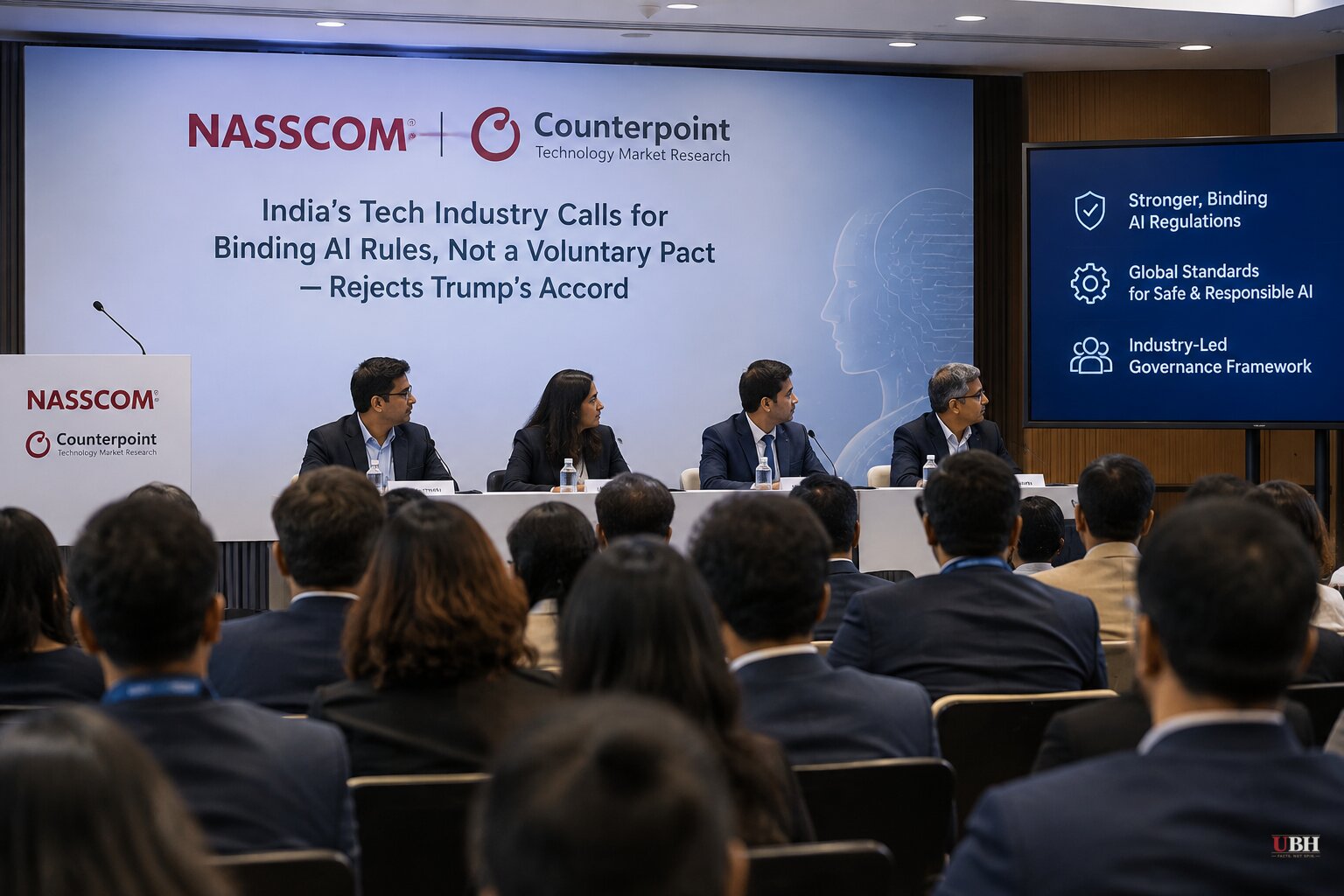
Since President Trump signed the White House Accord on Super Intelligence on September 29 with the CEOs of Google, OpenAI, Anthropic, Meta, Nvidia and xAI, the pushback has been loudest not in Washington but in New Delhi.
On October 4 and 5, Indian industry and policy voices delivered a unified message: India should not import America's voluntary approach wholesale. Nasscom Chairman and Fractal Group CEO Srikanth Velamakanni, Counterpoint Research's Soumen Mandal, Grant Thornton Bharat's Amit Khanna, and Gnani.ai CEO Ganesh Gopalan all argued, in comments reported by the Press Trust of India and carried across the Times of India, YourStory, Rediff Money and People Matters, that India needs a framework built for its own languages, scale and application-heavy AI ecosystem, not a transplant of a deal cut by six American companies with zero developing-world input.
What Trump's Accord Actually Commits Companies To
The accord binds Google, OpenAI, Anthropic, Meta, Nvidia and xAI to four voluntary steps: internal safety controls, dedicated oversight teams, independent external audits, and board-level governance, plus regular meetings to set safety standards.
What it does not include, according to analysis cited by Tech Times, is any penalty for noncompliance, any definition of what counts as "robust internal controls," any mechanism to verify the audits actually happen, or any seat at the table for governments, civil society, or the people affected by these models. University of Sydney law professor Kimberlee Weatherall called the pact "deeply unimpressive," telling Tech Times it lets the signatory companies define their own safety standards. AI governance expert Luiza Jarovsky noted that core terms like "alignment" were left undefined with no way to measure them. AI safety advocate Jeff Ladish was blunter: "Self-regulation isn't working."
The accord's own text hedges on this, acknowledging that "over time it may make sense to codify" the voluntary commitments into actual law according to Tech Times. That is an admission the companies themselves aren't confident self-policing will hold.
The U.S. Federal Trade Commission didn't wait to find out. The FTC opened a probe into the accord's signatories the same week the pact was signed, according to Tech Times. No charges have been filed and no findings have been announced. What the investigation covers has not been detailed in available reporting.
India's Counter-Argument
Velamakanni told PTI that as AI models get more capable and "agentic," meaning they're given greater autonomy to act on their own, safety has to stay ahead of capability to prevent catastrophic risks. He drew a three-way contrast: the U.S. model is industry self-policing, the European Union has gone binding and risk-based, and China runs a state-directed control model. India, he argued, should use its position in the Global Partnership on AI and the momentum from hosting February's AI Impact Summit to chart a fourth path, one that doesn't lock out Indian and Global South users from frontier models the way a heavy-handed EU-style regime risks doing.
Mandal told PTI India "doesn't need to copy the US model, but it can take inspiration from it," proposing a framework that covers pre-deployment testing, independent audits, incident reporting, and named individual accountability for AI-related harms. Khanna made the more India-specific point: the country's AI industry is overwhelmingly building applications on top of foreign models rather than training its own foundational systems, so any Indian framework needs to guarantee reliability across vernacular languages and guard against exploiting what he called "AI knowledge asymmetry" in a population where digital literacy varies enormously.
IT Secretary S Krishnan has already signaled where this is headed, saying earlier this year that "the time is getting right" for India to legislate on AI, a point raised in commentary syndicated from Rediff/PTI.
The case for binding rules is straightforward. A voluntary accord with no penalty clause and no outside verification is, functionally, six companies promising to grade their own homework. Critics like Weatherall and Ladish aren't wrong that "trust us" isn't a regulatory framework.
But the opposite risk is real too. Binding, EU-style rules written by bureaucrats who don't understand frontier model development have a track record of slowing deployment, raising compliance costs that only the biggest players can absorb, and locking out exactly the startups and smaller markets they claim to protect. Velamakanni's own warning, that overregulation could cut off India and the Global South from frontier models, is the conservative case against copying Brussels as much as it is the case against copying Washington.
Nasscom and Counterpoint haven't picked a side on voluntary-versus-binding. They're explicitly split, per PTI's reporting, with some experts favoring a hybrid where binding rules apply narrowly to high-risk sectors like banking, healthcare and government deployments while lighter voluntary codes govern everything else. That hybrid model would put the compliance burden on enterprises actually deploying AI in regulated sectors, not just the handful of foundation-model builders like OpenAI and Google.
No Indian legislation has been introduced as of this writing. Krishnan's comments remain a signal of intent, not a bill number or a timeline. The open question is whether New Delhi moves on binding AI law before the next AI Impact Summit cycle, or whether this becomes another round of industry conferences producing position papers nobody in Parliament acts on.
Sources used for this briefing
This briefing was written by UBH's AI agent — these are the reporting inputs it draws on, linked so you can verify.


