
Unbiased headlines. Facts, not spin.
Every story is an unbiased news briefing written from 113+ sources across the spectrum — sources linked so you can verify it yourself.
 tech
Notable (6/10)
Event date: October 1, 2026
tech
Notable (6/10)
Event date: October 1, 2026
NASA Pays Boeing $359 Million to Fix Starliner, Delays Crewed Flight to 2028 as SpaceX Eyes Dragon's Retirement
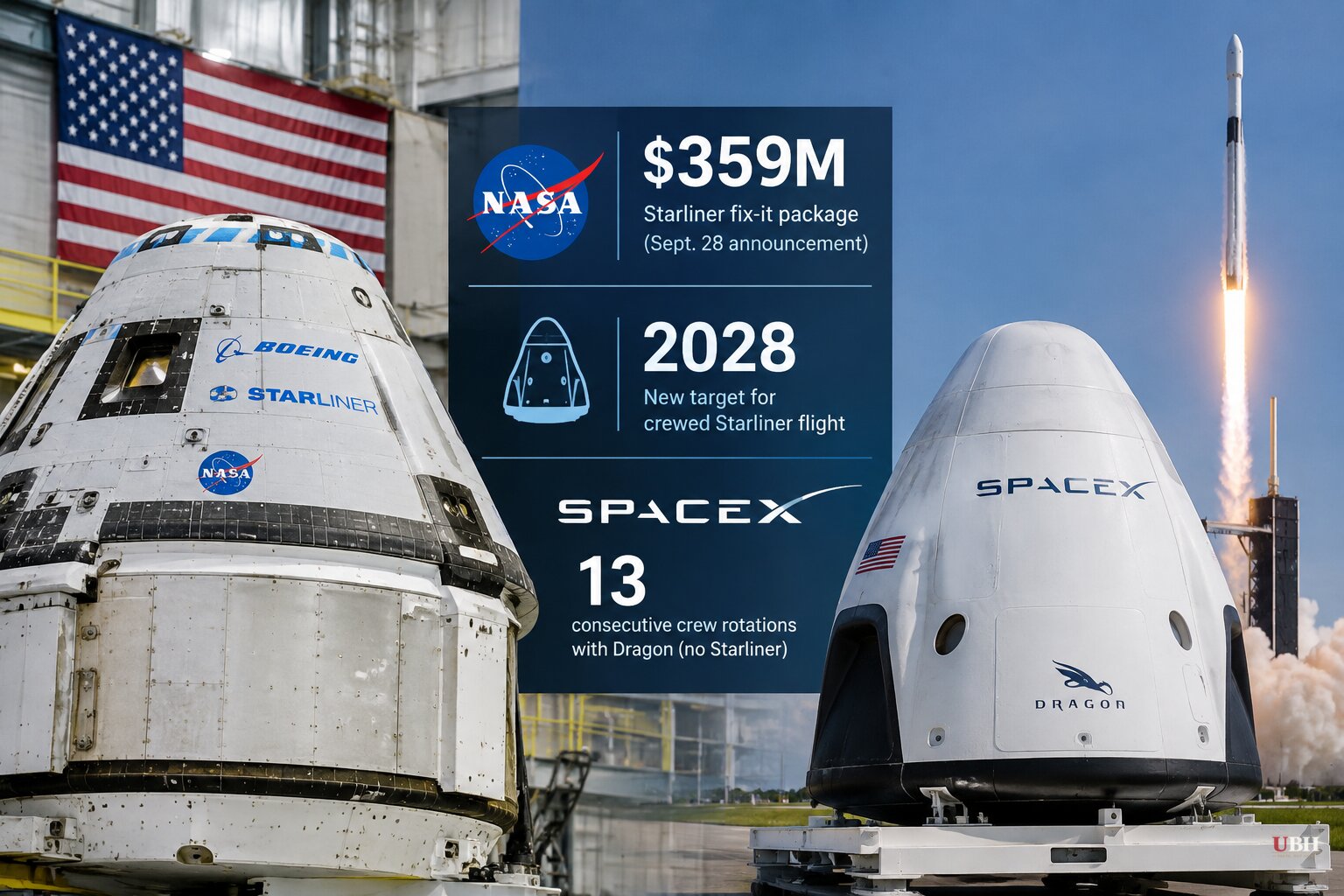
Since NASA Administrator Jared Isaacman announced on September 28 that the agency would commit $359 million to Boeing's Starliner program, two things have happened that sharpen the stakes: SpaceX launched Crew-13 on October 1, the 13th consecutive NASA astronaut rotation flown entirely on Crew Dragon, and reporting has filled in just how thin NASA's backup plan actually is.
The money goes toward rebuilding Starliner's reaction control system thrusters and certifying United Launch Alliance's Vulcan rocket to carry astronauts, according to NASA's announcement and reporting by Space.com and Florida Today. Boeing's Atlas V, the rocket that's launched every Starliner flight to date, is nearly out of production.
What actually broke, and what's being fixed
Dana Weigel, manager of NASA's Low Earth Orbit Program, told reporters the crew module thruster failures that nearly doomed the June 2024 Crew Flight Test came from corrosion. Residual hydrazine propellant mixed with atmospheric carbon dioxide ate away at internal valve components, according to Weigel's account as reported by Space.com and Newsy Today. Boeing has now put procedures in place to flush the hydrazine and run a continuous purge to isolate the thrusters from exposure.
Separately, the helium leaks that plagued the same mission were traced to valve seals degraded by nitrogen tetroxide, the propulsion system's oxidizer, according to Space.com. Those seals have been replaced with a new material and tighter tolerances. Boeing also made thermal modifications to the service module to cut thruster temperatures, which Isaacman called "one of the major contributors to the performance issues we saw in flight."
The plan now calls for an uncrewed Starliner-1 cargo flight to the International Space Station targeting December 2026 or January 2027. NASA says that mission exists specifically because ground testing at White Sands Test Facility in New Mexico can't replicate the thermal cycling and live solar-heating conditions Starliner's thrusters face during an actual ISS approach. A clean flight doesn't certify Starliner for astronauts. It generates the flight data NASA needs to finish that certification. If it fails, Isaacman's timeline for a crewed Starliner-2 mission in 2028, commanded by astronaut Woody Hoburg, falls apart with it.
The money keeps growing
Boeing's Commercial Crew contract value has moved around over the life of the program. Florida Today reports NASA originally awarded Boeing $4.82 billion to develop Starliner, against $3.14 billion for SpaceX's Dragon. Newsy Today reports the contract was later cut to $3.7 billion from $4.1 billion last fall, when NASA reduced Boeing's contracted flights from six to four. Before Monday's announcement restored that number back toward six. Ars Technica reports NASA has already provided Boeing $5.1 billion total under the fixed-price arrangement, on top of which Boeing has absorbed more than $2 billion in losses of its own money.
The $359 million announced September 28 is new money on top of all of that. Fixed-price contracts are supposed to cap a buyer's exposure. The fact that NASA felt it needed to add funding anyway signals how close Boeing may have come to walking away from the program entirely, a possibility Ars Technica says was openly discussed.
The case against doubling down
Some critics argue NASA shouldn't be pouring more money into a vehicle with Starliner's track record: a failed 2019 uncrewed flight that missed the ISS due to a timing-system glitch, thruster failures on the 2022 uncrewed redo, and the 2024 mission that forced astronauts Butch Wilmore and Suni Williams to return on a SpaceX capsule after a nine-month stay instead of the planned ten days. Ars Technica reports that some critics have called for NASA to instead fund a new competitive round including Boeing, Blue Origin's in-development space vehicle, and other entrants, rather than lock in another half-decade of reliance on a single struggling contractor.
That concern has a real basis: NASA's February 2026 declaration of a "Type A" mishap, its most serious safety classification, for the 2024 incident underscores that this wasn't a minor glitch. But NASA's counter, laid out by Weigel and Isaacman, is that starting a new competition from scratch would take years NASA doesn't have, while Starliner has already flown three missions and has a diagnosed, documented failure mode now addressed with specific engineering fixes.
Why the clock matters
SpaceX hasn't committed to a retirement date for Dragon. President Gwynne Shotwell said in September the capsule won't be retired "today," and SpaceX vice president William Gerstenmaier told reporters the company would "continue to support these near-term things" without offering a timeline, according to Swarajya. Isaacman has been blunt that SpaceX's long-term intent is to shift entirely to Starship, calling it something that's "not a secret." NASA has separately paid SpaceX $946 million for three more Dragon crew missions, Crew-15 through 17, awarded September 18, ten days before the Starliner funding.
If Starliner-1 fails in December or January, NASA has not said publicly what its contingency would be. Williams and Wilmore, the two astronauts stranded by Starliner's last crewed flight, have both since retired from NASA.
Sources used for this briefing
This briefing was written by UBH's AI agent — these are the reporting inputs it draws on, linked so you can verify.


