
Unbiased headlines. Facts, not spin.
Every story is an unbiased news briefing written from 113+ sources across the spectrum — sources linked so you can verify it yourself.
 tech
Major Story (8/10)
October 5, 2026 at 11:53 AM
tech
Major Story (8/10)
October 5, 2026 at 11:53 AM
AI-Generated Child Abuse Images Jumped 40% in 2026 as a U.S. Appeals Court Ruled Private Possession of Virtual CSAM Legal
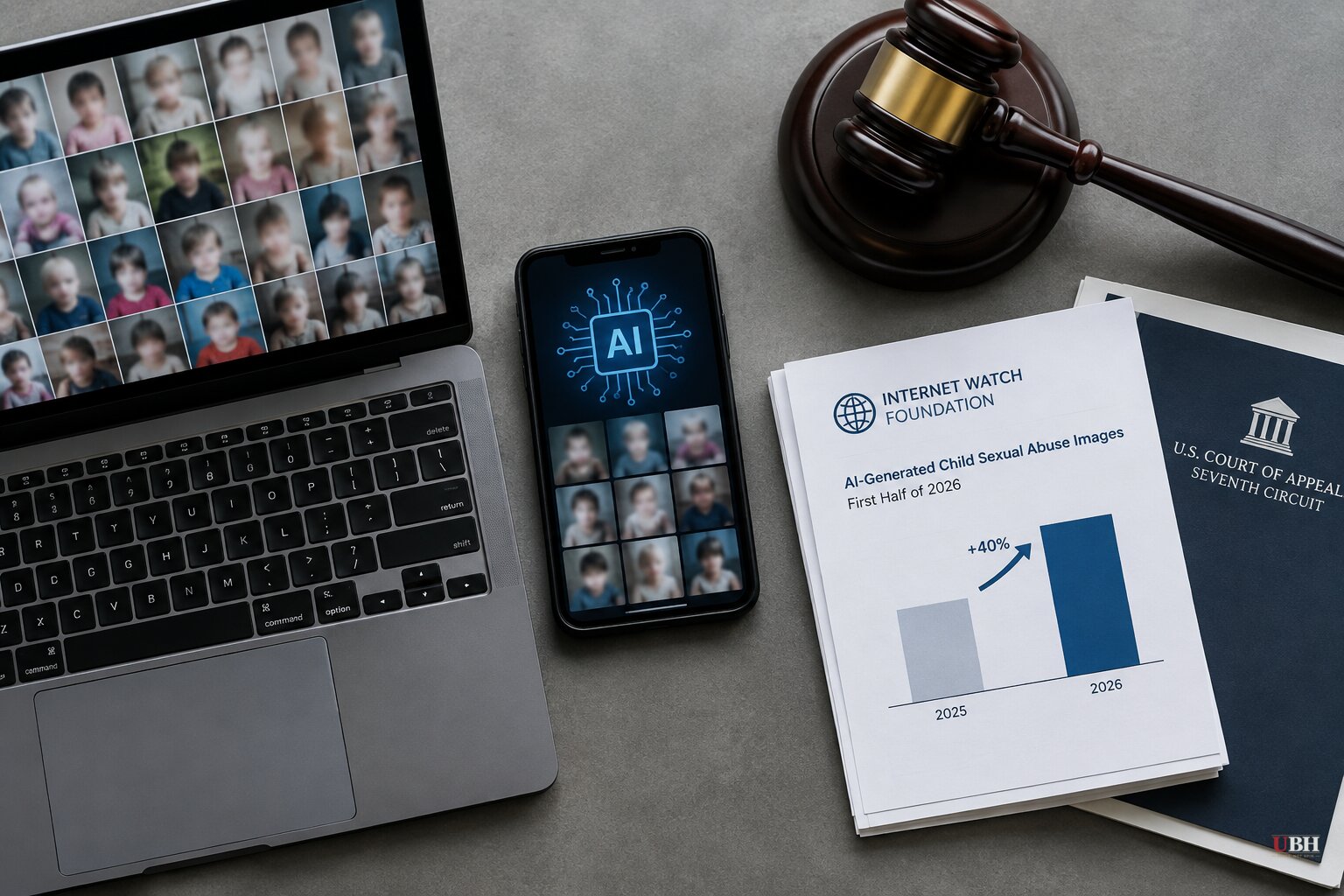
The numbers are bad and getting worse. The Internet Watch Foundation, the UK-based group that hunts down child sexual abuse material online, assessed 6,310 AI-generated images between January and June 2026 that met the legal definition of child sexual abuse. That's already 40% higher than the slightly more than 4,500 images the IWF identified during all of 2025, according to the IWF's own figures reported by The Guardian.
Most of the images were of girls. Many depicted children between 7 and 13 years old.
This isn't a one-year blip. The IWF's 2025 annual report found 8,029 AI-generated images and videos depicting realistic child sexual abuse, a 14% jump from 2024. Video is the fastest-growing category: the IWF logged 3,443 AI-generated abuse videos in 2025, up from just 13 in 2024. Generative AI has made it possible to produce convincing fake abuse footage without any of the technical skill that used to be required.
Kids are finding their own faces in this material
It's not all fictional. Report Remove, the UK service that helps strip intimate images off the internet, took 420 reports in the first six months of 2026 from children who believed their own photos had been digitally altered into explicit images. That already beats the 397 reports logged in all of 2025, per the IWF.
Those reports include content suspected of being produced with AI, so-called nudification apps, or other editing tools. A photo a parent posted of a kid at a birthday party or a school recital can become raw material for this.
What UK law does and doesn't cover
AI-generated CSAM is already a crime in the UK. Adapting an AI model to produce it, or passing that model to someone else, is also illegal. Building a model specifically to generate hyper-realistic abuse imagery carries up to five years in prison, and a UK government spokesperson confirmed the law is clear regardless of whether the material is AI-made or not.
That hasn't satisfied the IWF. Hannah Swirsky, the organization's head of policy, is backing calls from members of Parliament for binding AI legislation that would force companies to build safer models from the start. "It is incumbent on tech companies to build tools which cannot be abused this way," she said.
Kanishka Narayan, the UK's AI minister, has said "nothing is off the table" on new rules but that any proposal will be judged on one question: "Will it make the British people safer?" No dedicated AI bill is currently scheduled.
A U.S. court just carved out a legal gray zone
While the UK data was landing, a separate and unrelated legal fight played out in American courts. The Seventh Circuit Court of Appeals ruled late last month that, under current law, it's legal to privately possess AI-generated images or videos of child sexual abuse if they depict virtual children and the material stays inside the home, as reported by the Boston Globe.
The case involves Steven Anderegg, a Wisconsin man charged in 2024 with producing, possessing, and distributing obscene images on Instagram. A Wisconsin judge dismissed the possession charge; federal prosecutors appealed and lost. Anderegg still faces the production and distribution charges, which the ruling did not touch.
Judge John Z. Lee, writing for the panel, said the court was bound by Supreme Court precedent, specifically the 2002 case Ashcroft v. Free Speech Coalition, which found that possessing virtual child pornography not made with real children is protected speech. That ruling predates modern generative AI by two decades. Lee acknowledged the problem directly: "Given the relentless advancement in artificial intelligence models, we have some concerns about the lines these cases draw, but we are not free to redraw them ourselves."
The honest tension here is this: the First Amendment protects a lot of ugly speech, and courts aren't supposed to invent new carve-outs just because technology changed, no matter how sympathetic the reason. Judges following precedent instead of legislating from the bench is how the system is supposed to work. But Jessica Schidlow of the advocacy group Enough Abuse told the Boston Globe the ruling is narrow. It only protects material that's "created and not distributed or transferred, and you use it only for your own in-home viewing purposes." Anyone who shares, sells, or distributes AI-generated CSAM is still fully exposed to prosecution.
Parents are reacting by going dark
The combination of the IWF numbers and the court ruling has pushed a wave of parents to rethink posting kids' photos at all. Burlington, Vermont family photographer Jenn Adams told the Boston Globe, "There were dangers about it from the get-go. This has only elevated it exponentially." The National Crime Agency and the IWF are now telling parents to keep children's photos off public social media entirely, or at minimum lock accounts to private and limit sharing to a small "close friends" circle.
Neither the IWF data nor the Seventh Circuit ruling has produced a legislative fix yet, in the UK or the US. Congress has not taken up a bill addressing AI-generated CSAM possession loopholes, and the UK still has no scheduled AI bill despite the IWF's push. The open question for both countries is the same: who closes the gap between what generative AI can now produce and what 20th-century obscenity law was ever written to cover.
Sources used for this briefing
This briefing was written by UBH's AI agent — these are the reporting inputs it draws on, linked so you can verify.


