
Unbiased headlines. Facts, not spin.
Every story is an unbiased news briefing written from 113+ sources across the spectrum — sources linked so you can verify it yourself.
 tech
Major Story (8/10)
Event date: October 1, 2026
tech
Major Story (8/10)
Event date: October 1, 2026
Wall Street Banks Begin Syndicating Record $60 Billion AI Chip Package for Anthropic
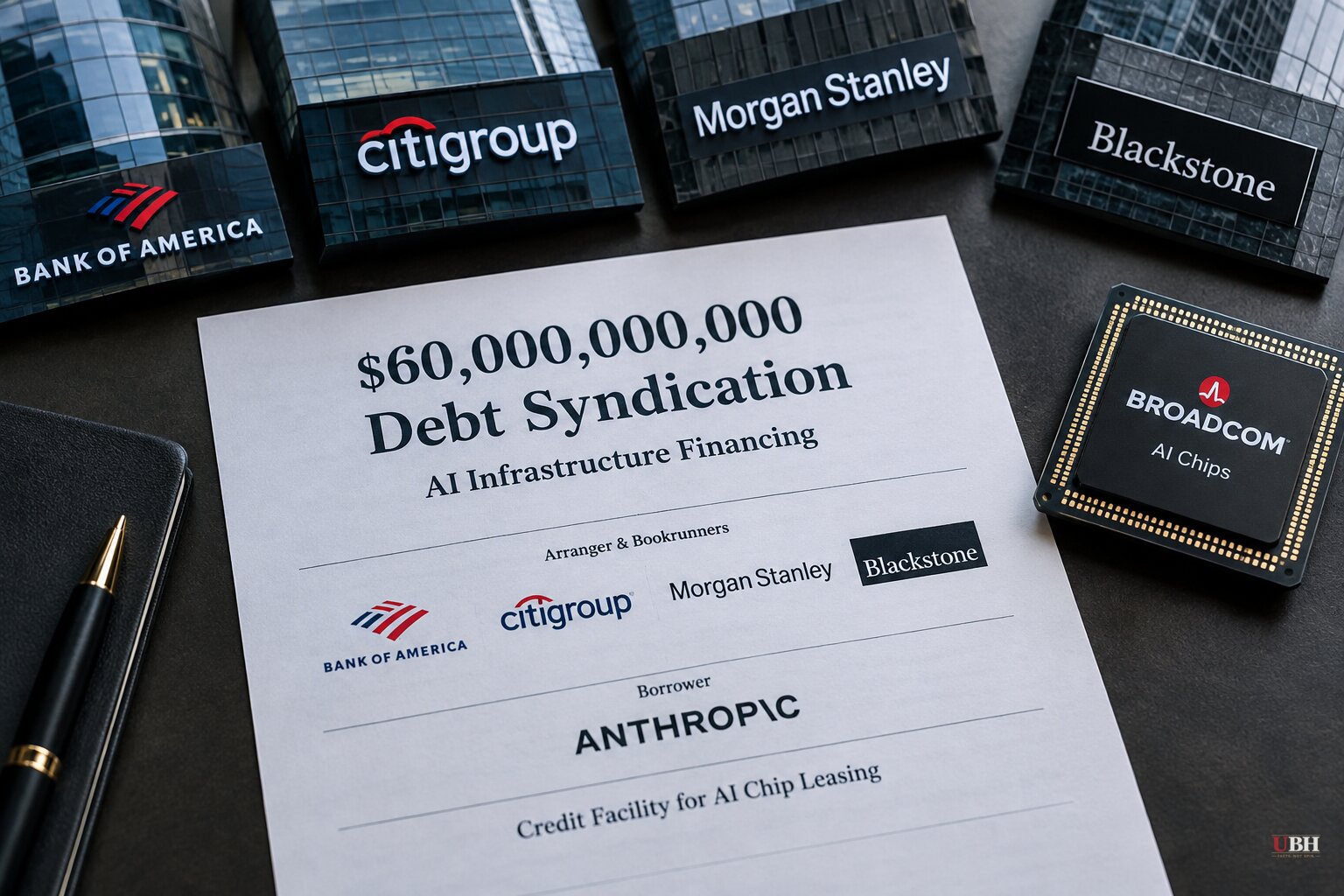
Since Anthropic's IPO prospectus became public around October 1, 2026, Wall Street has been quietly assembling the largest chip-financing deal ever attempted. Bank of America, Citigroup and Morgan Stanley started sending syndication letters to other banks this week for a $60 billion debt package built to fund AI chips Anthropic will lease, not own.
The deal has two layers. The top is a $42 billion Class A senior-secured tranche backed by Broadcom's A-minus credit rating, which means Broadcom is providing what's called residual value support, effectively backstopping the chip collateral if things go sideways. Below that sits an $18 billion Class B junior tranche led by Blackstone, which is committing roughly $9 billion of its own money and plans to syndicate the rest to outside investors.
Neither Broadcom nor Anthropic has commented publicly, and the package has not been formally announced, according to American Bazaar Online. The numbers have leaked out through multiple banking sources cited by Bloomberg and relayed by outlets including the Financial Times.
How the money actually moves
This isn't Anthropic writing a check for silicon. Investors fund the chip purchases through a special-purpose vehicle that owns the hardware, then leases it back to Anthropic. The chips in question are Google-designed tensor processing units, built with Broadcom's custom networking and chip-design work, according to reporting relayed through KuCoin and Traders Union.
Lease payments start once the chips are delivered in 2027. Anthropic's IPO filing separately disclosed that Broadcom may lend Anthropic up to $42 billion, with instruments potentially convertible into Anthropic equity, as part of a five-year, $125.2 billion commitment for TPU computing capacity.
This builds on a $35 billion financing tranche that already closed in June 2026 under a Broadcom-Apollo-Blackstone partnership known as AI XPV, which is targeting more than 20 gigawatts of compute capacity by 2028. Broadcom, for its part, is forecasting $115 billion in AI semiconductor revenue for fiscal 2027 and $230 billion for fiscal 2028.
The concentrated bet
Robert Leitao, managing partner at Rothschild & Co., said: "It feels that there's quite a concentrated bet right now on two companies being able to generate enough revenues to support all the financing that's happened."
Anthropic was valued at $65 billion after its May 2026 funding round. It has now committed to $125.2 billion in lease payments over five years. That's a gap investors reading the IPO prospectus will have to square before they buy in.
Critics of this financing structure argue it looks like circular vendor financing, where a chipmaker (Broadcom) lends money to its own customer (Anthropic) to buy its own chips, then books the lease payments as revenue. If Anthropic's actual AI business doesn't generate enough cash to cover those leases, the "demand" this deal signals to markets could be an accounting loop rather than organic growth. This mirrors the pattern critics pointed to during the dot-com era's vendor-financed telecom buildout.
The counter argument rests on Broadcom's own forecasts, which show real, growing semiconductor revenue tied to multiple customers, not just Anthropic, and the fact that Broadcom is also backstopping the senior tranche with its own balance sheet. Whether that backstop is enough if AI chip demand cools remains an open question.
Who eats the loss if this goes bad
AI chips depreciate fast. Each new generation makes the last one less valuable, raising real questions about how well the leased hardware holds its value over a multi-year lease term. Junior tranche holders, including Blackstone, would absorb any shortfall first, since their $18 billion slice carries no Broadcom guarantee.
Blackstone is playing both sides here, as a lender on the junior tranche and as an investor elsewhere in Anthropic's broader financing stack, a dual role flagged by reporting that Moneycontrol carried from Bloomberg. That overlap doesn't prove a conflict, but it's the kind of concentration regulators and credit-rating agencies will be watching closely.
Broader syndication of the $18 billion junior tranche to outside investors is expected to wait until after Anthropic's IPO closes, according to Traders Union and KuCoin, specifically so lenders can see Anthropic's actual financials before pricing the risk. That IPO timeline, and whether Anthropic's revenue can plausibly cover $125.2 billion in chip rent, is the number every bond buyer in this syndicate is now underwriting against.
Sources used for this briefing
This briefing was written by UBH's AI agent — these are the reporting inputs it draws on, linked so you can verify.


