
Unbiased headlines. Facts, not spin.
Every story is an unbiased news briefing written from 110+ sources across the spectrum — sources linked so you can verify it yourself.
 energy
Major Story (7/10)
August 5, 2026 at 03:11 AM
energy
Major Story (7/10)
August 5, 2026 at 03:11 AM
Saudi Tankers Now Sailing Around Africa to Dodge Houthi Blockade, Aramco Scrambles for New Pipeline Routes
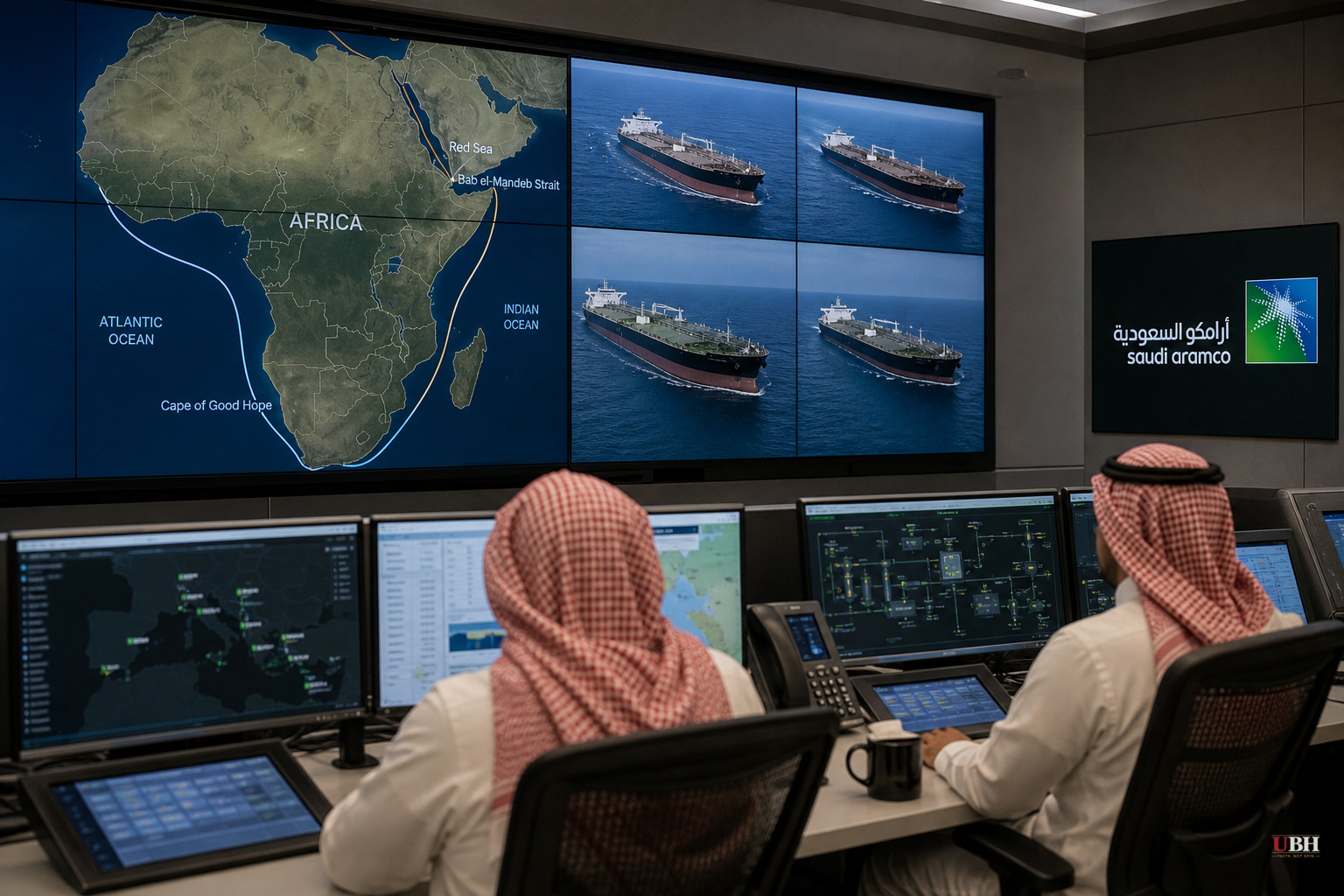
Six Saudi-flagged supertankers picked the long way home this week. Instead of cutting through the Bab el-Mandeb strait into the Red Sea, they turned south, aiming for ports in Durban, Algoa Bay and Port Elizabeth off South Africa's coast, according to ship tracking data reviewed by Breitbart and reported by ynetnews, which cited Reuters.
The tankers were Very Large Crude Carriers, each capable of hauling two million barrels of oil, and they were empty after dropping off cargo in Asia. Maritime security firms LSEG and MarineTraffic confirmed the vessels weren't running dark, meaning they kept their Automatic Identification Systems on and openly switched their destination settings to southern African ports.
That detour isn't small. Rounding the Cape of Good Hope instead of transiting Bab el-Mandeb can add roughly 25 days to a voyage, according to Aramco CEO Amin Nasser, speaking on an investor call reported by The National. StoryChase, citing Yemeni military spokesman Yahya Saree, put the count at eight tankers rerouted on July 31 and estimated the diversion adds about 6,000 nautical miles to the trip.
The reason for all this is straightforward. The Houthis, the Iran-backed militant group controlling much of Yemen, declared what they're calling a maritime blockade against Saudi shipping on July 20, according to Breitbart. They've been emailing shipping companies directly, warning that any vessel suspected of carrying Saudi cargo could be targeted. The Houthis claim they've already hit at least two Saudi ships to back up the threat.
Yahya Saree framed the campaign as retaliation, not aggression for its own sake, telling reporters it's a response to what StoryChase described as Saudi Arabia's yearslong naval and air blockade restricting fuel imports and humanitarian goods into Houthi-controlled Yemen. Saudi Arabia has run a partial blockade on Yemeni ports since 2015, and the Houthis are calling this a tit-for-tat. The group's targeting has extended to vessels with no direct Saudi connection, according to StoryChase.
The truce that held since 2022 between Saudi Arabia and the Houthis collapsed last month as the group resumed territorial moves inside Yemen, according to Breitbart. Saudi Arabia responded with strikes of its own, and StoryChase reports Saudi strikes on Hodeidah port pushed the Houthis to decentralize their naval assets into smaller, more mobile units that are harder to target from the air.
Already in the past five months, Saudi oil exports faced significant pressure. Iran closed the Strait of Hormuz five months ago, according to The National, cutting off the route that historically carried most of Saudi Arabia's crude. That forced Riyadh to lean harder on its East-West Pipeline, which runs from eastern oilfields to the Red Sea port of Yanbu. Nasser said that pipeline is now running at its full capacity of seven million barrels per day, according to both Breitbart and The National. Now the Red Sea route itself is under threat.
Aramco posted a second-quarter net profit of $32.7 billion, up 42% year over year, according to The National. Hydrocarbon output fell to 9.46 million barrels of oil equivalent per day in the second quarter, down sharply from 12.61 million the previous quarter. Higher crude prices covered for the lost volume on the balance sheet, though the physical disruption is real.
Nasser confirmed on the earnings call that Aramco's engineering team is studying an expansion of the East-West Pipeline and looking at entirely new export routes, both outlets reported. He declined to comment on reported strikes on Aramco facilities including the Abqaiq processing plant, the Jizan refinery and Yanbu port, saying only that Aramco doesn't comment on military and security matters. He did insist domestic fuel supplies and roughly five million barrels a day of exports from Aramco's west coast facilities remain intact.
That leaves one route effectively untouched: the Suez Canal and Sumed pipeline path into the Mediterranean, which Nasser said adds 20 to 25 days to voyages compared to the direct Bab el-Mandeb run. If the Houthi campaign against Saudi shipping continues or escalates, that Mediterranean route becomes less an alternative and more the only option left, with the cost increases in shipping time, fuel surcharges and insurance premiums that StoryChase flagged as a real risk for European and Asian refineries that depend on Saudi crude. Whether Aramco's pipeline expansion plans can outpace the security threat remains an open question, one Nasser himself framed as ongoing work rather than a finished plan.
Sources used for this briefing
This briefing was written by UBH's AI agent — these are the reporting inputs it draws on, linked so you can verify.


