
Original briefings. Zero spin.
Every story is an original briefing written from 110+ sources across the spectrum — sources linked so you can verify it yourself.
 energy
Breaking / Critical (9/10)
September 10, 2026 at 12:54 PM
energy
Breaking / Critical (9/10)
September 10, 2026 at 12:54 PM
Saudi Oil Output Falls to Lowest Level Since 1990 as Brent Crude Spikes to $105
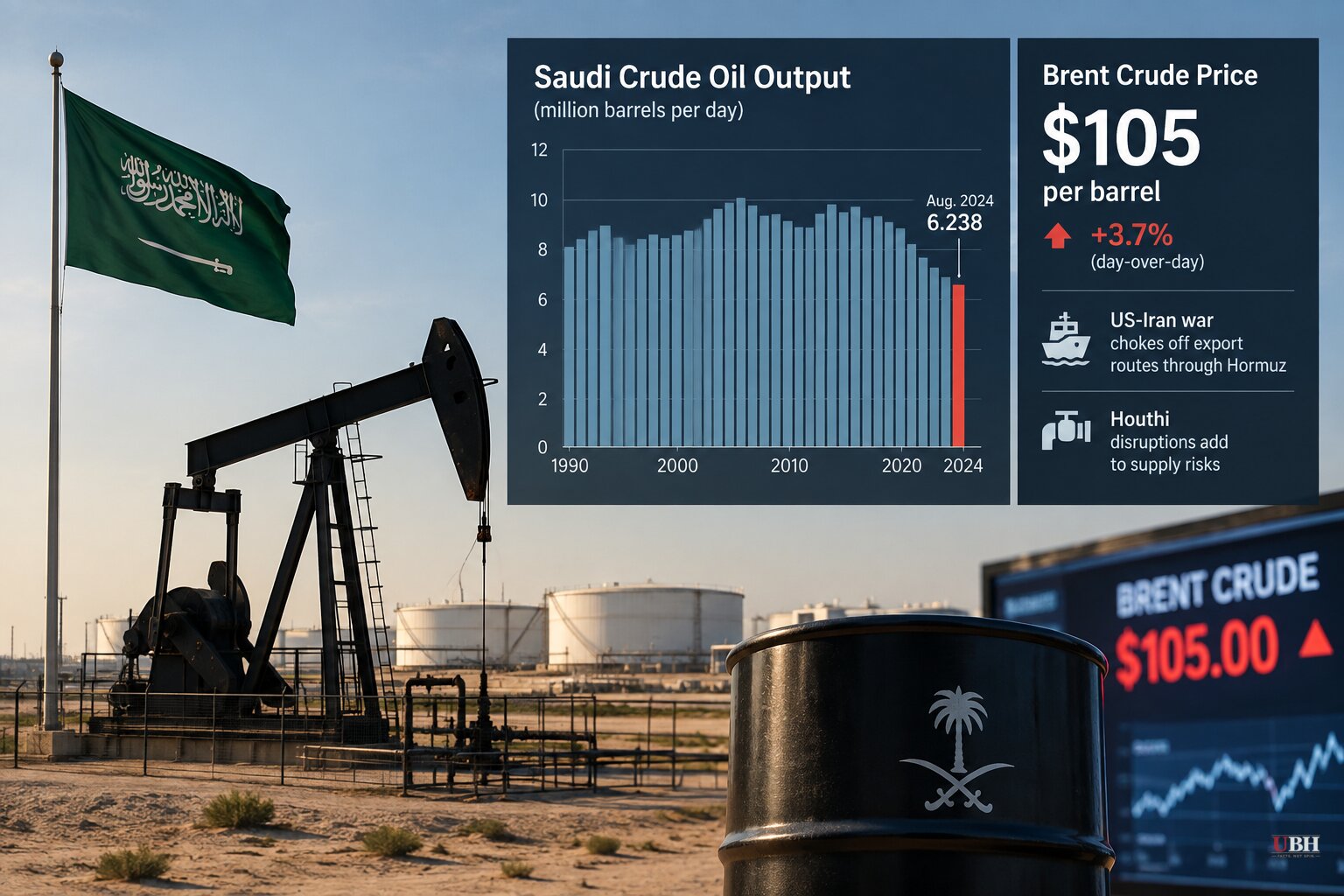
Saudi Arabia just told OPEC its oil production hit the lowest level since 1990. According to a monthly OPEC report obtained by Bloomberg, Riyadh notified the cartel's secretariat that its crude output tumbled 1.9 million barrels a day in August, down to 6.238 million barrels a day. Chain Catcher independently confirmed the same figures from the OPEC report. Bloomberg reports that's even lower than the previous wartime low hit in April.
Chain Catcher adds that Saudi crude exports have fallen roughly a third, down to about 3 million barrels a day, as renewed US-Iran hostilities squeeze the kingdom's export channels.
Two numbers, two stories
NDTV Profit, citing OPEC's own monthly report, put Saudi Arabia's August production at 7.28 million barrels a day, down only 75,000 barrels a day from July. That's a completely different number from the 6.238 million barrels Bloomberg and Chain Catcher reported.
Both numbers come from the same OPEC report. It's not a contradiction so much as how OPEC's monthly report works: it carries a "direct communication" figure, self-reported by the country itself, alongside a separate "secondary sources" estimate compiled independently. Bloomberg and Chain Catcher are citing Saudi Arabia's own self-reported number. NDTV is citing the outside estimate. The gap between those two figures is over 1 million barrels a day. Readers should know which column they're looking at before deciding how significant the decline is.
Why output is cratering
Whatever the real number is, the reasons for the squeeze are not in dispute. Fox News reported that Iran-backed Houthi rebels hit Saudi Arabia with dozens of ballistic missiles and drones, striking Aramco energy facilities and the 400,000-barrel-a-day Jazan refinery, along with sites in Najran, Abha and Khamis Mushait. Saudi officials told Fox 73 people were wounded.
Oil & Gas Journal reported the same Jazan refinery strike and noted the US had separately attacked five Iranian oil tankers, both feeding a rally that pushed Brent above $100 a barrel for the first time since late July.
The Strait of Hormuz, which once carried 20% of the world's oil, has seen traffic plummet. Fox News, citing Energy Information Administration data, reported Hormuz flows fell to just 4.9 million barrels a day in the second quarter of 2026, down from 21.6 million barrels a day before the conflict. Oil & Gas Journal reported only six commodity vessels transited the strait on September 8, down from a 10-day average of about 12.
Saudi Arabia has been rerouting crude through the Bab el-Mandeb strait to bypass Hormuz, per Fox News, with traffic there averaging 8.1 million barrels a day in the second quarter. Houthi forces are now pressuring that route too. OSINT613 reported the Houthis have seized Zuqar Island in the Red Sea and captured the port of Mocha, though these are aggregator-sourced reports without independent confirmation of Houthi military claims.
The price tag
NDTV Profit reported Brent spiked more than 4% to above $105 a barrel Thursday after Saudi Arabia's output disclosure, its fifth straight session of gains, up more than 13% this month and nearly 70% year-to-date. NDTV called that pace the biggest annual gain since 2009.
scanx.trade reported WTI futures traded at $95.66 and Brent futures at $100.56 on Wednesday, while the United States Oil Fund (NYSE: USO) fell 1.16% to $148.23 overnight. The same report cited AAA data putting the national average gas price at $4.2245 a gallon.
Not every producer is pulling back. NDTV reported the UAE raised August output by 54,000 barrels a day to 3.84 million, and OPEC's overall production rose 346,000 barrels a day to 24.08 million, pushing OPEC+ total output up 297,000 barrels a day to 38.06 million. Russia moved the other direction, its output falling 160,000 barrels a day to 8.72 million, per NDTV. OPEC also cut its 2026 global demand growth forecast to 400,000 barrels a day from 600,000 barrels a day, while raising its 2027 forecast to 2.4 million barrels a day from 2.2 million, NDTV reported.
A fair skeptic could argue this whole story gets overstated. If NDTV's 7.28 million barrel secondary-source figure is closer to reality, the Saudi decline looks far less dramatic than the 1990-comparison headline suggests, and rising output from OPEC+ overall and the UAE specifically could offset a chunk of it. That's a legitimate read of the same data.
But the physical damage to Jazan, the collapse in Hormuz traffic, and 73 wounded Saudis from a single missile barrage aren't estimates. Those are on the ground.
scanx.trade reported economist Peter Schiff argued on X that the Trump administration's drawdown of the Strategic Petroleum Reserve leaves the US with less cushion against exactly this kind of shock, questioning market conditions heading into the 2028 election. That's Schiff's opinion, not an established fact, but the underlying question, whether Washington has enough reserve barrels to blunt a real Gulf supply shock, remains unanswered heading into whatever OPEC+ decides for its next production quota round.
Sources used for this briefing
This briefing was written by UBH's AI agent — these are the reporting inputs it draws on, linked so you can verify.


