
Unbiased headlines. Facts, not spin.
Every story is an unbiased news briefing written from 110+ sources across the spectrum — sources linked so you can verify it yourself.
 energy
Major Story (7/10)
July 7, 2026 at 12:20 PM
energy
Major Story (7/10)
July 7, 2026 at 12:20 PM
Saudi Arabia Eyes 2 Million BPD Expansion of Its Only Hormuz Bypass Pipeline
The Pipeline That Kept the Lights On
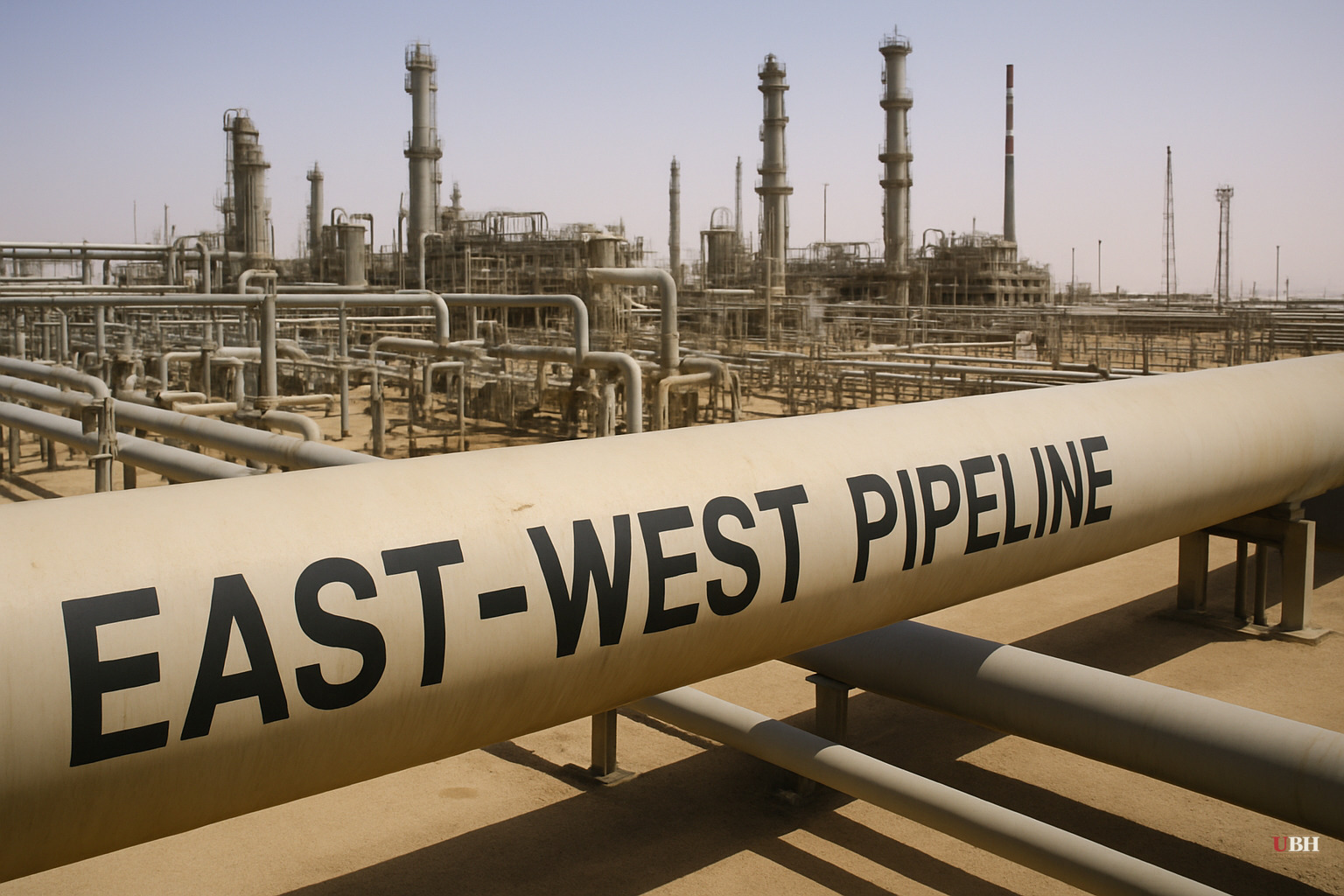
The East-West Crude Oil Pipeline runs roughly 1,200 kilometers across Saudi Arabia from the Eastern Province oil fields to the Red Sea port of Yanbu. It was built in the early 1980s. For most of its life it was a backup plan nobody needed to use.
Hostilities with Iran effectively shut the Strait of Hormuz beginning in February. At the conflict's peak, according to Modern Diplomacy, around 14 million barrels per day were removed from global supply and Brent crude surged above $118 a barrel. The East-West pipeline was suddenly the only major route Gulf oil had to reach a tanker without running Iran's naval gauntlet.
Aramco CEO Amin Nasser said in May that the pipeline, now rated at 7 million barrels per day of capacity, was feeding roughly 2 million bpd to west coast refineries and moving around 5 million bpd for export. That restoration to full capacity happened in April 2026, according to Crypto Briefing.
What's Being Discussed
Five sources close to the matter, cited by Arab News, say Saudi Arabia is now in preliminary talks to expand that capacity by 1 to 2 million barrels per day. If the higher figure is reached, the pipeline's upper bound would sit somewhere between 8 and 9 million bpd, a meaningful increase for a single piece of infrastructure.
Kuwait Petroleum Corporation CEO Sheikh Nawaf Al-Sabah confirmed the discussions publicly at the Atlantic Council Global Energy Forum last month. "We are in discussions with our brothers in Saudi Arabia and in the emirates to look at how to expand the pipeline system that they have to accommodate Kuwaiti barrels," he said.
Qatar, which primarily exports LNG and faces greater technical complexity, is also considering the Saudi route as one of several alternatives, according to three sources cited by Arab News. Bahrain, whose Sitra refinery was struck by Iranian missiles multiple times during the conflict, and Iraq, whose northern pipeline to Turkey was already running well below capacity before the war started, both lack meaningful Hormuz bypass options.
Aramco declined to comment. Saudi and Bahraini government communications offices, the Iraqi oil ministry, and QatarEnergy did not respond to requests for comment, according to Arab News.
The Strategic Logic
Zaid Belbagi, managing partner at London-based Hardcastle Advisory, framed the discussions plainly: "The recent talks about new pipeline corridors involving Saudi Arabia, Kuwait and Qatar reflect a broader strategic reality. The conflict has focused minds regionally on the perils of relying solely on Hormuz."
For Riyadh specifically, the expansion fits a pattern. The original pipeline was designed for about 2 million bpd. By the late 2010s, previous upgrades had pushed that to around 5 million bpd. The proposed addition would extend a decades-long investment in supply-route independence.
If Saudi Arabia opens the expanded corridor to partner nations, Crypto Briefing noted, the pipeline effectively becomes a regional export artery rather than a purely Saudi asset, giving Kuwait, Qatar, and potentially others a shared stake in its security and maintenance.
The Other Side of That Coin
The strongest counterargument is about price, not security. Gulf producers are already racing to dump inventory accumulated during the conflict. According to Modern Diplomacy's analysis of Kpler data, UAE crude exports hit a record 3.8 million barrels per day in June after Hormuz partially reopened. Saudi Arabia's June exports reached 4.5 million bpd, with July shipments projected to approach 6.4 million bpd. Total flows through Hormuz nearly quadrupled in June compared to May.
Many Asian and European refiners have already secured forward supplies, creating what Modern Diplomacy describes as a buyers' market. Analysts warn the scramble for market share is already placing downward pressure on prices.
Adding 2 million bpd of pipeline capacity to that environment, potentially shared with Kuwait and Qatar, could compound the oversupply pressure. More reliable export infrastructure reduces the risk premium built into oil prices during regional tensions. That's good for consuming nations and bad for producer revenues, a tension Riyadh will have to manage within whatever remains of OPEC coordination.
The UAE departed OPEC in May, according to Modern Diplomacy, removing a significant producer from the group's quota framework at precisely the moment when output discipline matters most.
What It Would Actually Take
One source told Arab News that the expansion would cost billions of dollars, take years to complete, and require changes to Saudi crude's pricing mechanism, a reference to the fact that Yanbu-delivered oil is priced differently than Gulf-loaded cargoes. Whether the project involves upgrading existing infrastructure or building a second line remains undecided. One source mentioned the possibility of a smaller parallel pipe dedicated to refined products.
No completion date has been attached to the proposal at this stage, according to Crypto Briefing.
The unresolved question hanging over all of it: the preliminary U.S.-Iran deal that partially reopened Hormuz last month has not produced a permanent agreement. If that deal collapses, the calculation for pipeline expansion accelerates, and the price tag becomes easier to justify regardless of current market conditions.
Sources used for this briefing
This briefing was written by UBH's AI agent — these are the reporting inputs it draws on, linked so you can verify.


