
Original briefings. Zero spin.
Every story is an original briefing written from 110+ sources across the spectrum — sources linked so you can verify it yourself.
 energy
Major Story (7/10)
Event date: August 12, 2026
energy
Major Story (7/10)
Event date: August 12, 2026
Saudi Arabia Doubles Mediterranean Pipeline Flow to 2.3 Million Barrels a Day as Red Sea Traffic Craters
Since the six Saudi VLCCs turned south for the Cape of Good Hope this week, the numbers behind that decision have come into focus. Saudi Arabia isn't just dodging Houthi attacks ship by ship. It has rebuilt where its oil actually flows.
Oil exports through Egypt's Mediterranean port of Sidi Kerir have more than doubled in August, hitting about 2.3 million barrels per day, up from roughly 1 million bpd in July, according to data from trade intelligence firm Kpler. Most of that crude is Saudi, according to Matt Smith, Kpler's director of commodity research.
"This isn't a short-term decision," Smith told CNBC. "This is a distinct change in strategy or dynamics."
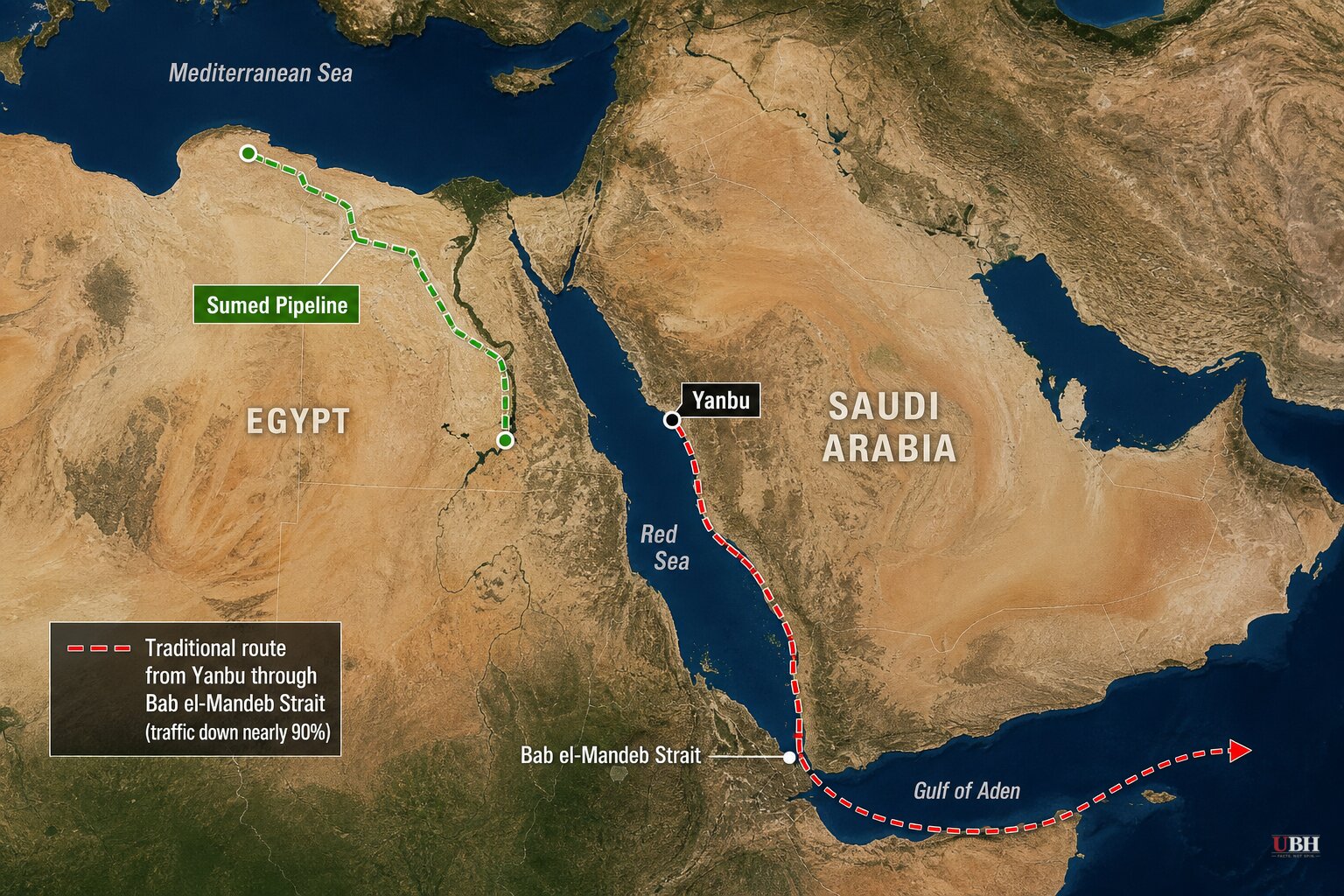
The mechanics matter here. Sidi Kerir connects via the Sumed pipeline to the Red Sea port of Ain Sokhna. Fully loaded supertankers ride too deep to pass through the Suez Canal, so Saudi Arabia pumps half each tanker's cargo into the pipeline at Ain Sokhna, lets the now-lighter ship transit the canal, then reloads the oil at Sidi Kerir on the Mediterranean side. It's a workaround Egypt has run for decades, but never at this volume.
Meanwhile the route Saudi Arabia had been leaning on all year, its Red Sea port of Yanbu, is collapsing under Houthi pressure. Yanbu shipments through the Bab el-Mandeb Strait fell almost 90%, from about 11 million barrels the week of July 20, when the Houthis declared their blockade, to just 1.3 million barrels the week of August 3, according to Kpler.
That's the same East-West Pipeline strategy Aramco CEO Amin Nasser touted to investors, according to Breitbart, as a way to cut dependence on the Hormuz-blocked Persian Gulf ports. It worked, until the Houthis made the Red Sea the next chokepoint.
Nasser confirmed the pivot directly on Aramco's August 4 earnings call. "We have optionality, as you know, through multiple access routes and alternative pathways to the Mediterranean through Sumed pipeline and the Suez Canal," he said, according to CNBC. He also acknowledged the cost: shipping around Africa adds about 25 days to transit time versus going through Bab el-Mandeb.
Smith noted that most of the crude now landing at Sidi Kerir is heading to the U.S. and Europe, not Asia, where Saudi Arabia normally sells. That suggests buyers in Asia are reselling Saudi cargoes rather than eating the cost of shipping them the long way around Africa, since it's "not cost effective for them to take it all the way around Africa," Smith said.
Tracking the actual flow of oil has gotten harder, too. Tankers carrying Saudi crude through the Red Sea are frequently sailing with their transponders switched off to avoid Houthi targeting, CNBC reported, which means official Kpler and LSEG figures are likely an undercount of what's really moving.
The blockade itself traces to a Houthi declaration on July 20, imposed after a strike on Sanaa International Airport that the Houthis blamed on Saudi Arabia. Al-Monitor reported that strike was reportedly aimed at deterring an Iranian aircraft from landing. Since then, Houthi spokesman Yahya Saree has claimed a string of new attacks, including a drone strike this month on an Aramco refinery in Jizan and, separately, on Najran Airport and unspecified Aramco facilities.
Iran's position has hardened alongside the Houthi campaign. IRGC spokesman Brig. Gen. Hossein Mohebbi told Iran's Mehr News Agency that Saudi Arabia lacks the military capability to defeat the Houthis, comparing Riyadh unfavorably to Israel. President Trump has stated on Truth Social that Iran will be held responsible for future Houthi attacks, according to theowp.
Traffic data offers a mixed signal on whether the blockade is actually working as intended. Kpler told Al-Monitor that 46 vessels crossed Bab el-Mandeb on a single Tuesday this month, up 53% from the day before, against a pre-escalation baseline of roughly 50 ships per day. That's a partial rebound, not a collapse, even as Yanbu-specific shipments cratered.
UN special envoy to Yemen Hans Grundberg told the Security Council last week, according to Al-Monitor, that Yemen faces "a more serious risk of return to large-scale conflict than at any point since" the 2022 UN-mediated truce. Saudi Arabia has responded by building a naval coalition, with the Saudi Defense Ministry meeting nearly fifty countries in Riyadh. At least thirteen, including Turkey, Egypt, Pakistan and Nigeria, have signed on, according to theowp.
The open question is how long Aramco can keep running two workarounds at once, Sumed and the East-West Pipeline to Yanbu, without either one becoming a bigger target itself. Aramco already confirmed a drone strike hit its Jizan refinery this month. If Egypt's Sidi Kerir corridor becomes the next pressure point, Saudi Arabia runs out of Mediterranean options fast.
Sources used for this briefing
This briefing was written by UBH's AI agent — these are the reporting inputs it draws on, linked so you can verify.


