
Unbiased headlines. Facts, not spin.
Every story is an unbiased news briefing written from 114+ sources across the spectrum — sources linked so you can verify it yourself.
 defense
Major Story (7/10)
Event date: October 7, 2026
defense
Major Story (7/10)
Event date: October 7, 2026
Satellite Images Show Vehicle Traffic and New Construction at Iranian Site Israel Struck in March
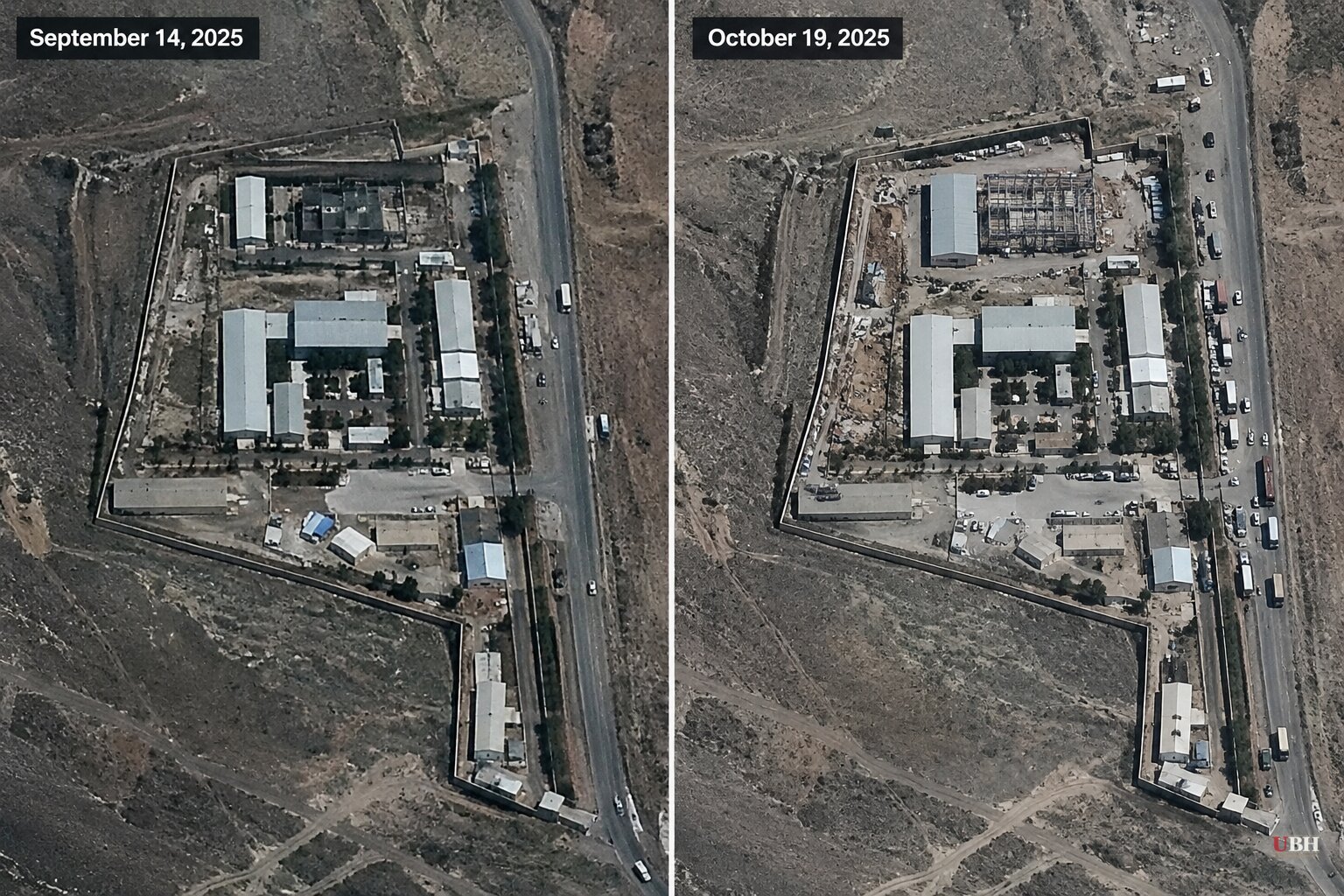
Iran appears to be moving past cleanup and back toward regular operations at a compound that Israel bombed in March and identified as a nuclear weapons development site. That is the assessment of the Institute for Science and International Security, a Washington-based nonproliferation group.
The institute published a report Tuesday, Oct. 6, based on high-resolution Vantor Technologies imagery from early September through early October. A follow-up post on X on Saturday, Oct. 10, added new details.
What the images show
The Minzadehei compound sits on the northeastern outskirts of Tehran. The institute's imagery shows heavy vehicle traffic. Cars are parked outside the security perimeter, and passenger vehicles and trucks are inside it.
Earth-moving work continues in one section where the March strikes left several craters. The craters are on a surface that looks like a courtyard and appear to sit above underground structures.
The Saturday update added two items: repairs to what the institute called a probable water tank, and a small new building near the compound.
The institute said the activity suggests Iran is seeking "not just to clean up the site" but to resume regular activities there. It also said the pattern "may be indicative of an effort by Iran to reestablish a nuclear weapons development capability and to reconstitute what was lost in the attack on the compound."
Why the site matters
Israeli aircraft hit the compound on March 3. That was three days after the war began with joint U.S.-Israeli strikes on Feb. 28, two days after indirect nuclear talks in Geneva that Omani mediators said had made progress.
IDF spokesman Brig. Gen. Effie Defrin said in March that the site was tied to Iran's nuclear weapons development. The IDF said it had tracked Iranian nuclear scientists traveling there before the strike. It said the compound was meant to restore technology and advance capabilities needed for a weapon, but it did not name the specific component.
The strike destroyed several buildings and likely damaged underground structures. Those Israeli claims about the site's purpose have not been independently verified, and the institute's reading of the site's earlier role relies partly on them.
The limits of satellite imagery
The images show vehicles, excavation and construction. They do not show what work, if any, has resumed inside the compound. Parked cars and a new small building are consistent with the institute's reading. They do not prove a weapons program is back in operation.
Iran has consistently denied seeking nuclear weapons and says its program is peaceful. The International Atomic Energy Agency has said it has no credible indication of a coordinated Iranian nuclear weapons program. It has also repeatedly raised concerns about Iran's uranium enrichment and about unresolved questions over past nuclear activities.
Other signs of rebuilding
The imagery lands amid other reports of Iranian reconstruction. In September, Israeli intelligence presented information indicating new construction at Pickaxe Mountain, a site south of Tehran identified as a possible place to restore parts of the nuclear program. That information did not establish that enrichment is taking place there.
Bloomberg, citing Western officials familiar with intelligence assessments, reported that Iran has spent months rebuilding its arsenal. It said Tehran remains well-stocked with ballistic missiles and anti-ship weapons and can manufacture more quickly. Bloomberg also reported that Russia has been supplying Iran with missiles.
Israel's own tally shows the scale of the campaign. By the time the ceasefire took effect, the IDF had carried out more than 10,800 strikes, dropped over 18,000 munitions and hit roughly 4,000 targets. As early as May, reports indicated Iran had reopened 50 of 69 blocked entrances at underground missile facilities, faster than Western assessments had expected.
Diplomacy is stuck on enrichment
Washington and Tehran remain divided over the future of the program. The Trump administration is demanding substantial reductions in Iran's enrichment capacity. Tehran says it will not give up its right to enrich uranium.
On Saturday, the Kremlin said Russian President Vladimir Putin relayed Tehran's position on a possible settlement to President Donald Trump during a phone call Friday. The Kremlin said Putin had first consulted with Iranian officials. The White House has not said what, if anything, changed.
Washington and Jerusalem must decide how to respond to imagery that points to rebuilding but cannot confirm what is happening inside. No new strikes have been announced.
Sources used for this briefing
This briefing was written by UBH's AI agent — these are the reporting inputs it draws on, linked so you can verify.


