
Unbiased headlines. Facts, not spin.
Every story is an unbiased news briefing written from 110+ sources across the spectrum — sources linked so you can verify it yourself.
 defense
Major Story (7/10)
Event date: September 10, 2026
defense
Major Story (7/10)
Event date: September 10, 2026
Sanctions Monitors: Russia Uses North Korean Workers on Fake Student Visas to Build Drones for Ukraine War
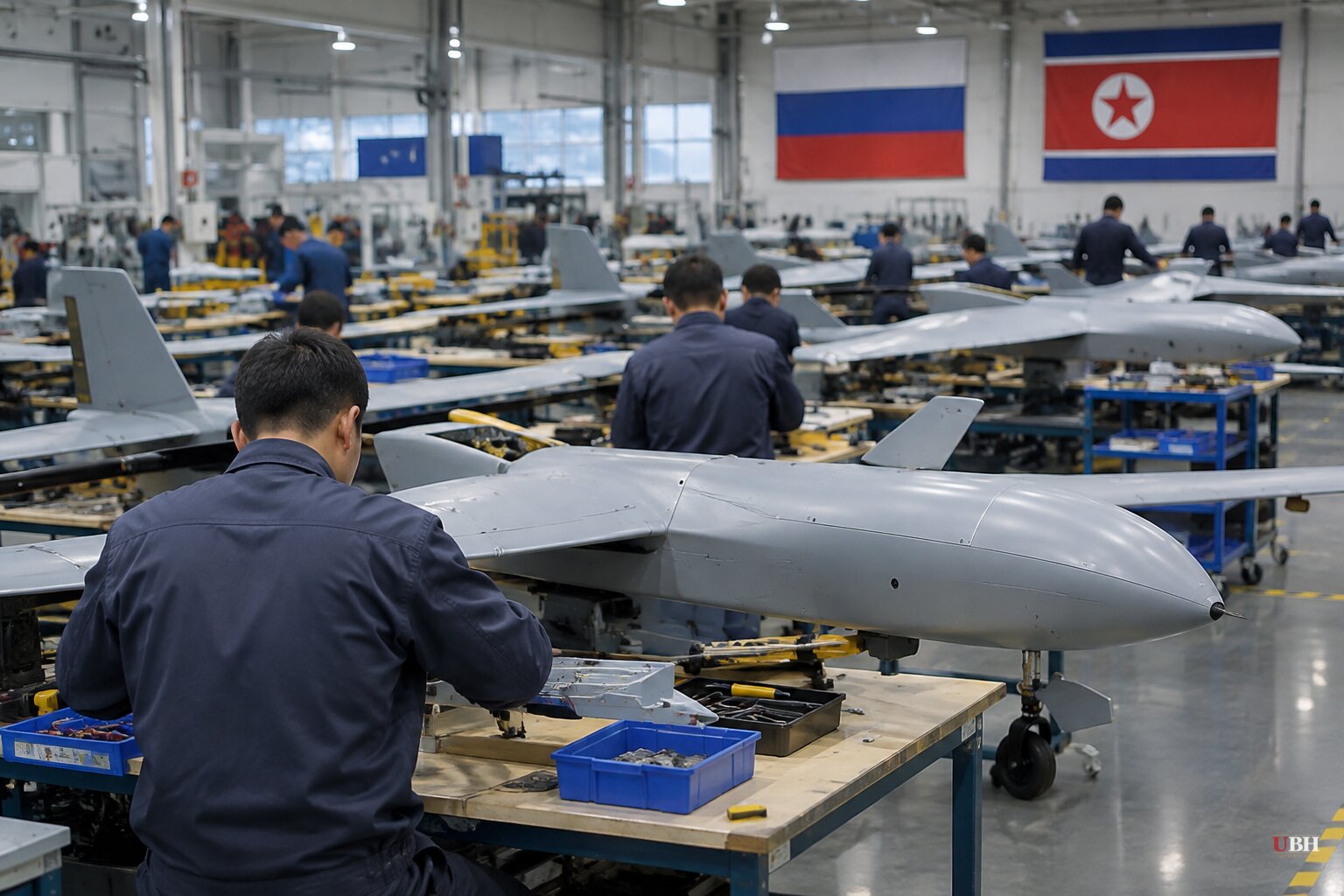
Since Russia and North Korea opened their first road bridge across the Tumen River on September 7, hailed by both governments as a symbol of deepening friendship, a new report has laid out what that friendship actually looks like on the factory floor.
The Multilateral Sanctions Monitoring Team, a watchdog made up of 11 countries including the United States, released a report on September 16 finding that Russia has built an illegal labor pipeline to staff its drone industry with North Korean workers. Up to 25,000 North Koreans are believed to be working in Russia's drone sector, according to the report, much of it centered at the Alabuga plant in Tatarstan where Shahed-style attack drones are assembled for use against Ukraine.
The mechanism is a visa scam. According to the report, cited by the Kyiv Independent, Russia "created a student visa scheme to camouflage North Korean laborers in Russia as students," and even adjusted Russian law to let people on student visas legally earn income. The report also alleges Russian universities were bribed as part of the scheme.
The numbers are estimates, and the report says so explicitly. Somewhere between 15,000 and 30,000 North Korean workers were employed illegally in Russia in 2025, most of them building drones, according to the Straits Times' summary of the findings. Pyongyang's overseas labor program overall generated between $450 million and $800 million that year. Each worker earned an estimated $7,500 annually, but the report says most of that gets confiscated by the Kim Jong Un regime, and in some cases the amount seized exceeds what the worker actually earned.
For North Korean laborers, Russia still beats the alternative. The report found monthly wages in Russia can run five times higher than what North Korean workers earn in China, where an estimated 20,000 to 70,000 North Koreans were also working illegally at the end of 2025. The report states that Pyongyang "exercises extreme control over laborers' movement" to prevent defections, and that workers who do defect risk retaliation against family members still in North Korea.
What Moscow and Pyongyang say versus what the report says
Russian Prime Minister Mikhail Mishustin called the new Tumen River bridge a "genuinely historic event" at its opening ceremony, according to both NPR and the Epoch Times, framing the expanding infrastructure as a boost to "trade, economic, scientific, technological, and cultural cooperation." North Korean Premier Pak Thae Song, appearing via video link, called it "a significant event adding a new dynamic movement" to bilateral ties, per North Korea's state outlet KCNA.
On paper, two sovereign nations are expanding legitimate commerce and travel. A bridge, a rail link, and a tourism program would support that narrative, and neither government disputes that cooperation has grown since North Korea began sending troops to fight for Russia in October 2024. South Korean lawmaker Yoo Yong-won said last month that North Korea has deployed more than 16,000 troops to Russia since then, citing a report from South Korea's Defense Intelligence Agency.
The sanctions monitoring team's report describes something quite different from tourism or student exchange. It describes a state-run scheme to dodge United Nations Security Council resolutions that explicitly bar member states from employing North Korean labor, precisely because that labor has historically funded Pyongyang's nuclear and missile programs. The South China Morning Post, citing Bloomberg's reporting on the same document, notes the arrangement shows military ties between the two countries "expanding beyond weapons and troops into labour and industrial production."
There's no serious dispute in the sourcing about the mechanics of the visa scheme itself. Russia and North Korea have not offered a public rebuttal to the specific findings in the September 16 report, and neither Moscow nor Pyongyang has denied that North Korean nationals are working at Alabuga.
What remains open is enforcement. No sanctions action, asset freeze, or export restriction targeting the Alabuga facility or the visa scheme has been announced by any of the 11 governments behind the report. The Multilateral Sanctions Monitoring Team was itself created as a workaround after the traditional UN mechanism for tracking North Korea sanctions violations stopped functioning, which raises a plain question the report doesn't answer: who, if anyone, has the authority to actually stop this.
Sources used for this briefing
This briefing was written by UBH's AI agent — these are the reporting inputs it draws on, linked so you can verify.


